Lesson 09 — My Goal and Its First Step
Learners set a simple, reachable personal goal of their own choosing and name its first, small step. Using a staircase image, they see that a tall goal is reached one step at a time, and they practice the feedback loop of making a first step small and doable — the seed of the planning skills later grades grow.
Objectives
Objectives
- D01.S3.03.01 Set a simple personal goal and name the first step toward it.
Essential question
What is my goal, and what is its first step?
Key vocabulary
Materials
Standard materials
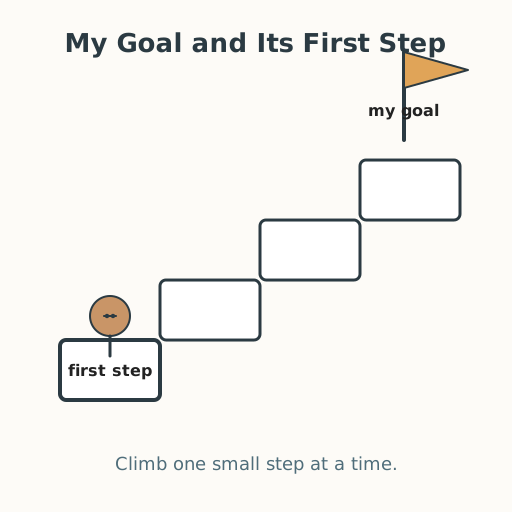
- Goal staircase chart · 1 A staircase with a flag at the top (the goal) and the bottom step highlighted (the first step)
- My goal card · 1 per learner A card with two lines — "My goal:" and "My first step:" — to draw or write
- Crayons and pencils · per learner
Low-tech / no-cost
- Voice and body Say your goal and act out the first step; no card needed
- Steps drawn on the ground Stand at the bottom step (the first step) and point up at the goal
Enriched / lab & device
- A goal-tracking chart · 1 per learner A reusable chart to mark off practice toward the goal over the following weeks
- A 'first step' check-in partner · 1 per pair Learners pair up to try their first step and report back next lesson
Works in different contexts
- large-group Model one shared goal and first step on the board, then learners write their own and share in small groups
- multi-age Older learners help a younger learner check that their first step is small and doable
- self-directed A learner writes a goal and first step alone and checks it with the "small and doable" test
- level-grouped Learners ready to extend write a second step after the first and a way to know they reached the goal
- outdoor-only Find a real climb or a set of steps and stand at the bottom to say the first step, looking up at the goal
Lesson 9 — My Goal and Its First Step
Summary
Learners set a simple, reachable personal goal of their own choosing and name its first, small step. Using a staircase image, they see that a tall goal is reached one step at a time. They practice the feedback loop of making a first step small and doable — the seed of the planning skills later grades grow.
Objectives
- Set a simple personal goal and name the first step toward it. (D01.S3.03.01)
Connection
Think of something you want to learn or do that you cannot do yet — tie a knot, read a whole chapter, swim across the pool, be kind to a new classmate, learn a song. That is a goal. A goal is not reached all at once; it is climbed like a staircase, one step at a time. The first step is the smallest thing you can do today. A fisher learns to mend nets one knot at a time; a runner trains one lap at a time. Everyone, everywhere, reaches goals the same way: first step first.
Materials
- Goal staircase chart
- My goal card
- Crayons and pencils
Preparation
- Print or draw the goal staircase chart.
- Copy a “my goal” card for each learner.
- Arrange space for sharing and the “small and doable” check.
Facilitator note
This lesson is written to the learner (“you”). The goal must be the learner’s own, not assigned, and there is no ranking of goals — a goal to be kinder is as real as a goal to read faster. The one skill to coach is the first step: it should be small and doable today or tomorrow (“I will ask for one knot lesson” not “I will learn every knot”). Model your own goal and first step first (worked example), then let learners write theirs, then use a quick peer/self check to make the first step smaller if needed. Keep it light — this is the beginning of agency, not a contract.
Procedure
- Gather (5 min). You have read your feelings and told your story. Now you look ahead: what do you want to reach, and how do you begin?
- Meet the staircase (10 min). Look at the chart. At the top is a flag — my goal. At the bottom is one highlighted step — the first step. You do not jump to the top; you climb one step at a time. A goal is something you want to do that you cannot do yet; the first step is the smallest thing you can do today.
- Hear a worked example (10 min). “My goal is to read a whole chapter book. My first step is to read three pages tonight.” Is that first step small and doable? Yes — three pages, tonight. Now test your own: if a first step feels too big, make it smaller until you can say “I could do that today.”
- Set your goal (10 min). On your card, draw or write your goal and your first step. Choose something you really want, not something others want for you. Then check it with a partner: is the first step small and doable? Help each other make it smaller if needed.
- Close (5 min). You are the author of your own next step. Hold your card, say your goal and first step, and know: you can begin today.
Differentiation
- Support: Offer goal idea cards (a game skill, a kindness, a school skill, a household help) and scribe the learner’s goal and step.
- Extension: Add a second step after the first, and one way you will know when you have reached your goal.
Assessment
- Formative (observation): Can the learner state a personal goal and a first step that is small and doable?
- Self-check: The learner uses the “small and doable” test on their own first step.
- Artifact (portfolio): The “my goal” card.
Home connection
Share your goal and first step with someone at home, and try the first step today.
Resources
- CASEL SEL Framework (self-management competency): https://casel.org/fundamentals-of-sel/