Lesson 10 — Strong Feelings in a Group
The capstone lesson. Learners put the whole unit together into one practical skill: noticing a strong feeling in a group and using a quiet signal — a calm breath, asking for a turn, or stepping to a calm spot — to manage it without disrupting others. They revisit the unit's feeling vocabulary and their goal-setting to choose the tool that fits them.
Objectives
Objectives
- D01.S3.03.02 Use a strategy to manage a strong feeling in a group setting without disrupting others.
- D01.S1.03.01 Describe how a feeling can change over time and name when they feel more than one feeling at once.
Essential question
How do I manage a strong feeling in a group without disrupting others?
Key vocabulary
Materials
Standard materials
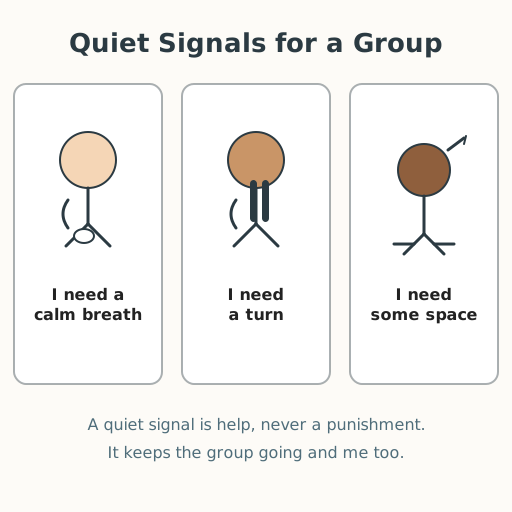
- Quiet signals poster · 1 Three quiet signals — hand on heart (I need a calm breath), two fingers up (I need a turn), step to the side (I need space)
- Group scenario cards · 1 set Moments when a strong feeling rises in a group (a game, a turn circle, a shared task, a hard wait)
- A 'my signal' card · 1 per learner A card for the learner to draw or write the signal they will use
Low-tech / no-cost
- Voice and body Practice the signals with your body; no poster or cards needed
- A hand signal agreed in the sand or on the ground Draw or mime the three signals where everyone can see them
Enriched / lab & device
- A laminated quiet-signals card for each desk or bag · 1 per learner A small reminder card to carry all day
- A short role-play recorded on a tablet · 1 per group Learners act out a group moment with a quiet signal and watch it back
Works in different contexts
- large-group Practice the three signals as a whole group first, then small groups role-play a scenario using one
- multi-age Older learners model a quiet signal while younger learners copy it, then they role-play together
- self-directed A learner reads the signals, chooses one, and practices it in a real group moment (or a mirror) later
- level-grouped Learners ready to extend explain *why* a signal helps both them and the group, thinking of the group's needs too
- outdoor-only Practice the signals in an open circle outdoors, stepping to a real calm spot for "I need space"
Lesson 10 — Strong Feelings in a Group
Summary
The capstone lesson. Learners put the whole unit together into one practical skill: noticing a strong feeling rising in a group and using a quiet signal — a calm breath, asking for a turn, or stepping to a calm spot — to manage it without disrupting others. They revisit the unit’s feeling vocabulary (mixed and changing feelings) and their goal-setting to choose the tool that fits them.
Objectives
- Use a strategy to manage a strong feeling in a group setting without disrupting others. (D01.S3.03.02)
- Describe how a feeling can change over time and name when they feel more than one feeling at once. (D01.S1.03.01)
Connection
A strong feeling can rise in the middle of a group — a game is lost, a turn is skipped, a shared task gets hard, a long wait gets long. The feeling is real and allowed. The question is what you do with it while the group is still going. You can notice the feeling and use a quiet signal to get what you need — a calm breath, a turn, a little space — so the group keeps working and you keep being okay. Managing a feeling in a group is a kindness to yourself and to everyone else in the circle.
Materials
- Quiet signals poster
- Group scenario cards
- A “my signal” card
Preparation
- Print or draw the quiet signals poster.
- Prepare group scenario cards.
- Arrange an open circle for role-play.
Facilitator note
This lesson is written to the learner (“you”). The capstone is a skill, not a test, and never a punishment. Frame the quiet signals as help, exactly like the Grade 2 calm tools: a learner uses them to care for themselves and the group — not because they are “in trouble.” Model each signal with your own body, then guide role-play, then let learners choose their own. Some learners will need a movement option (stepping to the side) rather than a stillness one (a calm breath) — both are equally good. A learner with motor differences may signal any way that works — a nod, a point, a glance, holding up a printed signal card, or a partner voicing the need for them; any safe signal counts as the skill. Never shame a learner whose first instinct is to burst out; the win is that they notice and try a tool, not that they are silent. A learner may choose any safe signal; there is no single “right” one.
Procedure
- Gather (5 min). This is your last lesson in “Mixed Feelings, My Story & My Goals.” Look back: you learned that feelings change and mix, that the same moment can feel different to different people, that your life is a story with people, places, and groups, and that you can set a goal and take a first step. Today you put it to work in a group.
- Meet the quiet signals (10 min). Look at the poster. Hand on heart = I need a calm breath. Two fingers up = I need a turn. Step to the side = I need some space. A signal is a quiet way to say what you need without stopping the whole group. It is help, never a punishment.
- Practice together (15 min). Hear a scenario: “Your team is one point behind and the ball goes out. Your chest is hot.” Choose a signal and use it: hand on heart, one slow breath, then two fingers up — “I need a turn.” Try it with two more scenarios (a skipped turn, a long wait, a task that keeps failing).
- Role-play your own (10 min). With a partner or small group, act out a real group moment where a strong feeling rises. Use your chosen signal quietly, and let the group keep going. Then switch roles.
- Close (5 min). You are a person who can feel big things, name them, and choose what to do — in a group and on your own. That is your strength, and you are still growing it, and that is exactly right. Choose your signal, and carry it with you.
Differentiation
- Support: Practice one signal only (hand on heart) until it is solid, then add another; provide the feeling word as a choice (“is it mad or frustrated?”).
- Extension: For each signal, name how it helps the group too, not just you.
Assessment
- Formative (observation): Can the learner use a quiet signal to manage a strong feeling in a group role-play without disrupting the group?
- Performance: The learner demonstrates a chosen signal in a role-play.
- Artifact (portfolio): The “my signal” card, added to the unit portfolio alongside the feeling story, story map, and goal card.
Home connection
Teach your quiet signal to someone at home, and use it together the next time a group moment (a meal, a game, a long wait) feels big.
Resources
- CASEL SEL Framework (self-management and responsible decision-making): https://casel.org/fundamentals-of-sel/