Lesson 02 — Rounding & Comparing to 1,000
Learners place numbers on a number line to 1,000, round them to the nearest ten and hundred by seeing which is nearer, and compare numbers with greater-than, less-than, and equal-to. Rounding becomes a picture of "nearer to," not a rule to memorize.
Objectives
Objectives
- D05.S1.03.01 Use place value to 1,000 to read, write, round, and compare whole numbers.
Essential question
How do I round a number to the nearest ten or hundred, and how do I compare two numbers up to 1,000?
Key vocabulary
Materials
Standard materials
- A long number line to 1,000 · 1 Drawn on paper, chalked on the ground, or made of string with marks every ten and hundred
- Small objects or cards with numbers · per pair Numbers up to 1,000 to place on the line, compare, and round
- Paper or slate and a drawing tool · per learner To record rounded and compared numbers
Low-tech / no-cost
- A ground number line and stones Chalk or scratch a line to 1,000 in the dirt, mark tens and hundreds, and stand or drop a stone at each number
- Voice and body Learners stand on a number line and walk toward the nearer ten or hundred to "round" with their bodies
Enriched / lab & device
- A printed 0–1,000 number line and arrow cards · 1 set per pair A strip number line with clear hundred marks and cards with greater-than/less-than symbols
- A "climb the hill" rounding chart · 1 per learner A hill picture with the midpoint at the top to see whether a number rolls forward or back
Works in different contexts
- large-group Draw one big number line and round numbers as a whole group, with learners walking to the nearer ten or hundred
- self-directed A learner places numbers on a number line, rounds each to the nearest ten and hundred, and writes the comparison sentences
- outdoor-only Lay a long string or chalked line to 1,000 outdoors; learners stand at a number and step to the nearer ten or hundred
- multi-age Older learners explain the "halfway point" rule while younger learners walk the line and read rounded numbers aloud
- level-grouped Learners who round easily can round to the nearest hundred mentally and explain why; others place a number on the line and count the steps to each ten
Lesson 2 — Rounding & Comparing to 1,000
Summary
Learners place numbers on a number line to 1,000, round them to the nearest ten and nearest hundred by seeing which mark is nearer, and compare numbers with greater-than, less-than, and equal-to. Rounding becomes a picture of “which is nearer,” not a rule to memorize, and comparing becomes a matter of walking the line.
Objectives
- Use place value to 1,000 to read, write, round, and compare whole numbers. (D05.S1.03.01)
Connection
A cook buys about 250 grams of rice; a bus driver says “about 400 people” rode today; a gardener counts 347 seeds and says “about 350.” When an exact number is hard or not needed, people round to a friendly number that is close. And when two numbers sit side by side — 347 and 374 — putting them on a line tells you at once which is more. Rounding and comparing are how people talk about “about how many” and “which is more” in markets, kitchens, and journeys everywhere.
Materials
- A long number line to 1,000 (drawn, chalked, or string)
- Small objects or cards with numbers up to 1,000
- Paper or slate and a drawing tool
Preparation
- Draw (or lay out) a number line to 1,000 with every ten and hundred marked.
- Prepare number cards or objects to place on the line.
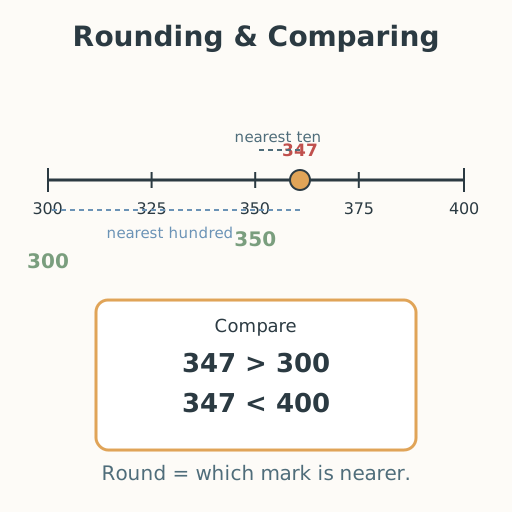
- Plan a quick example of “347 is nearer 350 than 340, so it rounds to 350.”
Facilitator note
This lesson is written to the learner (“you”). It builds on Grade 2’s comparing of two-digit numbers and adds rounding — the new skill is deciding which ten or hundred a number is nearer to. Teach with a worked example (philosophy §13): put 347 on the line, count the steps to 340 and to 350, and see that 350 is nearer; do the same for the nearest hundred. The picture is the point: rounding is “nearest mark,” not a memorized “five or more goes up.” Comparing uses the same line. A number being “more” is a fact about quantities, never a worth about a person; no one’s speed at rounding measures their smartness. The midpoint (five) rule is one convention used in many school systems; the underlying idea — nearer to this mark than that one — is universal. Count in the home language; number words differ and all are correct. For learners who are Deaf or hard of hearing, mark “nearer” with hand signs and arrows; for learners who are blind or low-vision, use a tactile string line with knots at tens and hundreds so the hands can feel which mark is closer. Learners with limited movement direct a partner to walk the line. Mastery arrives at its own pace for each child.
Procedure
- Gather — a big line (5 min). Look at our number line to 1,000. Where is 0? Where is 100? 500? 1,000? Touch each hundred as you say it.
- Worked example — round to the nearest ten (8 min). Put 347 on the line. Which is nearer, 340 or 350? Count the steps: from 340 it is 7 steps; from 350 it is 3 steps. 350 is nearer, so 347 rounds to 350. Say it together.
- Round to the nearest hundred (8 min). Now find the nearest hundred. Is 347 nearer 300 or 400? It is 47 past 300 and 53 before 400, so 347 rounds to 300. The two answers are both right — they just answer different questions (“which ten?” or “which hundred?”).
- Guided practice — round and compare (15 min). Choose numbers from the pile. Place each on the line, then round it to the nearest ten and nearest hundred. Take two numbers: which is greater? Which is less? Write your answers with the signs: 347 > 300, and 347 < 400. Read each sentence aloud.
- Check with a friend (8 min). Trade numbers with a friend and check each other’s rounding and comparing. Do you agree? If not, walk the line again together, kindly.
- Close (6 min). Remember: rounding means “which mark is nearer,” and comparing means “which number is more.” You can now say “about” and “more than” with real numbers.
Differentiation
- Support: Round only to the nearest ten today; add the nearest hundred another day. Use a line with every ten marked.
- Support (blind/low-vision): Use a string line with a knot at each ten and a bigger knot at each hundred; feel which knot is closer.
- Extension: Round to the nearest ten, then use that rounded number to estimate a sum (for example, 347 + 152 is about 350 + 150 = 500), and say whether the estimate is high or low.
Assessment
- Formative (observation): Can the learner place a number on the line, say which ten and hundred it is nearer to, and write a greater-than/less-than comparison?
- Self: Can the learner explain, in their own words, why 347 rounds to 350 (nearest ten) but to 300 (nearest hundred)?
Home connection
At home, round the numbers you see — the price of a food item, the number of steps you walk, the page of a book — to the nearest ten and the nearest hundred, and tell a grown-up which two numbers are more and less.
Resources
- Van de Walle, J. A., Karp, K. S., & Bay-Williams, J. M. (2019). Elementary and Middle School Mathematics: Teaching Developmentally (10th ed.). Pearson. (Using number lines to develop place value, rounding, and comparison before symbols.)