Lesson 01 — A Fair Test — Change One Thing
Learners take the first real step of fair testing: they plan a test that changes exactly one thing and keeps everything else the same, and they name their prediction. "Fair" is not about winning — it is about making the test honest, so the data can be trusted.
Objectives
Objectives
- D06.S1.03.01 Plan and carry out a simple fair test by changing one thing and keeping the rest the same.
Essential question
How do I plan a fair test by changing one thing and keeping the rest the same?
Key vocabulary
Materials
Standard materials
- One toy car or ball and a ramp (a board or book to prop up) · 1 set For the worked example — does it roll farther on a smooth floor or a rough mat?
- A smooth surface and a rough surface · 1 each A floor and a mat, towel, or rug — two places to roll
- A class "fair test" chart or large paper · 1 Two columns — "What stays the same" and "What changes"
- Paper and pencils · per learner
Low-tech / no-cost
- A found object to roll or slide (a stone, a seed, a stick) Test one thing on two surfaces — smooth ground and rough ground
- Voice and a partner Say "we keep ___ the same" and "we change only ___" aloud together
Enriched / lab & device
- A "my fair test" planning card per learner · per learner A card with "Question — Change one thing — Keep the same — Predict"
- A meter stick or tape and masking tape · 1 set To measure and mark roll distances for later lessons
Works in different contexts
- large-group Plan the fair test together on the shared chart; pairs each decide one thing they would keep the same and one they would change
- self-directed A learner writes or draws one fair-test question, the one thing to change, three things to keep the same, and a prediction
- outdoor-only Plan a fair test outside — a stone on smooth rock versus rough sand — and name what stays the same and what changes
- multi-age Older learners model planning the "change one thing" rule, then coach younger ones to plan their own fair test
- level-grouped Learners still forming the idea use a picture card of "same / change"; learners who can write plan a full fair test with a prediction
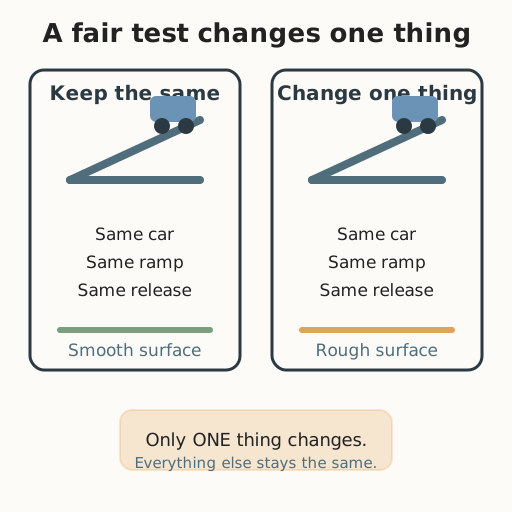
Lesson 1 — A Fair Test: Change One Thing
Summary
Last year learners made a prediction and tested it by doing. This year their testing grows a crucial step: a fair test. A fair test changes exactly one thing and keeps everything else the same, so that when something different happens, we know what caused it. Learners plan a fair test together, name the one thing they will change and the many things they will keep the same, and offer a prediction. They see that “fair” here means honest — not winning.
Objectives
- Plan and carry out a simple fair test by changing one thing and keeping the rest the same. (D06.S1.03.01)
Connection
You want to know: does my toy car roll farther on a smooth floor or a rough mat? If you change the surface and give a harder push and use a different car, you will never know what made the difference. A fair test changes only one thing — the surface — and keeps the car, the ramp, and the release the same. Then, if the car rolls farther on the smooth floor, you can trust that the surface is what changed it. Fair means honest, the same idea as a fair game where everyone follows the same rules.
Materials
- One toy car or ball and a ramp (a board or a book to prop up)
- A smooth surface and a rough surface (a floor and a mat, towel, or rug)
- A class “fair test” chart or large paper
- Paper and pencils
Preparation
- Set up the ramp on the smooth surface and place the rough surface beside it.
- Prepare the chart with two columns: “What stays the same” and “What changes.”
- Have the toy car (or ball) and the rough surface ready for a quick worked example.
Facilitator note
This lesson is written to the learner (“you”), so it works in a classroom and for a self-directed learner. The core skill — change one thing, keep the rest the same — is a foundational inquiry skill, so teach it with a worked example and guided practice before independent planning (Kirschner, Sweller & Clark, 2006): you model the ramp test once, then pairs plan their own. Keep it joyful and honest: a fair test is about trust, not trickery, and it connects naturally to the fairness learners already care about in games and sharing (the egalitarian lens). Where a “right” answer is not known ahead of time — and sometimes we cannot test a thing at all — that is not a failure; it is the edge of what we can find out. This lesson sets up Lesson 2, where the same test is carried out and recorded; the two lessons deliberately space the planning and the doing.
Procedure
- Gather and remember (5 min). Last year you predicted and tested. What is one thing you predicted and tested, and what happened? Today your testing grows up: you will plan a fair test.
- Meet a fair test (10 min). Watch the worked example: “Does the car roll farther on the smooth floor or the rough mat?” A fair test changes only one thing — the surface — and keeps the car, the ramp, and the release the same. Say together: what stays the same? What changes?
- Plan a fair test together (15 min). Pick a question you can test: “Does a stone slide farther on smooth rock or sand?” “Does warm water melt ice faster than cold?” On the chart, list everything you will keep the same, and the one thing you will change. Say your prediction: what do you think will happen, and why?
- Plan your own (15 min). On your paper, draw three boxes: My question, The one thing I change, and What I keep the same. Add a prediction. A fair test changes one thing and keeps the rest the same.
- Close (5 min). Fair means honest: one thing changes, the rest stay the same. Keep your plan — tomorrow you will carry it out and read what the data show.
Differentiation
- Support: Plan together on the shared chart; the learner names one thing to change and one to keep the same with a partner.
- Support (non-speaking): Point to picture cards for “same” and “change,” or move two cards to show the plan.
- Support (blind/low-vision): Plan a test by touch and sound — a ball rolled on two surfaces you can feel — and describe the plan aloud.
- Support (motor): Direct a partner to roll or slide the object while you name the one change and the things you keep the same.
- Extension: Write a second fair test question and explain which thing is hardest to keep the same and why.
Assessment
- Formative (observation): Can the learner name the one thing they will change and at least two things they will keep the same?
- Self: The learner checks their own plan: “Did I change only one thing?”
Home connection
At home, plan a tiny fair test with a grown-up: “Which cup keeps water warmer — the covered one or the open one?” Agree on the one thing you will change and what you will keep the same.
Resources
- BBC Bitesize (KS2 Science), “What is a fair test?” — what a fair test is, and why scientists change one thing and keep the rest the same. https://www.bbc.co.uk/bitesize/topics/zqkk7ty/articles/z69qwnb