Lesson 04 — A Plant's Helping Parts
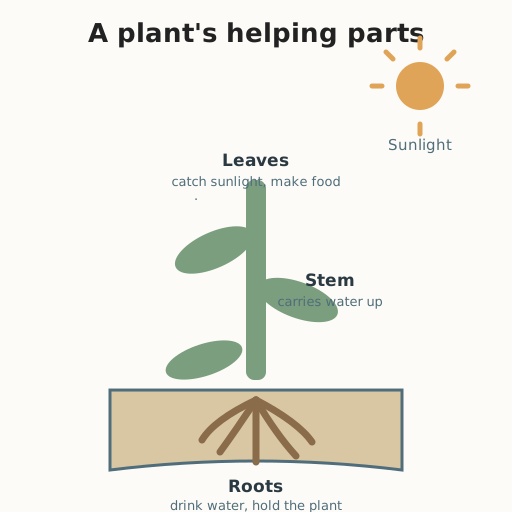
Learners meet the three big parts of a plant — roots, stem, and leaves — and what each one does: roots drink water and hold the plant in the ground, the stem carries water up and holds the leaves to the light, and the leaves catch sunlight to make the plant's food. They draw and label a plant and connect the parts to plants people grow and eat all over the world.
Objectives
Objectives
- D06.S2.03.02 Describe how the parts of a plant (roots, stem, and leaves) help it survive and grow.
Essential question
How do a plant's roots, stem, and leaves help it survive and grow?
Key vocabulary
Materials
Standard materials
- A real plant to look at (a potted plant or a pulled-up weed with roots) · 1 To see roots, stem, and leaves up close
- A large plant-parts drawing or poster · 1 A plant with roots, stem, and leaves labeled
- Paper and crayons · per learner
Low-tech / no-cost
- A pulled-up plant or a picture drawn in the dirt Find or draw a plant and point to its roots, stem, and leaves
- Voice and body Act out the parts — roots reach down, the stem stands up, the leaves reach out for light
Enriched / lab & device
- A clear cup with a plant in water · 1 To watch the roots drink and the stem carry water up
- A "plant parts" flip book · per learner A small book with a page for each part and what it does
Works in different contexts
- large-group Label the parts together on a big poster, then pairs draw and label their own plant
- self-directed A learner looks at a real plant, draws it, and labels each part with one thing it does
- outdoor-only Find a real plant outside, gently look at its roots, stem, and leaves, and say what each part does
- multi-age Older learners read the job of each part aloud while younger learners point to the part on a real plant
- level-grouped Learners who can write a sentence about each part do so; learners still learning point and match each part to its job
Lesson 4 — A Plant’s Helping Parts
Summary
Every plant is built from parts that help it survive and grow. Learners meet the three big ones: roots reach down to drink water and hold the plant in the ground; the stem carries water up and holds the leaves toward the light; and the leaves catch sunlight to make the plant’s food. They draw and label a plant and connect each part to plants people grow and eat around the world.
Objectives
- Describe how the parts of a plant (roots, stem, and leaves) help it survive and grow. (D06.S2.03.02)
Connection
Look at any plant you know — a bean in a cup, a tree by the road, rice in a field. It stands there quietly doing three jobs at once. Its roots drink water from the soil and hold it steady. Its stem is like a straw and a tower: it carries water up and holds the leaves up to the light. And the leaves catch sunlight to make the plant’s food. Pull up a weed and you can see all three with your own eyes.
Materials
- A real plant to look at (a potted plant or a pulled-up weed with roots)
- A large plant-parts drawing or poster
- Paper and crayons
Preparation
- Have a real plant (with visible roots, stem, and leaves) ready for close looking.
- Prepare or draw the labeled plant poster.
Facilitator note
This lesson is written to the learner (“you”). Teach the three parts with a worked example — point to the roots, stem, and leaves on a real plant and say each job once — then let learners point and say them with a partner (guided practice) before drawing alone. Keep the global lens wide: many staple foods are plant parts — carrots and sweet potatoes are roots, sugarcane and asparagus are stems (celery stalks are leaf stalks, not true stems), spinach and cabbage are leaves, and rice and maize are seeds. Naming foods from many places makes no single diet the default and honors the way plants feed the whole world. Handle the pulled-up plant with care and return it or compost it — a small ethical step of respect for a living thing. Scientific claims (roots take up water and minerals, leaves make food in sunlight) are well-supported; state them plainly and let learners wonder beyond them.
Procedure
- Gather and remember (5 min). In the last lesson you traced a food chain, and the producer was a plant. Today: how does a plant stay alive and grow?
- Meet the parts (10 min). Look at a real plant. Roots reach down into the soil to drink water and hold the plant steady. The stem carries water up and holds the leaves high. The leaves catch sunlight and make the plant’s food. Point to each part and say its job.
- Act it out (10 min). Use your body: be the roots reaching down, the stem standing tall, the leaves reaching out for the light. Say each job as you do it.
- Draw and label (15 min). Draw a plant with roots, a stem, and leaves. Label each part and write or draw one thing it does. “Roots — drink water.” “Stem — carries water up.” “Leaves — catch sunlight.”
- Close (5 min). Roots drink, the stem carries, the leaves catch the light. Together the parts keep the plant alive — and plants keep us and the whole food chain alive.
Differentiation
- Support: Match three cards (roots, stem, leaves) to three jobs with a partner.
- Support (non-speaking): Point to each part on the real plant; a partner says its job.
- Support (blind/low-vision): Feel a real plant — its roots, stem, and leaves — and describe each by touch; a partner labels the drawing.
- Extension: Name one food you eat that is a root, one that is a stem, and one that is a leaf, and draw all three.
Assessment
- Formative (observation): Can the learner point to each part and say (or match) one thing it does?
- Artifact (portfolio): The labeled plant-parts drawing.
Home connection
At home, look at a vegetable or plant with a grown-up. Which part are you eating — a root, a stem, or a leaf? Say what that part does for the plant.
Resources
- BBC Bitesize (KS2 Science), “The structure of flowering plants” — how roots, stems, and leaves help a plant survive and grow. https://www.bbc.co.uk/bitesize/topics/zy66fg8/articles/z2d4g7h