Lesson 05 — Solids, Liquids, and Gases
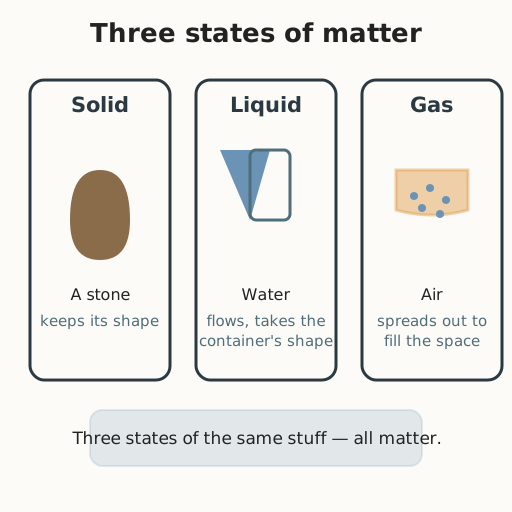
Learners meet the three states of matter: a solid keeps its shape, a liquid takes the shape of its container and flows, and a gas spreads to fill the space around it. They sort real examples — a stone, water, and air — and describe each state in their own words, seeing that all three are matter, just arranged differently.
Objectives
Objectives
- D06.S3.03.01 Describe the three states of matter (solid, liquid, and gas) and how heating and cooling change them.
Essential question
What are the three states of matter, and how are they different?
Key vocabulary
Materials
Standard materials
- A solid, a liquid, and a gas to observe · 1 of each A stone or ice cube (solid), water in a cup (liquid), air in a clear bag (gas)
- Two clear containers of different shapes · 2 To show a liquid takes the shape of its container
- Paper and crayons · per learner
Low-tech / no-cost
- Found things from around you A stone (solid), water in a leaf or cupped hands (liquid), your breath (gas)
- Voice and body Act it out — stand firm like a solid, flow like a liquid, spread like a gas
Enriched / lab & device
- A three-state sorting card set · 1 set Pictures of solids, liquids, and gases from around the world to sort
- A clear balloon or bag to catch a gas · 1 To feel that air is real matter that takes up space
Works in different contexts
- large-group Sort a big set of pictures into solid, liquid, and gas together, then pairs sort their own set
- self-directed A learner collects one solid, one liquid, and one gas around them and describes each state
- outdoor-only Find a solid (a stone), a liquid (a stream), and a gas (the wind you feel) outside and describe each
- multi-age Older learners read the three-state names and definitions while younger learners point and sort
- level-grouped Learners who can compare explain why a tricky thing (sand, jelly) is one state; learners still learning sort clear examples
Lesson 5 — Solids, Liquids, and Gases
Summary
Everything around us that takes up space is matter, and matter comes in three states. A solid keeps its shape; a liquid takes the shape of its container and flows; a gas spreads out to fill the space around it. Learners observe a stone, water, and air, sort examples, and describe each state in their own words — seeing that the same world can be firm, flowing, or invisible.
Objectives
- Describe the three states of matter (solid, liquid, and gas) and how heating and cooling change them. (D06.S3.03.01)
Connection
Look around you right now. The floor and your chair are solid — they keep their shape. The water you drink is a liquid — it pours and takes the shape of your cup. And the air you are breathing is a gas — you cannot see it, but it is there, filling the whole room. Three states of the same stuff, and you are touching all three at once. Wherever you live — by a river, in a desert, on a mountain — you meet solids, liquids, and gases every day.
Materials
- A solid, a liquid, and a gas to observe (a stone or ice cube, water in a cup, air in a clear bag)
- Two clear containers of different shapes
- Paper and crayons
Preparation
- Gather the three examples and the two differently-shaped containers.
- Fill a clear bag with air and seal it so learners can see and feel that a gas takes up space.
Facilitator note
This lesson is written to the learner (“you”). Introduce the three states with a worked example — hold up the stone, the water, and the air bag and say each state’s rule once — then let learners sort with a partner (guided practice). A common misconception is that gas is “nothing”; emphasize gently that air is matter — it takes up space, and a sealed bag of air is the proof a child can hold. Keep examples global: ice and snow (solid) on a mountain, river water (liquid), the wind and breath (gas) — the same three states appear everywhere. Note honestly that some “in-between” things (sand, jelly, clay) can be tricky to sort, and that is fine — classification is a tool, not a test. This lesson pairs with Lesson 6, where heating and cooling move matter between states.
Procedure
- Gather and remember (5 min). What is everything around you made of? Scientists call it matter. Matter comes in three states. Can you name one?
- Meet the three states (15 min). Feel a solid — it keeps its shape. Pour a liquid — it takes the shape of its cup and flows. Feel the sealed bag of gas — you cannot see the air, but it is there, filling the space. Say the rule for each: solid keeps its shape; liquid flows and takes the container’s shape; gas spreads out to fill the space.
- Sort and describe (15 min). Look around you and sort things into solid, liquid, and gas. Name one of each and say why it belongs there.
- Draw the three states (10 min). Draw one solid, one liquid, and one gas, and label each with its rule.
- Close (5 min). One world, three states: firm, flowing, and filling the air. You are breathing matter right now.
Differentiation
- Support: Sort three clear examples (stone, water, air) with a partner and say each name.
- Support (non-speaking): Point to the solid, the liquid, or the gas when named; a partner says the rule.
- Support (blind/low-vision): Feel the stone (solid), the water (liquid), and the moving air of a fan or breath (gas), and describe each by touch.
- Support (motor): Direct a partner to pour the water and hold the air bag while you name each state and its rule.
- Extension: Find one “tricky” thing (sand, jelly, honey) and explain which state it is and why it is tricky.
Assessment
- Formative (observation): Can the learner name the three states and say one rule for each?
- Self: The learner checks their drawing: “Did I show all three states?”
Home connection
At home, find one solid, one liquid, and one gas and tell a grown-up the rule for each. Your breath is the gas — prove it by fogging a spoon or a mirror.
Resources
- BBC Bitesize (KS2 Science), “Solids, liquids and gases” — the three states of matter and what makes each one different. https://www.bbc.co.uk/bitesize/topics/zgwc96f/articles/zngfp4j