Lesson 03 — Three Big-Grown Feelings: Jealousy, Guilt, and Pride
Learners meet three complex feelings — jealousy, guilt, and pride — that go beyond simple happy/sad. They learn what each one feels like, a real situation where it shows up, and the useful signal each one carries: jealousy points to what I want, guilt to what I did, and pride to what I worked for.
Objectives
Objectives
- D01.S1.04.02 Recognize complex feelings such as jealousy, guilt, and pride and connect them to real situations.
Essential question
What are jealousy, guilt, and pride, and what do they tell me?
Key vocabulary
Materials
Standard materials
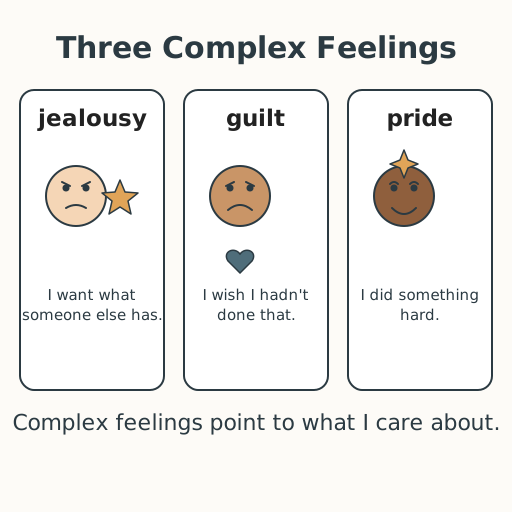
- Complex feelings chart · 1 Three labeled cards — jealousy, guilt, pride — each with a face, a short situation clue, and what the feeling points to
- My complex feeling card · 1 per learner A card with three lines — "I felt jealous when…", "I felt guilty when…", "I felt proud when…" — to draw or write
- Pencils and crayons · per learner
Low-tech / no-cost
- Voice and body Describe and act out each complex feeling with a partner; no cards needed
- Found objects Use a stone (heavy = guilt), a reaching hand (jealousy), and an open chest (pride) to stand for each feeling
Enriched / lab & device
- A 'feeling → what it points to' sorting set · 1 set per pair Cards pairing jealousy, guilt, and pride with what each points to (what I want, what I did, what I worked for)
- A short story or video clip · 1 A child-focused story in which a character feels jealousy, then guilt, then pride, for a shared discussion
Works in different contexts
- large-group Teach all three feelings on the board first, then have learners act them out in a circle and fill their cards in small groups
- multi-age Older learners tell a story with all three feelings while younger learners hold up the matching feeling card as each one appears
- self-directed A learner reads each feeling, thinks of a real moment for each, and writes or draws it, then checks with the "what does it point to" test
- level-grouped Learners ready to extend name a fourth complex feeling (such as embarrassment or relief) and say what it points to
- outdoor-only Take the three feeling cards outside and find a real moment from the day for each, telling it aloud to a partner
Lesson 3 — Three Big-Grown Feelings: Jealousy, Guilt, and Pride
Summary
Learners meet three complex feelings — jealousy, guilt, and pride — that go beyond simple happy or sad. They learn what each one feels like, a real situation where it shows up, and the useful signal each one carries: jealousy points to what I want, guilt to what I did, and pride to what I worked for.
Objectives
- Recognize complex feelings such as jealousy, guilt, and pride and connect them to real situations. (D01.S1.04.02)
Connection
Some feelings are more than “happy” or “sad.” They are bigger, more layered — like feelings with a story inside. When a friend gets a new bike and you wish it were yours, that is jealousy. When you remember a hurtful word you said and wish you could take it back, that is guilt. When you finish something hard you practiced for weeks, that is pride. These feelings show up everywhere — in a city, a village, a desert, or a mountaintop — because every human who cares about something feels them. They are not bad or good by themselves; they are signals that tell you what matters to you.
Materials
- Complex feelings chart
- My complex feeling card
- Pencils and crayons
Preparation
- Print or draw the complex feelings chart.
- Copy a “my complex feeling” card for each learner.
- Arrange space for sharing in pairs and a quiet space for drawing.
Facilitator note
This lesson is written to the learner (“you”). The key teaching move is to frame each
complex feeling as a signal, not a verdict: jealousy points to a want, guilt points
to a past action, pride points to effort. This keeps the lesson warm and non-shaming —
important, because jealousy and guilt can feel heavy. Teach all three aloud (worked
example) before learners connect their own. Never label a learner “jealous” or “guilty”;
talk about the feeling, not the person. See docs/facilitation.md on holding
difficult topics safely.
Procedure
- Gather (5 min). Last time you learned that your body tells you how strong a feeling is. Today you meet three feelings that are bigger and more layered than happy or sad: jealousy, guilt, and pride.
- Meet the three feelings (15 min). Look at the chart. Jealousy is the wishing feeling — a friend gets a new bike and you wish it were yours. It points to what you want. Guilt is the heavy feeling after you did something you wish you had not — you said a hurtful word. It points to what you did. Pride is the warm, full feeling after you worked hard — you finished a drawing you practiced for days. It points to what you worked for. These are complex feelings: they mix several things at once, and they are signals, not bad or good by themselves.
- Act them out (10 min). With a partner, take turns showing each feeling with your face and body — the reach of jealousy, the heavy shoulders of guilt, the lifted chest of pride — while your partner guesses which one it is.
- Connect to your own life (10 min). On your card, draw or write one real moment for each: “I felt jealous when…”, “I felt guilty when…”, “I felt proud when…”. You do not have to share anything you want to keep private.
- Close (5 min). Complex feelings are messengers. Jealousy says “I want something.” Guilt says “I want to do better.” Pride says “I did something hard.” Listening to them — without being ruled by them — is a skill you will use your whole life.
Differentiation
- Support: Offer ready-made example cards to choose from for each feeling, and scribe the learner’s own moment for each.
- Extension: Name a fourth complex feeling (such as embarrassment, relief, or hope) and say what it points to.
Assessment
- Formative (observation): Can the learner describe what jealousy, guilt, and pride each mean and connect at least one to a real situation?
- Self-check: The learner checks their card against the “what does it point to” test (want / did / worked for).
Home connection
Ask someone at home about a time they felt proud of something they worked for, and share one of your three feeling moments with them if you like.
Resources
- CASEL SEL Framework (self-awareness competency): https://casel.org/fundamentals-of-sel/