Lesson 02 — What Each Level Feels Like in My Body
Learners connect each feeling-strength level to what it feels like in the body. A little feels like a small flutter; some feels warm and faster; a lot feels hot, tight, or shaky. By scanning their own bodies, they learn that body signals are honest clues to how strong a feeling is — an early step toward regulating it.
Objectives
Objectives
- D01.S1.04.01 Describe the intensity of a feeling as a little, some, or a lot, and what each level feels like.
Essential question
What does a little, some, or a lot feel like in my body?
Key vocabulary
Materials
Standard materials
- Body signal chart · 1 A simple body outline with three intensity levels labeled — a little (flutter), some (warm, faster), a lot (hot, tight, shaking)
- My body signal page · 1 per learner A blank body outline with three lines to record what a little, some, and a lot feel like for one feeling
- Pencils and crayons · per learner
Low-tech / no-cost
- Your own body Scan your body with attention and describe the signal aloud; no page needed
- A drawn outline in the sand or on paper Point to where a feeling shows up and say how strong it is
Enriched / lab & device
- A body-signal 'detective' card set · 1 set per pair Cards with body signals (flutter, warm, tight, fast, heavy, hot) to sort onto a body outline by strength
- A short guided body-scan audio · 1 A 3-minute recording that guides learners slowly from head to toes to notice sensations
Works in different contexts
- large-group Lead one whole-group body scan aloud; learners point to where the feeling lives on a big body outline, then record their own
- multi-age Older learners read a body signal and act it out while younger learners guess the feeling and its strength
- self-directed A learner does a slow body scan alone and writes or draws one signal for each of the three strength levels
- level-grouped Learners ready to extend notice a second body signal at the same strength and describe how the two signals work together
- outdoor-only Use a quiet spot outside for the body scan; describe how the wind, sun, or ground feels as a warm-up to noticing inner signals
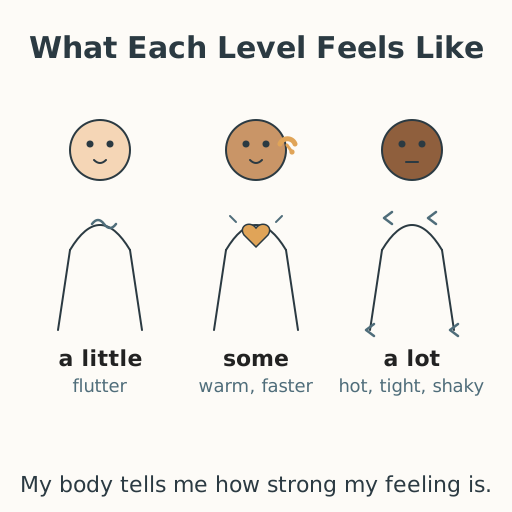
Lesson 2 — What Each Level Feels Like in My Body
Summary
Learners connect each strength level of a feeling to what it feels like in the body. A little might feel like a small flutter; some might feel warm and a bit faster; a lot might feel hot, tight, or shaky. By scanning their own bodies, they learn that body signals are honest clues to how strong a feeling is — an early step toward regulating it.
Objectives
- Describe the intensity of a feeling as a little, some, or a lot, and what each level feels like. (D01.S1.04.01)
Connection
Your body is a quiet messenger. When you feel a little excited, your stomach may do a tiny flutter. When you feel some, your cheeks get warm and your heart beats a bit faster. When you feel a lot, your shoulders rise, your hands shake, and your breath gets short. You can notice all of this without anyone telling you — because your body is already telling you. A child by the sea feels a little flutter when a big wave approaches, and a lot of pounding heart when the wave is taller than they are. Bodies everywhere speak the same quiet language.
Materials
- Body signal chart
- My body signal page
- Pencils and crayons
Preparation
- Print or draw the body signal chart.
- Copy a “my body signal” page for each learner.
- Arrange a quiet space where learners can close their eyes and scan their bodies.
Facilitator note
This lesson is written to the learner (“you”). Body awareness (called interoception —
sensing signals from inside the body) is a real skill and grows with practice. Keep the
body scan slow and optional — some learners may not feel comfortable closing their eyes;
they may keep eyes open and that is fine. Model the three levels on yourself first
(worked example), then let learners find their own signals. A learner’s body may not
match the “typical” list — every body is different, and that is the point: their body is
their own honest messenger. See docs/facilitation.md on holding big feelings safely.
Procedure
- Gather (5 min). Last time you learned that feelings have a strength — a little, some, or a lot. Today you learn where that strength shows up: in your own body.
- Meet the body signal chart (10 min). Look at the three figures. A little feels like a small flutter — maybe in your stomach. Some feels warm, with a faster heartbeat in your chest. A lot feels hot, with tight shoulders and shaking hands. These are body signals: your body’s way of telling you how strong a feeling is.
- Practice a worked example (10 min). Together, pick the feeling nervous. Close your eyes or look down softly. Scan from your head to your toes: where do you notice something? A flutter? Warmth? Tightness? Notice how the signal gets bigger as the feeling gets stronger.
- Scan your own body (15 min). Choose one feeling you felt recently. On your page, write or draw what a little of it feels like, what some feels like, and what a lot feels like — in your own body, with your own words.
- Close (5 min). Your body tells you the truth about how strong your feelings are. The more you listen, the better you get at it. Next time a big feeling comes, you can pause and ask: where do I feel this, and how strong is it?
Differentiation
- Support: Offer a menu of body-signal words (flutter, warm, tight, fast, heavy, hot) to choose from, and scribe the learner’s own answers.
- Extension: Notice a second body signal at the same strength and describe how the two signals work together (“my heart beats fast and my hands shake”).
Assessment
- Formative (observation): Can the learner name one body signal for each strength level of a feeling (a little, some, a lot)?
- Self-check: The learner checks that their body signals grow with the strength of the feeling.
Home connection
Ask someone at home where a feeling shows up in their body, and teach them the little/some/a lot body check you practiced today.
Resources
- CASEL SEL Framework (self-awareness competency): https://casel.org/fundamentals-of-sel/