Lesson 10 — Staying With It When It Is Hard or Tempting to Quit
Learners practice self-control as a skill: staying with a task or rule when it is hard or tempting to quit. They meet three concrete strategies — breathe, break it small, and make an if-then plan — and apply them to a real task of their own. As the unit capstone, they also look back across the unit and name what they now understand about their feelings, their growing self, and their goals.
Objectives
Objectives
- D01.S3.04.02 Practice self-control by staying with a task or rule even when it is hard or tempting to quit.
Essential question
How do I stay with a task or rule when it is hard or tempting to quit?
Key vocabulary
Materials
Standard materials
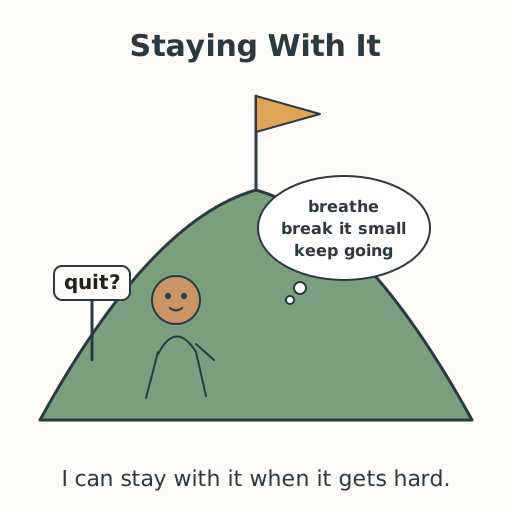
- Climb-the-hill chart · 1 A figure partway up a hill toward a flag, with a "quit" sign on one side and a "keep going" thought bubble on the other
- My stay-with-it plan page · 1 per learner A page with a task, the temptation, and three strategies — breathe, break it small, if-then plan — to fill in
- Pencils and crayons · per learner
Low-tech / no-cost
- A real hill, staircase, or a line on the ground Stand partway and practice one strategy aloud at the hard spot; no page needed
- Voice and body Name a hard moment, show the temptation to quit, then act out breathing and an if-then plan
Enriched / lab & device
- A 'stay-with-it' timer set · 1 per pair Short timers so learners can practice staying with a task for a set, fair amount of time before a break
- An if-then plan card deck · 1 set per pair Cards to build "if I feel like quitting, then I will…" plans for common hard moments
Works in different contexts
- large-group Teach the strategies aloud and have the whole group chant an if-then plan together, then learners write their own in small groups
- multi-age Older learners model a real stay-with-it moment from their week and coach a younger learner to build their own if-then plan
- self-directed A learner picks one real task, names the temptation to quit, and writes a three-strategy plan to use this week
- level-grouped Learners ready to extend practice a harder, longer task with a partner and reflect on which strategy helped most
- outdoor-only Find a small hill or set of steps and actually climb it, pausing at the hard spot to breathe, break it small, and say your if-then plan
Lesson 10 — Staying With It When It Is Hard or Tempting to Quit
Summary
Learners practice self-control as a skill: staying with a task or rule when it is hard or tempting to quit. They meet three concrete strategies — breathe, break it small, and make an if-then plan — and apply them to a real task of their own. As the unit capstone, they also look back across the unit and name what they now understand about their feelings, their growing self, and their goals.
Objectives
- Practice self-control by staying with a task or rule even when it is hard or tempting to quit. (D01.S3.04.02)
Connection
Every hard thing has a moment in the middle — the moment you want to stop. The page of math you don’t want to finish, the promise to help before you play, the rule about waiting your turn, the screen calling you away from your homework. That moment is temptation, and everyone meets it. Self-control is not about never wanting to quit; it is about knowing what to do when you want to quit. You can breathe, break the job into one small step, and make an if-then plan: “If I feel like quitting, then I will do just one more small step.” A child waiting out a long storm, a child finishing a weaving, a child keeping a promise — all of them use the same quiet skill.
Materials
- Climb-the-hill chart
- My stay-with-it plan page
- Pencils and crayons
Preparation
- Print or draw the climb-the-hill chart.
- Copy a “my stay-with-it plan” page for each learner.
- Arrange space for practice and a closing circle.
Facilitator note
This lesson is written to the learner (“you”), and it closes the unit — so the closing
circle is also a retrieval and capstone moment: learners recall the feeling
thermometer, the complex feelings, the self-map, and the plan-adjust loop. Teach the
three strategies explicitly (worked example) — self-control is a skill, and explicit
strategy instruction beats vague “try harder” (see docs/contexts.md on when to
instruct). Note honestly that willpower is not infinite and the evidence for “building”
it like a muscle is mixed; the practical, well-supported levers are strategies and
changing the situation (removing the distraction, planning ahead) more than sheer
effort. Never shame a learner who struggled — “not yet” applies here too.
Procedure
- Gather (5 min). This is the last lesson of our unit. You have learned to measure your feelings, meet complex feelings, map your growing self, and plan-and-adjust a goal. Today you learn the skill that ties it all together: staying with it when it is hard or tempting to quit.
- Meet the hard moment (10 min). Look at the chart. A figure is partway up a hill. The flag — the goal — is at the top. But there is a quit sign on the side. That is the hard moment, and everyone reaches it. Self-control is knowing what to do when you reach it.
- Learn three strategies (10 min). One: breathe — pause and take a slow breath before you act. Two: break it small — do not face the whole hill; face just the next step. Three: if-then plan — “If I feel like quitting, then I will do one more small step.” These are tools, and you can practice them.
- Make your own plan (15 min). On your page, write one real task or rule you want to stay with this week. Name the temptation to quit. Then write your three strategies: how you will breathe, how you will break it small, and your exact if-then plan. If you can, try one small step right now.
- Close — the capstone (5 min). Look back: how strong can a feeling be? What do jealousy, guilt, and pride tell you? What makes you, you? What is your next step? You are the one who measures your feelings, knows your growing self, and chooses to stay with what matters. That is a big, true thing — and it is yours.
Differentiation
- Support: Offer a fill-in-the-blank if-then sentence and a picture of the three strategies; scribe the learner’s plan.
- Extension: Practice a longer task with a partner using a timer, then reflect on which strategy helped most and why.
Assessment
- Formative (observation): Can the learner name a task or rule, the temptation to quit, and at least two strategies to stay with it?
- Self-check: The learner tries one strategy on a real task and notes whether it helped.
- Artifact (portfolio): The stay-with-it plan page, kept with the self-map and the goal-steps page.
Home connection
Choose one task or rule at home to stay with this week, and tell someone your if-then plan so they can cheer you on.
Resources
- CASEL SEL Framework (self-management competency): https://casel.org/fundamentals-of-sel/
- Duckworth, A. L., Gendler, T. S., & Gross, J. J. (2016). Situational strategies for self-control. Perspectives on Psychological Science, 11(1), 35–55. (Evidence that changing the situation and planning ahead support self-control; note that willpower is limited and strategies matter more than effort alone.)