Lesson 09 — Plan the Steps, Try It, and Adjust
Learners move beyond the single first step of Grade 3 to plan several ordered steps toward a goal, then learn the adjust loop: try the plan, check whether a step works, and change that step when it does not. This is the core skill of reaching goals — a plan is a living thing you improve as you go, not a fixed script.
Objectives
Objectives
- D01.S3.04.01 Plan the steps to reach a goal, try the plan, and adjust when a step does not work.
Essential question
How do I plan several steps, try my plan, and adjust when a step does not work?
Key vocabulary
Materials
Standard materials
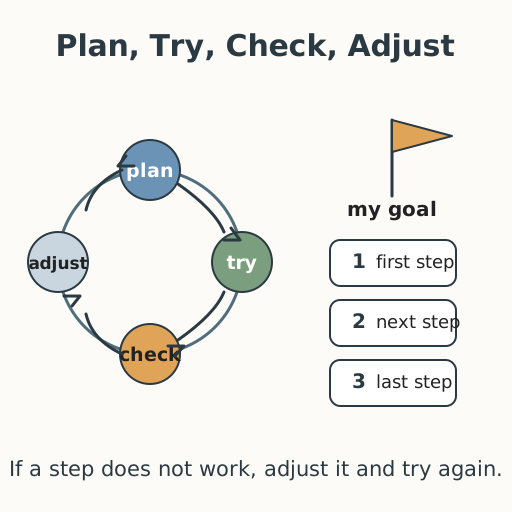
- Plan–try–adjust loop chart · 1 A circular loop with four stops — plan, try, check, adjust — and an arrow returning to try
- My goal steps page · 1 per learner A page with a goal line, three step boxes, and an "adjust" line for what to change when a step does not work
- Pencils and crayons · per learner
Low-tech / no-cost
- Four marked spots on the ground Walk the loop — plan, try, check, adjust — saying your goal and steps aloud at each stop
- Voice and body Tell a partner your plan, act out trying one step, and say how you would adjust if it failed
Enriched / lab & device
- A reusable goal-tracker with adjustable steps · 1 per learner A chart with movable step cards the learner can reorder or replace as they adjust their plan
- A peer 'plan coach' pairing · 1 per pair Learners pair up to test each other's plan with the "does it work? adjust" check across the next week
Works in different contexts
- large-group Model one shared plan and adjustment on the board, then learners write their own in small groups with a peer coach
- multi-age Older learners help a younger learner break their goal into three small, doable steps and check the order
- self-directed A learner writes a three-step plan alone, tries the first step, and notes what to adjust if it does not work
- level-grouped Learners ready to extend add a way to measure success for each step and a backup step in case one fails
- outdoor-only Lay out four stops on the ground and physically walk plan → try → check → adjust, carrying a small stone from stop to stop
Lesson 9 — Plan the Steps, Try It, and Adjust
Summary
Learners move beyond the single first step of Grade 3 to plan several ordered steps toward a goal, then learn the adjust loop: try the plan, check whether a step works, and change that step when it does not. This is the core skill of reaching goals — a plan is a living thing you improve as you go, not a fixed script.
Objectives
- Plan the steps to reach a goal, try the plan, and adjust when a step does not work. (D01.S3.04.01)
Connection
Think of something you want to reach — learn a song, grow a plant, save for a tool, run faster, be kind more often. That is your goal. You do not jump to it; you take steps, one after another. But here is the secret every builder, cook, and farmer knows: the first plan is never perfect. A recipe needs more salt, a seed needs more water, a wall needs a stronger brace. So you try, you check, and you adjust — then try again. A fisher sets a net, finds a hole, mends it, and sets it again. Reaching a goal is a loop, not a straight line.
Materials
- Plan–try–adjust loop chart
- My goal steps page
- Pencils and crayons
Preparation
- Print or draw the plan–try–adjust loop chart.
- Copy a “my goal steps” page for each learner.
- Arrange space for pair coaching and quiet writing.
Facilitator note
This lesson is written to the learner (“you”). The skill to coach is adjustment — treating a failed step as information, not failure. This mirrors evidence that learning is more effective when learners get feedback and act on it (mastery learning; Bloom 1984). Model a real adjustment from your own life first (worked example), and keep the goal the learner’s own. Watch for learners who fear a step “failing”; reframe loudly: “the plan changed — that means the plan is working, because now you know more.” This is a portfolio artifact — have learners keep their goal-steps page for a follow-up check-in.
Procedure
- Gather (5 min). In Grade 3 you set a goal and named its first step. Today you grow that into a full plan with several steps — and you learn the loop that makes any plan succeed: plan, try, check, adjust.
- Meet the loop (10 min). Look at the chart. You plan your steps. You try the first step. You check: did it work? If not, you adjust that step — change it — and try again. The arrow loops back. That loop is the whole skill.
- Hear a worked example (10 min). “My goal is to grow a plant. My steps: (1) find seeds, (2) plant them, (3) water them every day. I tried step 2, and the seeds did not sprout. I checked: the soil was too dry. I adjusted: I moved the pot to a shadier spot and watered more. Then they grew.” A step did not work — so I changed it. That is not failure; that is the loop.
- Write your own plan (15 min). On your page, write your goal and three ordered steps. Try the first step in your mind — or really, if it is small enough. Then write what you would adjust if that step did not work. Check with a partner: are your steps small and in a sensible order?
- Close (5 min). A plan is a living thing. When a step does not work, you do not quit — you adjust. You are the one who makes the plan, and you are the one who can change it.
Differentiation
- Support: Offer goal idea cards and a three-step frame with pictures; scribe the learner’s steps and adjustment.
- Extension: Add a way to measure success for each step, and a backup step to use if the first fails.
Assessment
- Formative (observation): Can the learner write an ordered multi-step plan, try a step, and name an adjustment when a step does not work?
- Self-check: The learner checks that their steps are small, ordered, and adjustable.
- Artifact (portfolio): The goal-steps page, kept for a follow-up check-in.
Home connection
Try your first step today, and tell someone at home what you would adjust if it does not work.
Resources
- CASEL SEL Framework (self-management competency): https://casel.org/fundamentals-of-sel/
- Bloom, B. S. (1984). The 2 sigma problem: The search for methods of group instruction as effective as one-to-one tutoring. Educational Researcher, 13(6), 4–16. (Evidence for mastery learning and feedback loops.)