Lesson 01 — My Body's Quiet Engine
Learners meet their heartbeat at rest. They find their pulse on the wrist or neck, count it for 15 seconds while still, and describe it as a steady, quiet engine that never stops — the first of three body signals this unit will read.
Objectives
Objectives
- D03.S1.04.01 Describe how the body changes with activity and rest, such as heartbeat, breathing, and warmth, and why.
Essential question
What is my heartbeat doing when I am still, and how can I feel it?
Key vocabulary
Materials
Standard materials
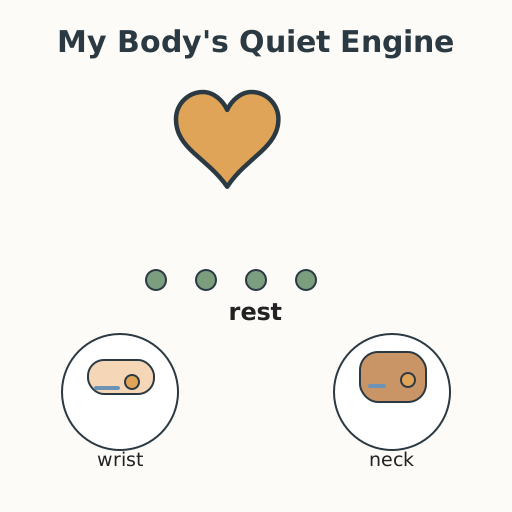
- A pulse-finding chart · 1 A simple diagram showing two places to feel a pulse — the wrist and the side of the neck
- A timer or a second hand · 1 To count heartbeats for 15 seconds
- Paper and pencils · per learner To record a resting heartbeat
Low-tech / no-cost
- Your own body and a friend's Feel a pulse with two fingers; no chart or timer needed — count with a steady clap instead
- Chalk or a stick Draw a heart on the ground and tap out the beat you felt
Enriched / lab & device
- A stethoscope (real or made from a paper tube) · 1 per pair To listen to the heartbeat through the chest, the way a health worker does
- A simple heart-rate app or clip-on monitor · 1 per group To compare a felt pulse with a measured one — technology as a tool, not a replacement for noticing
Works in different contexts
- large-group Model finding the pulse on yourself at the front, then have learners try in pairs; count aloud together for the whole group
- self-directed A learner follows the procedure alone, finds a pulse on their own wrist or neck, and counts with a steady clap
- outdoor-only Sit on a patch of ground or a bench, feel a pulse, and tap the beat on your knee; no paper needed
- multi-age Older learners count for younger ones and compare, then younger learners tap the beat while older ones count
Lesson 1 — My Body’s Quiet Engine
Summary
Learners meet their heartbeat at rest. They find their pulse — the throb of the heartbeat they can feel through the skin — on the wrist or the side of the neck, count it for 15 seconds while sitting still, and describe it. The heartbeat is the first of three body signals this unit will read: heartbeat, breathing, and warmth.
Objectives
- Describe how the heartbeat feels and changes with activity and rest, and why. (D03.S1.04.01)
Connection
Every moment — even right now, while you sit still — a pump inside your chest is working. It is your heart, squeezing about once every second, pushing blood around your body the way a river carries water to every field. You cannot usually hear it, but you can feel it. Health workers in every country listen to hearts with a stethoscope, and you can feel yours with just two fingers. A heartbeat you can find and count is a body signal you can read.
Materials
- A pulse-finding chart (wrist and side of the neck)
- A timer or a clock with a second hand
- Paper and pencils
Preparation
- Print or draw the pulse-finding chart (two places to feel a pulse: wrist and neck).
- Have a timer ready, or teach the steady-count clap as a low-tech timer.
- Arrange a quiet circle where learners can sit still.
Facilitator note
This lesson is written to the learner (“you”) so it works in a classroom and for a self-directed learner. Model finding the pulse on yourself before learners try — worked example first, then guided practice. Remind learners to use two gentle fingers, never a thumb (the thumb has its own pulse), and to press lightly. Some children cannot easily find a pulse; that is normal and not a failure — offer the chest (hand flat over the heart) as an alternative, or let them count their breathing instead. Never press on the neck too hard or for long. Keep it calm and curious, not a test: there is no “correct” number, only each body’s own number. This begins the body-signals strand of the unit and builds on Grade 3’s body-signal map.
Procedure
- Gather (5 min). Last year you learned to read four body signals: hunger, fullness, thirst, and tiredness. This year you read three new ones: your heartbeat, your breathing, and your warmth. Today, the heartbeat.
- Meet the heartbeat (10 min). Your heart is a muscle that squeezes and relaxes, about once every second. Each squeeze pushes blood through your body. You can feel that squeeze as a pulse. Watch the worked example: press two fingers gently on the inside of the wrist, just below the thumb — or on the side of the neck. Feel the soft tap-tap-tap. That is your pulse.
- Find your own pulse (10 min). Try it. Use two gentle fingers on your wrist or the side of your neck. If you cannot find it, lay your hand flat over your chest and feel the thump there. Sit very still and quiet.
- Count it (10 min). With a timer or a steady clap, count your heartbeats for 15 seconds. Say the number to yourself. It might be near 20 or 25 when you are resting — every body has its own number.
- Record and close (10 min). Draw a small heart and write your resting count next to it. Say it together: “my heart beats even when I am still.” How did it feel to find your own pulse?
Differentiation
- Support: Use the chest method (hand over the heart) with a partner counting the beats aloud; count for a shorter stretch if needed.
- Extension: Count for a full 30 seconds and multiply by two to estimate beats per minute, then compare with a partner.
Assessment
- Formative (observation): Can the learner find a pulse (or heartbeat on the chest) and describe it as a steady, quiet beat at rest?
- Self-check: The learner reads back their resting count and confirms it felt steady and even.
Resources
- Nemours KidsHealth — how the heart works (child-friendly): https://kidshealth.org/en/kids/heart.html
- World Health Organization — physical activity fact sheet: https://www.who.int/news-room/fact-sheets/detail/physical-activity
Home connection
Tonight, before you sleep, lie still and feel your heartbeat with a hand on your chest. Tell someone at home what you felt — a quiet, steady engine that never stops.