Lesson 02 — Heartbeat at Work
Learners compare their heartbeat at rest and at work. They count their pulse while still, then move hard for two minutes and count again, discovering the heartbeat speeds up with activity — and learning why: working muscles need more fuel and oxygen, which the faster heart delivers.
Objectives
Objectives
- D03.S1.04.01 Describe how the body changes with activity and rest, such as heartbeat, breathing, and warmth, and why.
Essential question
What happens to my heartbeat when I move hard, and why?
Key vocabulary
Materials
Standard materials
- A clear space to move · 1 per group Room to march, jump, or step in place safely
- A timer or a second hand · 1 To count heartbeats before and after moving
- A before-and-after record sheet · per learner Two boxes — "at rest" and "after moving" — to write a pulse count in each
Low-tech / no-cost
- Your own body and voice March or jump in place, then feel a pulse and count with a steady clap; no sheet or timer needed
- A stone or stick Mark two spots on the ground — "rest" and "move" — and stand on each while you count
Enriched / lab & device
- A stethoscope or heart-rate monitor · 1 per group To compare a felt count with a measured count at rest and after moving
- A large class chart · 1 A shared two-column chart to collect everyone's rest and work counts without ranking any body
Works in different contexts
- large-group Count at rest together first, then lead a whole-group movement burst, then count again in pairs
- self-directed A learner counts at rest, moves hard for two minutes, and counts again, writing both numbers
- outdoor-only Run or jump on open ground, then stop, sit, and feel the fast beat; trace two boxes in the sand for rest and work
- level-grouped Learners ready to extend count for a full 30 seconds and describe how fast the beat felt compared with rest
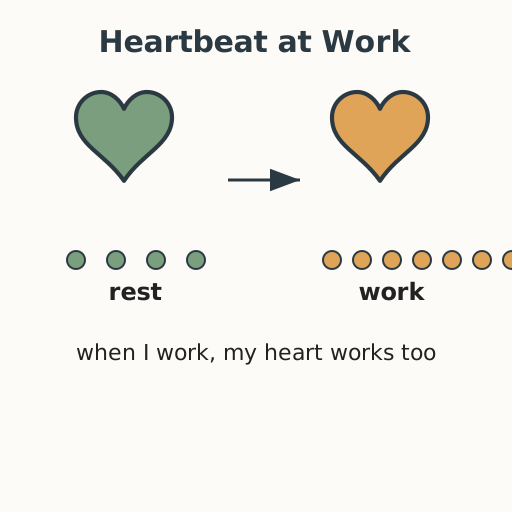
Lesson 2 — Heartbeat at Work
Summary
Learners compare their heartbeat at rest and at work. They count their pulse while still, move hard for about two minutes, then count again — and discover the heartbeat speeds up with activity. They learn why: working muscles burn fuel and need oxygen, and the faster heart pumps more blood to carry both to the muscles.
Objectives
- Describe how the heartbeat changes with activity and rest, and explain why working muscles need a faster heartbeat. (D03.S1.04.01)
Connection
Think of the last time you ran hard to catch up with a friend, chased a ball, or helped carry water home. Your heart was pounding. That is not a problem — it is your body’s engine revving. When muscles work hard, they ask for more fuel and more oxygen, and your heart answers by pumping faster. A runner in a mountain village, a child playing football in a city street, a farmer working a field — every working body’s heart speeds up, then slows again when the work stops.
Materials
- A clear space to move
- A timer or a clock with a second hand
- A before-and-after record sheet (at rest / after moving)
Preparation
- Clear a safe space to march, jump, or step in place.
- Copy the before-and-after record sheet (two boxes: “at rest” and “after moving”).
- Plan a two-minute movement burst everyone can join — including seated versions.
Facilitator note
This lesson is written to the learner (“you”). Run the worked example first: model counting at rest, moving, and counting again, then let learners do it. Keep the movement burst inclusive — marching in place, arm circles, or seated stomping all raise the heartbeat; a wheelchair user can wheel or press arms. Remind learners that a fast heartbeat is healthy and expected, not scary, and that every body’s number is different — there is no “best” count and no ranking. If a learner cannot find a pulse, the hand-over-chest method works, or they can describe the feeling (“thumping fast”). This lesson carries retrieval practice from Lesson 1 (finding the pulse) and adds the “why” the standard asks for.
Procedure
- Gather (5 min). Recall: yesterday you found your pulse at rest. What did it feel like? Today you ask: what happens when you move?
- Count at rest (10 min). Sit still and quiet. Find your pulse again and count it for 15 seconds. Write the number in the “at rest” box.
- Move (10 min). Stand and move hard for about two minutes — march fast, jump gently, or pump your arms. Choose the way your own body moves. Notice what you feel.
- Count after moving (10 min). Stop and sit. Find your pulse right away and count for 15 seconds. Write the number in the “after moving” box. Compare your two numbers.
- Ask why (10 min). Why did your heart speed up? Your muscles were working, so they needed more fuel and oxygen from your blood. Your heart pumped faster to deliver them. When you rest, the need drops, and your heart slows down again.
- Close (5 min). Say it together: “when I work, my heart works too.” Your heartbeat is a signal that changes with what your body is doing.
Differentiation
- Support: A partner counts aloud while the learner moves, then together they compare “rest” and “work” words instead of numbers (“slow” vs. “fast”).
- Extension: Estimate beats per minute at rest and after moving, and describe the difference with numbers.
Assessment
- Formative (observation/performance): Can the learner count a pulse at rest and after moving, and say which was faster and why?
Resources
- Nemours KidsHealth — the heart and circulatory system: https://kidshealth.org/en/kids/heart.html
- World Health Organization — physical activity fact sheet: https://www.who.int/news-room/fact-sheets/detail/physical-activity
Home connection
Run or dance at home for one minute, then feel your heartbeat. Tell someone why your heart is pounding — it is delivering fuel and oxygen to your working muscles.