Lesson 03 — Breathing Deep and Easy
Learners compare their breathing at rest and at work. They count breaths while still, move hard, and count again, discovering breathing speeds up with activity — and learning why: the body breathes in oxygen for working muscles and breathes out carbon dioxide, the waste gas, faster when it is working.
Objectives
Objectives
- D03.S1.04.01 Describe how the body changes with activity and rest, such as heartbeat, breathing, and warmth, and why.
Essential question
How does my breathing change with activity and rest, and why?
Key vocabulary
Materials
Standard materials
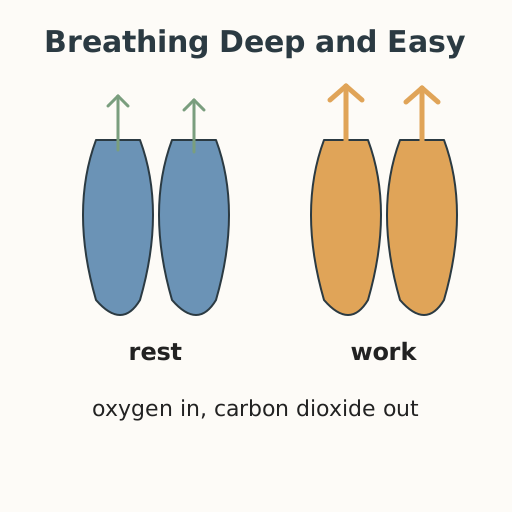
- A lungs picture chart · 1 A simple diagram of two lungs filling and emptying with air
- A timer or second hand · 1 To count breaths at rest and after moving
- A before-and-after breathing sheet · per learner Two boxes — "at rest" and "after moving" — to count breaths in each
Low-tech / no-cost
- Your own breath and a friend's Count breaths with a hand on the belly; no chart or timer needed — use a steady clap
- A feather, leaf, or scrap of paper Hold it near your mouth to watch your breath move it, slower at rest and faster after moving
Enriched / lab & device
- A balloon or paper bag · 1 per pair To feel air moving in and out the way lungs fill and empty
- A simple stethoscope · 1 per group To listen to breath moving through the chest, the way a health worker does
Works in different contexts
- large-group Breathe together as a whole group first — slow at rest, then after a movement burst — and count aloud in pairs
- self-directed A learner counts breaths at rest, moves for two minutes, and counts again, comparing the two
- outdoor-only Sit on the ground and watch a leaf or feather flutter with your breath, slower then faster
- multi-age Older learners count breaths for younger ones and vice versa, then compare rest and work
Lesson 3 — Breathing Deep and Easy
Summary
Learners compare their breathing at rest and at work. They count breaths while still, move hard, and count again, discovering breathing speeds up with activity. They learn why: the body breathes in to take in oxygen for working muscles, and breathes out to clear away carbon dioxide, the waste gas the body makes as it burns fuel.
Objectives
- Describe how breathing changes with activity and rest, and explain why the body needs more oxygen when it moves. (D03.S1.04.01)
Connection
Every few seconds, without thinking about it, you pull air in and let it go. Sit very still and your breath is slow and small — deep and easy. Run up a hill and your breath comes fast and deep. You already knew this without being taught; today you notice it on purpose. Divers who hold their breath, singers who fill their lungs, and children running home from school all feel the same thing: breathing is a body signal that changes with what you are doing.
Materials
- A lungs picture chart
- A timer or a clock with a second hand
- A before-and-after breathing sheet (at rest / after moving)
Preparation
- Print or draw the lungs chart.
- Copy the before-and-after breathing sheet.
- Clear a safe space to move, and have a feather, leaf, or scrap of paper ready.
Facilitator note
This lesson is written to the learner (“you”). Model counting breaths at rest, moving, and counting again — worked example first, then guided practice. Count one full breath as a breath in and a breath out. Keep the movement burst inclusive; seated arm-pumping raises breathing too. Some learners breathe through a tube or in other ways — all ways of breathing count, and this is stated with dignity, never as a “special” case. The lungs picture chart should be simple and honest, not anatomical clutter. This lesson retrieves Lesson 1–2 (pulse, rest vs. work) and adds the breathing signal.
Procedure
- Gather (5 min). You have read your heartbeat at rest and at work. Today you read a second signal: your breathing. Put a hand on your belly. Feel it rise and fall.
- Count at rest (10 min). Sit very still. Count your breaths for 15 seconds — each breath is one breath in and one breath out. Write the number in the “at rest” box. Notice how slow and small it is.
- Move (10 min). Stand and move hard for about two minutes — march, jump, or pump your arms. Choose your own way to move.
- Count after moving (10 min). Stop and sit. Count your breaths for 15 seconds. Write the number in the “after moving” box. Compare your two numbers. Which was faster?
- Ask why (10 min). Your working muscles needed more oxygen, so you breathed in faster and deeper. Your body also made a waste gas called carbon dioxide, so you breathed out to clear it. At rest, the body needs less, so breathing slows. Watch a feather near your mouth to see your breath move the air.
- Close (5 min). Say it together: “when I work, my breathing works too.” Two signals now — heartbeat and breathing — both change with what your body does.
Differentiation
- Support: A partner counts breaths aloud while the learner rests, then moves; use “slow” and “fast” words instead of numbers.
- Extension: Count breaths at rest and after moving for a full 30 seconds, and describe how deep or shallow each felt.
Assessment
- Formative (observation): Can the learner count breaths at rest and after moving, and explain that breathing speeds up to bring in oxygen and clear carbon dioxide?
Resources
- Nemours KidsHealth — how the lungs work (child-friendly): https://kidshealth.org/en/kids/lungs.html
- World Health Organization — physical activity fact sheet: https://www.who.int/news-room/fact-sheets/detail/physical-activity
Home connection
Tonight, sit still and count ten slow breaths before bed. Tell someone at home how your breathing is different when you rest than when you run.