Lesson 05 — My Body Dashboard
Learners bring the three body signals — heartbeat, breathing, and warmth — into one "body dashboard." They mark each signal at rest, move, and mark again, then write why each changes. The dashboard is their own guide to reading the body at work and at rest — the unit's portfolio artifact.
Objectives
Objectives
- D03.S1.04.01 Describe how the body changes with activity and rest, such as heartbeat, breathing, and warmth, and why.
Essential question
How do I read all three signals — heartbeat, breathing, and warmth — together, at work and at rest?
Key vocabulary
Materials
Standard materials
- A body-dashboard sheet · per learner A page with three dials or rows — heart, breath, warmth — each with a "rest" and a "work" side
- Crayons or markers · per learner To mark each signal's level at rest and at work
- A clear space to move · 1 per group Room for a short movement burst
Low-tech / no-cost
- Paper and a pencil Draw three dials — heart, breath, warmth — and mark each one rest and work
- Your own body Show each signal with a gesture — slow or fast taps for heart, small or big breaths, cool or warm hands — no page needed
Enriched / lab & device
- A large class dashboard poster · 1 A shared three-dial chart to collect the group's observations, never ranking any body
- A camera or tablet · 1 per group To photograph each learner's dashboard as a portfolio record
Works in different contexts
- large-group Build one big class dashboard together first — heart, breath, warmth at rest and work — then each learner fills their own
- self-directed A learner fills all three dials at rest, moves, fills them again, and writes one sentence about what changed and why
- outdoor-only Draw the three dials in the sand or with chalk, and mark each one with a stone at rest and again after moving
- multi-age Older learners scribe the "why" for each signal while younger learners mark the dials, then they trade to check
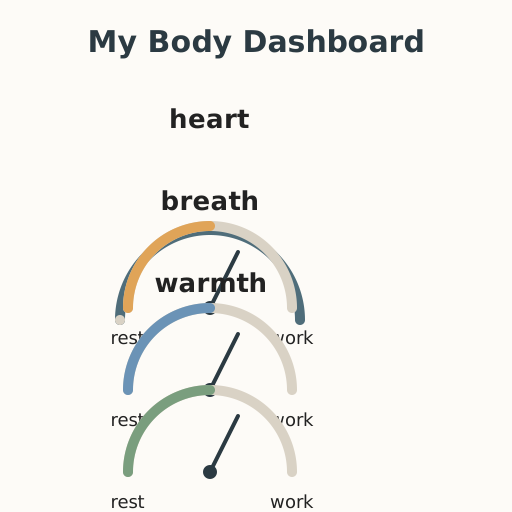
Lesson 5 — My Body Dashboard
Summary
Learners gather the three body signals — heartbeat, breathing, and warmth — into one “body dashboard,” the way a driver reads several dials at once. They mark each signal at rest, move, and mark again, then write why each changes. The finished dashboard is their own guide to reading the body at work and at rest — the unit’s portfolio artifact.
Objectives
- Describe how heartbeat, breathing, and warmth each change with activity and rest, and explain why. (D03.S1.04.01)
Connection
A pilot watches many dials at once to know how the plane is doing; a gardener checks soil, sun, and water to know how a plant is doing. Your body has its own set of dials — heart, breath, warmth — and you have learned to read all three. Today you put them on one dashboard, so you can read your whole body at a glance: how it works, and how it rests.
Materials
- A body-dashboard sheet (heart, breath, warmth — each with a rest and work side)
- Crayons or markers
- A clear space to move
Preparation
- Print or draw the body-dashboard sheet for each learner.
- Set out crayons and clear a safe space to move.
- Prepare a spot to share finished dashboards.
Facilitator note
This lesson is written to the learner (“you”) so it works in a classroom and for a self-directed learner. This is the unit’s portfolio artifact — the “my body at work and at rest” record named in the assessment plan — and it closes the body-signals strand. Guide the marking and keep it gentle: there is no “correct” number, and no body is praised or shamed for how fast or warm it gets. A learner’s dashboard is a record of their noticing, never a grade. Honor each body’s own pace — a fast, slow, or differently feeling heart is all fine. If a learner cannot feel a signal, they may describe it or use a partner’s help. Dashboards are shared only if the learner chooses.
Procedure
- Gather (5 min). You have read three signals in the last four lessons: heartbeat, breathing, warmth. Today you will put them all on one dashboard.
- Recall the signals (10 min). Say each signal, what it does at rest, and what it does at work, and why: heart → slow at rest, faster at work (muscles need fuel and oxygen); breath → small at rest, big at work (oxygen in, carbon dioxide out); warmth → cool at rest, warm at work (muscles make heat).
- Mark at rest (10 min). On your dashboard, mark each of the three dials at its rest position. Sit still and quiet first, and really notice.
- Move and mark at work (15 min). Move hard for two minutes, then mark each dial at its work position. Your dashboard now shows all three signals, at rest and at work.
- Write the why (10 min). Beside each dial, write or tell one sentence about why that signal changes.
- Share and close (5 min). Share your dashboard with a partner if you want. Say it together: “I can read my body at work and at rest.” Every dashboard is right for its own body.
Differentiation
- Support: Mark two dials at a time, or have a partner scribe while the learner points and marks each dial.
- Extension: Add a fourth dial — something else the learner notices about their body at work and rest (such as tiredness or thirst) — and its “why.”
Assessment
- Summative (portfolio/observation): Can the learner mark all three signals at rest and at work and explain why each one changes?
- Artifact (portfolio): The completed body dashboard, kept in the learner’s portfolio.
Resources
- Nemours KidsHealth — the heart, lungs, and how the body works: https://kidshealth.org/en/kids/heart.html
- World Health Organization — physical activity fact sheet: https://www.who.int/news-room/fact-sheets/detail/physical-activity
Home connection
Show your body dashboard to someone at home and read it to them — all three signals and why each one changes. Ask them if their body does anything a little differently.