Lesson 06 — Many Ways to Sense and Move
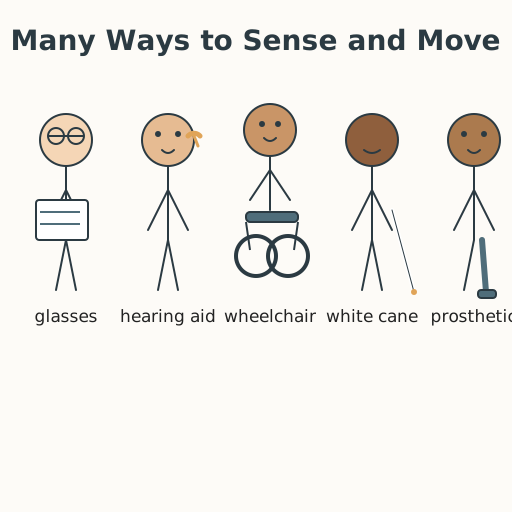
Learners notice and respect the many ways bodies sense and move. They match common aids and assistive tools — glasses, hearing aids, wheelchairs, canes, prosthetics — with the sense or movement each supports, and learn that an aid is a tool that extends a body's own ability, not something that makes a body "less."
Objectives
Objectives
- D03.S1.04.02 Notice and respect differences in how bodies sense and move, including people who use aids or assistive tools.
Essential question
How do different bodies sense and move, and how do aids and assistive tools help?
Key vocabulary
Materials
Standard materials
- A "many ways" picture card set · 1 set Cards showing people using glasses, hearing aids, wheelchairs, canes, prosthetics, and other aids — living their everyday lives
- A matching sheet · per learner A page to match each aid or tool with the sense or movement it supports
- Pencils and crayons · per learner
Low-tech / no-cost
- Everyday objects as examples A spoon, a string, a shadow, or a friend's arm — notice how tools and help extend what a body can do; no cards needed
- Paper and pencil Draw one aid you have seen and what it helps with
Enriched / lab & device
- Real or pictured examples of aids · 1 set A crutch, a magnifier, a hearing aid, or clear photos of assistive tools to look at closely and ask respectful questions about
- A short video of athletes or artists using aids · 1 A film clip, such as wheelchair basketball or a sign-language song, to see aids in joyful action
Works in different contexts
- large-group Hold up each picture card large for all to see, name the aid and what it supports, and match as a whole group before learners fill their own sheets
- self-directed A learner works through the card set alone, matches each aid to its sense or movement, and draws one aid they have seen
- outdoor-only Look around the neighborhood — ramps, canes, glasses, and helping arms are everywhere; name the aids you see and what they support
- multi-age Older learners read the card labels while younger learners match and point, then they trade to check
Lesson 6 — Many Ways to Sense and Move
Summary
Learners notice and respect the many ways bodies sense and move. They match common aids and assistive tools — glasses, hearing aids, wheelchairs, canes, prosthetics — with the sense or movement each supports, and learn that an aid is a tool that extends a body’s own ability, not something that makes a body “less.”
Objectives
- Notice and respect differences in how bodies sense and move, including people who use aids or assistive tools. (D03.S1.04.02)
Connection
Every body senses and moves a little differently — and every body, everywhere, uses tools to do more. A spoon extends a hand; a rope extends an arm; glasses extend the eyes. Some people use a wheelchair to move, a hearing aid to hear, a white cane to feel the way ahead, or a prosthetic to walk. These are called aids or assistive tools. They are not “less than” — they are a body’s own clever way of doing things. All over the world, people live full, joyful lives with them.
Materials
- A “many ways” picture card set
- A matching sheet (aid → sense or movement it supports)
- Pencils and crayons
Preparation
- Print or draw the “many ways” picture cards.
- Copy the matching sheet for each learner.
- Gather one or two real aids (a magnifier, a crutch, an extra pair of glasses) if available.
Facilitator note
This lesson is written to the learner (“you”). The goal is dignity and accurate language, not pity: an aid is a tool, and a person is never defined by it. Use person-first language naturally (“a person who uses a wheelchair,” not “a wheelchair-bound person”) and model respectful curiosity. Invite learners who use aids to share only if they want to — never put anyone on the spot. Keep the frame global: aids look different across cultures and resources, from a wooden walking stick to a high-tech hearing aid, and all are worthy of respect. This lesson retrieves Grade 3’s sense work (two senses team up) and opens the unit’s second strand: honoring diverse bodies. It also prepares for the next lesson on welcoming every body into play.
Procedure
- Gather (5 min). You have been reading your own body’s signals. Now you look at how different bodies sense and move. How does your body move today? How might a friend’s body move differently?
- Meet the aids (15 min). Look at the picture cards. Name each aid and what it supports: glasses help eyes see; a hearing aid helps ears hear; a wheelchair helps a person move; a white cane helps a person who cannot see feel the way ahead; a prosthetic replaces and helps a limb. Say it plainly: an aid is a tool, and the person using it is whole.
- Match them (15 min). On your matching sheet, draw a line from each aid to the sense or movement it supports. With a partner, check your lines and talk about one you have seen in real life.
- Draw or write (10 min). Draw one aid you have seen — or would like to know more about — and write one sentence about what it helps with.
- Close (5 min). Say it together: “every body is different, and every body belongs.” A body that senses or moves differently is not less — it is just different, like every body.
Differentiation
- Support: Use a smaller set of three cards and match them together aloud; scribe the sentence the learner says.
- Extension: Ask learners to list two more aids they know (a step stool, a cane seat, a communication board) and explain what each supports.
Assessment
- Formative (observation): Can the learner name several aids and match each to the sense or movement it supports, speaking about them with respect?
Resources
- United Nations — Convention on the Rights of Persons with Disabilities: https://www.un.org/development/desa/disabilities/convention-on-the-rights-of-persons-with-disabilities.html
- World Health Organization — assistive technology fact sheet: https://www.who.int/news-room/fact-sheets/detail/assistive-technology
Home connection
Look around home and neighborhood for aids and tools that help people — glasses, ramps, canes, a step stool. Tell someone at home one aid you noticed and what it helps with.