Lesson 10 — Balance, Agility, Coordination
Learners apply three movement skills — balance, agility, and coordination — at three stations, each with a standing and a seated version, then build a short routine that uses all three. Every body moves the skills its own way, and every version counts fully. The lesson closes the unit with a celebration of bodies at work and at rest.
Objectives
Objectives
- D03.S2.04.02 Apply movement skills such as balance, agility, and coordination to a variety of activities, including adapted or seated versions.
Essential question
How do I use balance, agility, and coordination to move — and how can every body move them its own way?
Key vocabulary
Materials
Standard materials
- A movement station card set · 1 set Three stations — balance, agility, coordination — each with a standing and a seated version
- A clear space to move · 1 per group Room for balance, weaving, and tossing, with a seated option at each station
- Soft objects to toss and balance · 1 per pair A rolled cloth or small soft ball for coordination and balance
Low-tech / no-cost
- Your own body and a wall or chair for support Balance on one foot near a wall, weave between stones, and toss a rolled cloth — no special equipment needed
- A line drawn on the ground Walk the line for balance, step over and around marks for agility, and toss a stone hand to hand for coordination
Enriched / lab & device
- A balance beam or line of tape · 1 per group A low beam or a taped line for balance work
- A video of adapted movement · 1 A clip such as seated yoga or wheelchair dance to see balance, agility, and coordination in adapted forms
Works in different contexts
- large-group Run the three stations in rotation, with one station demonstrated at a time before learners move through in small groups
- self-directed A learner works through the three stations alone, trying the standing or seated version of each, and builds a short routine
- outdoor-only Balance on a log or line, weave between trees or stones, and toss a rolled cloth or stone — the outdoors is the equipment
- multi-age Older learners demonstrate each station while younger learners try it, then they build a routine together
Lesson 10 — Balance, Agility, Coordination
Summary
Learners apply three movement skills — balance, agility, and coordination — at three stations, each with a standing and a seated version, then build a short routine that uses all three. Every body moves the skills its own way, and every version counts fully. The lesson closes the unit with a celebration of bodies at work and at rest.
Objectives
- Apply movement skills such as balance, agility, and coordination to a variety of activities, including adapted or seated versions. (D03.S2.04.02)
Connection
When you walk a narrow log over a stream, you use balance. When you dart between people at a busy market without bumping anyone, you use agility. When you toss and catch a ball while running, you use coordination. These three skills show up in every sport and dance on Earth — a surfer balancing on a wave, a footballer weaving past players, a drummer coordinating both hands. And every one of them can be done standing, seated, or with wheels.
Materials
- A movement station card set (balance, agility, coordination — standing and seated)
- A clear space to move
- Soft objects to toss and balance
Preparation
- Set up three stations: balance, agility, coordination — each with a standing and a seated version.
- Clear the space and gather soft objects.
- Plan the rotation so each learner visits all three stations.
Facilitator note
This lesson is written to the learner (“you”). Model each skill at its station before learners try — worked example, then guided practice — and always offer the seated or supported version as an equal choice, not a “lesser” one. Balance can be done on one foot or seated with arms out; agility can be weaving on foot or wheeling or sliding around marks; coordination can be tossing hand to hand standing or seated. Honor every version fully. Keep it a celebration, never a competition. This lesson closes the unit and pulls together the whole arc — reading the body’s signals (Lessons 1–5), honoring diverse bodies (6–7), and playing fairly (8–9) — into joyful, inclusive movement.
Procedure
- Gather (5 min). You have read your body at work and rest, welcomed every body, and played fairly. Today you move with three skills: balance, agility, and coordination. Which of these have you used today already?
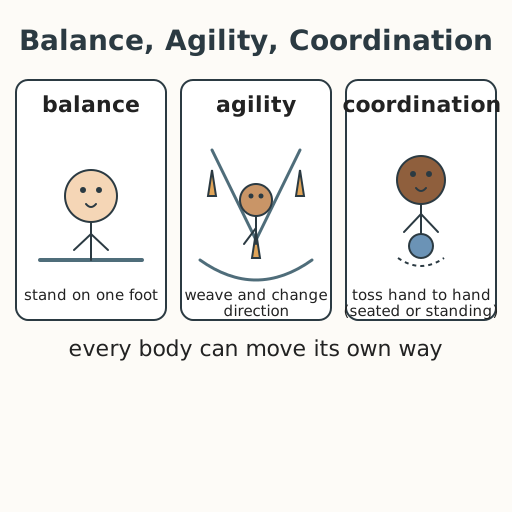
- Meet the three skills (10 min). Watch each one modeled. Balance — stay steady on a line or one foot (or seated, arms out like wings). Agility — change direction quickly, weaving around marks (or wheeling/sliding around them). ** Coordination** — toss a soft object from hand to hand, or toss and catch (standing or seated).
- Visit the stations (20 min). Rotate through all three stations. At each one, try the version that fits your body — standing, seated, or with support. Do each skill slowly at first, then a little faster.
- Build a routine (10 min). Put the three skills together in a short routine: a balance, an agility weave, a coordination toss. Practice it twice.
- Show and celebrate (10 min). Show your routine to a partner or the group. Watch your friends and cheer every version — standing, seated, or with wheels. Say it together: “every body can move, and every body belongs.”
Differentiation
- Support: Try one station at a time with a partner’s hand or a wall for support; accept a two-skill routine instead of three.
- Extension: Ask learners to link the three skills into a longer, smoother routine and add a fourth skill of their own.
Assessment
- Formative (performance/observation/self): Can the learner perform balance, agility, and coordination each in a version that fits their body, and combine them into a short routine?
Resources
- World Health Organization — physical activity fact sheet: https://www.who.int/news-room/fact-sheets/detail/physical-activity
- Nemours KidsHealth — how muscles move the body and why using them matters: https://kidshealth.org/en/kids/muscles.html
Home connection
Teach your balance-agility-coordination routine to someone at home, and try each skill both standing and seated together. Which version felt best for each of you?