Lesson 09 — Playing Fair, All Together
Learners practice fair play as a set of doable acts — taking turns, being honest, encouraging others, and losing or winning with grace. They sort scenes as fair or unfair, play the cooperative game again with fair play in mind, and make one fair-play rule of their own.
Objectives
Objectives
- D03.S2.04.01 Learn and follow the rules of simple cooperative games and sports while playing fairly.
Essential question
What does playing fairly look like, and how do I do it even when it is hard?
Key vocabulary
Materials
Standard materials
- Fair-play scenario cards · 1 set Short scenes — taking a turn, losing a point, cheering a teammate, admitting a mistake — to sort as fair or unfair
- A simple cooperative game card · 1 set Reuse the game and rules from Lesson 8
- A soft ball or rolled cloth · 1 per group The game object
Low-tech / no-cost
- Your voices and bodies Act out fair and unfair scenes with words and gestures; no cards or object needed
- Paper and pencil Draw one "fair play" rule to remember
Enriched / lab & device
- A fair-play poster kit · 1 per group Paper, markers, and a poster frame to make a class fair-play charter to display
- A short video of sportsmanship · 1 A clip of players helping a rival up or cheering a teammate, to discuss grace in sport
Works in different contexts
- large-group Hold up each scenario card for the whole group, thumbs-up for fair and thumbs-down for unfair, then play the game in small groups
- self-directed A learner sorts scenario cards alone, writes one fair-play rule, and checks it against a friend's
- outdoor-only Act out fair and unfair scenes in an open space, then play the passing game with the fair rules agreed
- multi-age Older learners read the scenarios and younger learners act them out, then they play together and practice encouraging words
Lesson 9 — Playing Fair, All Together
Summary
Learners practice fair play as a set of doable acts — taking turns, being honest, encouraging others, and winning or losing with grace. They sort scenes as fair or unfair, play the cooperative game again with fair play in mind, and make one fair-play rule of their own.
Objectives
- Learn and follow the rules of simple cooperative games and sports while playing fairly. (D03.S2.04.01)
Connection
Fair play is not just following the rules with your head; it is playing with a fair heart. It is letting someone else have a turn, telling the truth when you touched the line, cheering a teammate who is trying hard, and shaking hands whether your side won or lost. Everywhere people play — a football pitch in Lagos, a chessboard in a Moscow café, a skipping game on a Hanoi street — the game means more when it is played fairly.
Materials
- Fair-play scenario cards
- A simple cooperative game card (reused from Lesson 8)
- A soft ball or rolled cloth
Preparation
- Print or write the fair-play scenario cards (fair and unfair scenes).
- Reuse the game and rules from Lesson 8, and clear the play space.
- Prepare a way to gather for sorting (thumbs-up / thumbs-down).
Facilitator note
This lesson is written to the learner (“you”). Fair play is a skill and a value — teach it explicitly with worked examples (model each fair act), then let learners practice in the game. Keep it non-judging: an “unfair” scene is about the act, never the child, and a learner who has not yet got it revisits and tries again — “not yet” is information. Watch for the learner who always lets others go first but never gets a turn themselves; fair play includes taking your own turn too. Celebrate every honest admission and every encouraging word out loud. This lesson deepens Lesson 8’s rules with the heart of fairness, and leads into the final lesson on movement skills.
Procedure
- Gather (5 min). Yesterday you learned the rules of a game. Today you learn the heart of a game: fair play. What does “playing fair” look like to you?
- Sort the scenes (10 min). Look at each scenario card and decide: is it fair or unfair? Thumbs-up for fair, thumbs-down for unfair. Talk about why. Scenes might be: taking your turn, cutting in line, admitting you touched the line, cheering a teammate, gloating after a win.
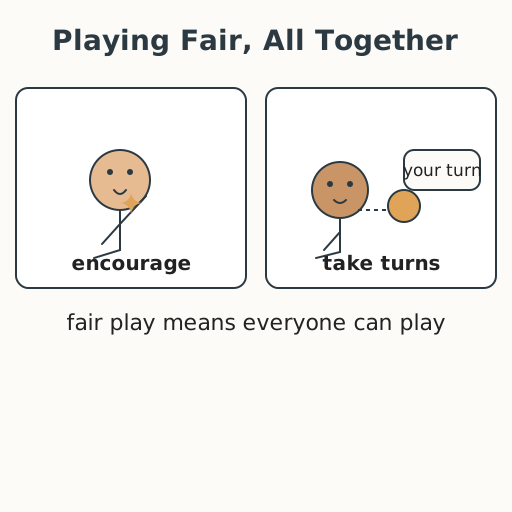
- Learn the fair-play acts (10 min). Say the four acts of fair play: take turns, be honest, encourage, be gracious — whether you win or lose. Watch each one modeled.
- Play with fair play (15 min). Play the cooperative game again from Lesson 8. This time, notice your own fair-play acts. Take your turn, tell the truth, cheer a teammate, and be gracious at the end.
- Make your rule (10 min). Write or draw one fair-play rule of your own — something you will remember the next time you play. Share it with a partner.
- Close (5 min). Say it together: “I play fair, so everyone can play.” How did it feel to play fairly — and to be encouraged?
Differentiation
- Support: Sort two scenes at a time, and model one fair-play act for the learner to copy during the game.
- Extension: Ask learners to write a short “fair-play charter” of three rules for the class to keep.
Assessment
- Formative (observation/self/peer): Can the learner name and practice the acts of fair play — turn, honesty, encouragement, grace — during the game?
Resources
- SHAPE America — appropriate practices in movement and cooperative play: https://www.shapeamerica.org/
- World Health Organization — physical activity fact sheet: https://www.who.int/news-room/fact-sheets/detail/physical-activity
Home connection
Next time you play with family or friends, name one fair-play act you did — a turn you took, a truth you told, or a kind word you gave. Tell someone at home about it.