Lesson 01 — Listen and Say It Back
Learners meet active listening: hearing a partner, then paraphrasing — saying back in their own words — before responding. They practice a three-step "listen, say it back, check" loop in pairs.
Objectives
Objectives
- D02.S1.04.01 Practice active listening by paraphrasing what a partner said before responding.
Essential question
How do I show someone I really heard them?
Key vocabulary
Materials
Standard materials
- Paraphrase starters chart · 1 Sentence starters — "So what I hear you saying is…", "It sounds like you…", "Let me check — did you mean…?"
- Pair talk cards · 1 set Small friendly topics a partner shares for 20–30 seconds — "my favorite place," "what I like to do after school," "a time I felt proud"
Low-tech / no-cost
- Voices and bodies Say back what a partner said aloud; no chart or cards needed — the starters can be spoken from memory
- A found "talking object" A stone, seed pod, or stick held by the speaker to show whose turn it is
Enriched / lab & device
- A laminated paraphrase starters chart · 1 per pair A durable copy of the starters for repeated practice
- A voice recorder · 1 per pair Record a talk, then listen back to check whether the paraphrase matched what was said
Works in different contexts
- large-group Model the paraphrase loop in front of everyone, then split into pairs; circulate and spot-check one paraphrase per pair
- self-directed A learner writes or records a short statement, then writes their own paraphrase of it, checking it against the starters
- outdoor-only Sit facing a partner in the open air and practice the loop with a found talking object; the speaker's voice carries the turn
- multi-age Older learners model a full paraphrase; younger learners repeat the first words — "So you're saying…" — and add one thing they heard
- level-grouped Group by comfort with speaking, not age; every group practices the same three starters, and confident speakers model first
Lesson 1 — Listen and Say It Back
Summary
Learners meet active listening: not just waiting for a turn to speak, but really hearing a partner and then paraphrasing — saying back in their own words — before they respond. They practice a three-step loop: listen, say it back, check.
Objectives
- Practice active listening by paraphrasing what a partner said before responding. (D02.S1.04.01)
Connection
Think of a friend telling you about something that happened to them. If you only wait for your turn to talk, you miss half of what they said. But if you listen and then say, “So what you’re saying is you were left out of the game” — you show them you heard, and you give them a chance to fix it if you got it wrong. A fisher checking the net, a cook tasting the soup, a friend saying a worry back to you — everywhere, people check that they understood. That is active listening, and it is how trust is built between people.
Materials
- A paraphrase starters chart
- Pair talk cards
- A soft talking object (optional)
Preparation
- Post the paraphrase starters where everyone can see them.
- Prepare small, friendly pair talk cards (one topic per card).
- Arrange the room or outdoor space for partner work.
Facilitator note
Active listening is a skill, so teach it with explicit instruction and a worked example before learners try it alone (Kirschner, Sweller & Clark, 2006). The one idea to protect: paraphrasing is not repeating word-for-word — it is saying the idea back in your own words and then checking. Model the difference clearly, and model the “check” (“Did I get it right?”) as a genuine question, not a test. CASEL places listening inside relationship skills. Honor every way of listening and speaking: a learner who signs, points to a starter, or writes a paraphrase is doing active listening fully, and their turn is treated the same as any other. This is an egalitarian moment — the quiet voice and the loud voice each get a turn, and no one is skipped. Keep topics friendly and small so no learner’s life is put on display. Read the procedure aloud and model each starter with voice and body.
Procedure
- Gather (5 min). Last year you learned to take turns and build on what a classmate said. Today you go deeper: it is one thing to wait for your turn — it is another to really hear the person. What does it feel like when someone truly listens to you?
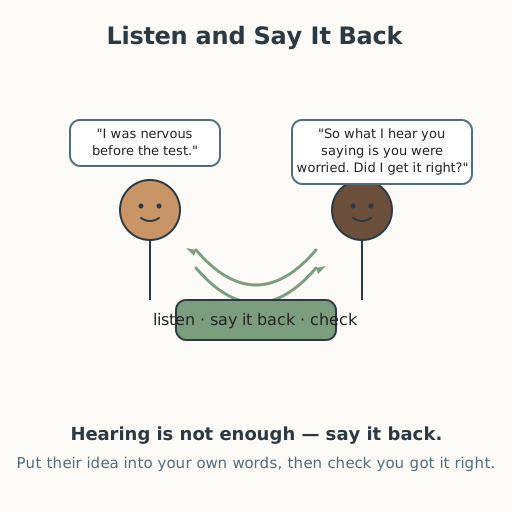
- Meet the loop (10 min). Learn the three steps of active listening: one, listen — look at the speaker and keep your own reply waiting; two, say it back — put their idea into your own words using a starter: “So what I hear you saying is…”; three, check — ask, “Did I get it right?” Watch a worked example: a volunteer shares one sentence; the facilitator says it back in different words and checks. Notice it is not copying — it is understanding.
- Say it back, not copy (10 min). With a partner, try the difference. Your partner says, “I was nervous before the test.” First, copy it word-for-word (that is not paraphrasing). Then say it in your own words: “It sounds like you were worried about the test.” Check: “Did I get it right?”
- Partner loop (15 min). Use a pair talk card. One of you shares for about half a minute. The other listens, says it back, and checks — then you switch roles. Take turns so each of you paraphrases at least twice.
- Close (5 min). Remember: active listening is listen, say it back, check. It tells the speaker, “I hear you,” and it gives you a chance to be corrected kindly. This is a skill you will use your whole life.
Differentiation
- Support: Offer the single starter “So what I hear you saying is…” and a very short topic; a non-speaking learner points to the starter and signs or writes their paraphrase.
- Extension: Paraphrase and add one follow-up question (“So you were nervous before the test — what helped you feel better?”).
Assessment
- Formative (observation): Does the learner paraphrase the partner’s idea in their own words and then check, rather than repeating word-for-word or skipping to their own reply?
- Peer (check): In the loop, did the listener’s paraphrase match what the speaker meant — and did the speaker get to correct it?
Home connection
The next time someone at home tells you about their day, listen and say it back in your own words, then check: “Did I get it right?”
Resources
- CASEL SEL Framework (relationship skills competency): https://casel.org/fundamentals-of-sel/