Lesson 02 — Negotiating a Fair Fix
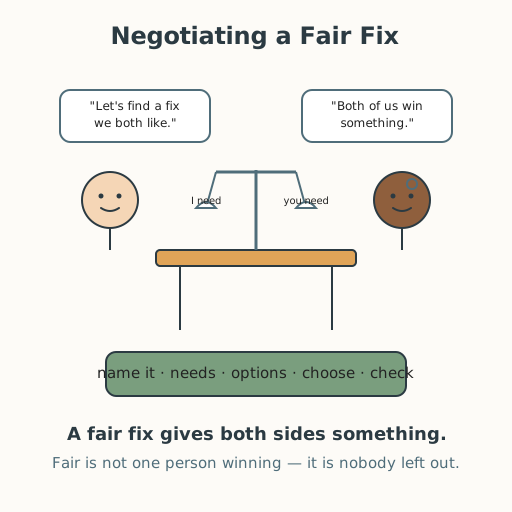
Learners learn to negotiate a fair solution to a disagreement with a peer, with minimal adult help, using five steps: name the problem, say what each side needs, think of options, choose one both can live with, and check that it feels fair.
Objectives
Objectives
- D02.S1.04.02 Negotiate a fair solution to a disagreement with a peer, with minimal adult help.
Essential question
How do two people solve a disagreement fairly, with almost no adult help?
Key vocabulary
Materials
Standard materials
- Fair-fix steps chart · 1 Five steps — name the problem, say what each needs, think of options, choose one both can live with, check it feels fair
- Disagreement scenario cards · 1 set Small, friendly disagreements — two people want the same book, both want the last swing, a game rule is disputed
Low-tech / no-cost
- Voices and bodies Role-play the steps aloud with no chart or cards; the five steps can be spoken from memory
- Found "option stones" Lay out one stone per possible solution to make the choices visible
Enriched / lab & device
- A laminated fair-fix steps chart · 1 per pair A durable copy for repeated negotiation practice
- A "solutions" whiteboard or slate · 1 per pair To write and erase the options while the pair chooses together
Works in different contexts
- large-group Model one full negotiation in front of everyone, then let pairs work; call the room back to share one fair fix each
- self-directed A learner reads a scenario, writes what each side needs and two possible options, and chooses the fairer one with a reason
- outdoor-only Use real found objects (stones for options) laid on the ground to make each possible fix visible before choosing
- multi-age Older learners act as "reminders" who only ask "What does each side need?" while younger learners propose the options
- level-grouped Group by comfort with speaking; every pair works the same five steps, and confident speakers model the "say what you need" turn
Lesson 2 — Negotiating a Fair Fix
Summary
Learners learn to negotiate a fair solution to a disagreement with a peer, with almost no adult help, using five steps: name the problem, say what each side needs, think of options, choose one both can live with, check that it feels fair. The goal is not that one person wins — it is that both people get something they need.
Objectives
- Negotiate a fair solution to a disagreement with a peer, with minimal adult help. (D02.S1.04.02)
Connection
Two children both want the same book; two neighbors both want to use the one shared hose; two friends want to play different games. In every one of these, a fair fix is possible — and it almost never means one person gives up and the other takes it all. In a market stall, two traders who both want the same load of fruit might split it; in a game, two teams might agree to alternate. Everywhere people live together, they work out solutions both sides can live with. That is negotiating — and you can do it without an adult stepping in.
Materials
- A fair-fix steps chart
- Disagreement scenario cards
- Option stones or slips (optional)
Preparation
- Post the fair-fix steps chart where everyone can see it.
- Prepare small, friendly disagreement scenario cards.
- Arrange the room for pair work.
Facilitator note
This builds directly on Grade 3’s “I” statements and on Lesson 1’s active listening — so begin by having learners recall those, then add the new piece: turning needs into options and choosing one both can live with. Teach the five steps as explicit, worked instruction (Kirschner, Sweller & Clark, 2006), and model one full negotiation aloud. Protect the core idea: fair does not mean both sides give up everything; it means both sides get something they need, and nobody is left out. Watch for the learner who “wins” by making the other give up — name that as not yet fair and invite another option, never as a verdict on the learner. Honor every way of contributing — sign, gesture, picture card, written word — all count as a full voice at the table. This is the egalitarian heart of the unit: negotiation is how power is shared fairly between people. A learner who cannot yet do all five steps alone may still carry two or three; that is progress, and the adult (or a peer) supplies only the missing piece.
Procedure
- Gather (5 min). Remember Lesson 1: listen, say it back, check. And remember Grade 3’s “I” statements. Today you add the next skill: when you disagree, you can negotiate a fair fix together.
- Meet the five steps (10 min). Learn them: one, name the problem (“We both want the same book”); two, say what you need (“I need it for my homework”; “I need it to finish my story”); three, think of options (“share it now, one uses it first then the other, ask for a second copy”); four, choose one both can live with; five, check it feels fair (“Do we both feel okay about this?”).
- Watch a worked example (10 min). Two volunteers (or the facilitator and a learner) model the five steps with a real scenario. Notice how each side says their need with an “I” statement, and how the chosen option gives both something.
- Try it (15 min). In pairs, draw a scenario card. Work the five steps together — no adult needed unless you are truly stuck, and even then, ask only for a nudge, not an answer. Try two scenarios if you finish one.
- Close (5 min). A fair fix is not one person winning — it is both people getting something they need and leaving as friends. You can do this with almost no adult help.
Differentiation
- Support: Offer the two starter sentences (“I need…”, “What if we…”) and one scenario with only two obvious options; a non-speaking learner signs or points to picture options.
- Extension: Negotiate a fix where a third friend is involved, or where the “fair” choice must also be fair to the whole class.
Assessment
- Formative (observation): Does the learner state their need with an “I” statement, propose at least one option, and help choose a solution both sides can accept?
- Peer (check): After the pair chooses, ask each partner: “Does this feel fair to you? Why or why not?”
Home connection
The next time you and a sibling or friend disagree about something shared, try the five steps before an adult steps in — and tell them what fair fix you found.
Resources
- CASEL SEL Framework (relationship skills and responsible decision-making): https://casel.org/fundamentals-of-sel/