Lesson 03 — Clues to Feelings
Learners become clue detectives: they explain *why* a person might feel the way they do by gathering clues — what happened, the face and body, and the voice and words — and turning them into a "they might feel… because…" sentence.
Objectives
Objectives
- D02.S2.04.01 Explain why a person might feel the way they do, using clues about what happened.
Essential question
How do I figure out why a person feels the way they do?
Key vocabulary
Materials
Standard materials
- Clue detective chart · 1 Three clue kinds — what happened, face and body, voice and words — leading to "so they might feel… because…"
- Feeling-scenario cards · 1 set Short scenes with an event and a person's reaction — "The team lost the final", "She found her lost cat", "He wasn't invited"
Low-tech / no-cost
- Voices and bodies Act out the scene and read the clues aloud; no chart or cards needed
- A found "clue trail" Lay out three stones for the three clue kinds, then a fourth for the feeling
Enriched / lab & device
- A laminated clue detective chart · 1 per pair A durable copy for repeated clue-reading practice
- A short film clip or picture set · 1 set A short scene or three pictures to read for feeling clues and discuss
Works in different contexts
- large-group Read one scenario aloud and collect clues from the whole group on a shared board before pairs work their own
- self-directed A learner reads a scenario, lists the clues, and writes or records a "they might feel… because…" sentence
- outdoor-only Use the clue trail of stones on the ground — step from "what happened" to "face and body" to "voice" and land on the feeling
- multi-age Older learners name the feeling and the "because"; younger learners point to the clue kind (what happened, face, body)
- level-grouped Group by comfort with explaining; every group reads the same three clue kinds, and confident speakers model the full sentence
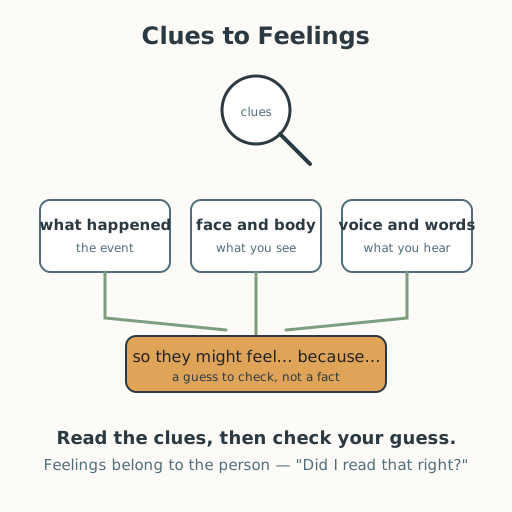
Lesson 3 — Clues to Feelings
Summary
Learners become clue detectives. They explain why a person might feel the way they do by gathering three kinds of clues — what happened, the face and body, and the voice and words — and turning them into a single sentence: “They might feel…, because…”.
Objectives
- Explain why a person might feel the way they do, using clues about what happened. (D02.S2.04.01)
Connection
A friend walks in and slams the door. You do not know yet why they are upset — but you can read the clues: the slammed door (what happened), the tight jaw and crossed arms (face and body), the short, sharp words (voice). Put them together and you can guess: “They might feel angry because something just went wrong.” A farmer reads the sky and the wind to guess the weather; you read faces, bodies, and events to guess feelings. The clues are never a guarantee — feelings are private — so you always leave room to be wrong. That is why you check with the person, like you learned in Lesson 1.
Materials
- A clue detective chart
- Feeling-scenario cards
- Paper and pencils (optional)
Preparation
- Post the clue detective chart where everyone can see it.
- Prepare feeling-scenario cards with an event and a reaction.
- Arrange the room for pair work.
Facilitator note
This deepens Grade 3’s “guess how a classmate feels by reading face, voice, or body” — here the new piece is explaining the why with a “because” that ties the feeling to what happened. Teach it as explicit, worked instruction: model reading one scenario, naming each clue kind, then speaking the full “they might feel… because…” sentence (Kirschner, Sweller & Clark, 2006). Guard the honest limit: clues let us guess, not know — feelings belong to the person, and our first guess can be wrong. Always pair the guess with a check (“Did I read that right?”), which loops back to Lesson 1’s active listening and Lesson 2’s “check it feels fair.” Honor every culture’s ways of showing feeling — some faces are quieter, some voices louder, and no one way is the “right” one. Read the procedure aloud and model with voice and body.
Procedure
- Gather (5 min). Remember Lessons 1 and 2: you listen and say it back, and you negotiate fair fixes. Today you add a detective’s skill: reading the clues that tell you why someone feels the way they do.
- Meet the three clues (10 min). Learn the clue kinds: what happened (the event), face and body (what you see), and voice and words (what you hear). Watch a worked example: “The team lost the final.” Clues: the score (what happened), heads down and slow steps (face and body), quiet mumbling (voice). So: “They might feel disappointed because the team lost the game they practiced so hard for.”
- Read clues together (10 min). With a partner, take a scenario card. Find one clue of each kind, then say the sentence together: “They might feel…, because…”. Take turns.
- Add the check (15 min). For each scenario, after you guess, add the honest check: “Did I read that right?” — because a guess about feelings is a question, not a fact. Try two or three scenarios.
- Close (5 min). You can now explain why someone might feel the way they do — and you know that your guess is a kind guess to check, never a verdict on them.
Differentiation
- Support: Offer a three-box frame (what happened / face and body / voice and words) and a sentence starter “They might feel… because…”; a non-speaking learner points to clue cards.
- Extension: Read a scenario where the same event makes two people feel different things, and explain why.
Assessment
- Formative (observation): Does the learner name a feeling and give a “because” that connects it to what happened (the event), not just to a face?
- Peer (check): Did the partner’s guess use at least one clue of each kind, and did they check it rather than state it as fact?
Home connection
Next time someone at home seems happy or upset, quietly gather the clues — what happened, their face and body, their voice — and try a kind “You might feel… because…?” Then check.
Resources
- CASEL SEL Framework (social awareness competency): https://casel.org/fundamentals-of-sel/