Lesson 05 — My Role in My Community
Learners identify a real need in their class or neighborhood, match it to a role they can play using their own strengths, and plan the steps to carry it out — then carry it out and record it.
Objectives
Objectives
- D02.S3.04.01 Identify a role they can play in their class or neighborhood community and carry it out.
Essential question
What role can I play in my class or neighborhood — and how do I carry it out?
Key vocabulary
Materials
Standard materials
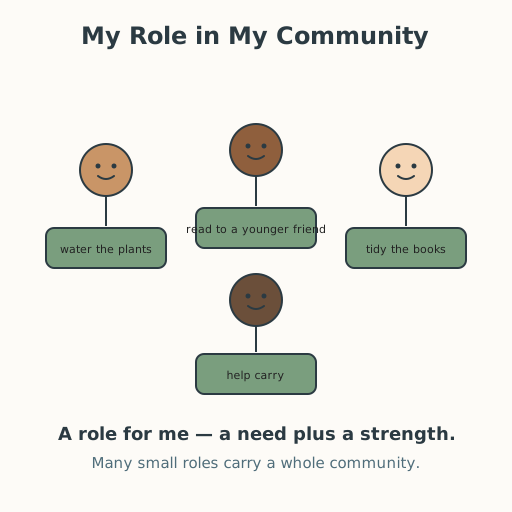
- Community roles chart · 1 Columns — "what our community needs" and "a role I can play" — with example roles such as water the plants, read to a younger friend, tidy the books, help carry
- My role card · 1 per learner A card to name one role, what it helps, and the steps to carry it out
Low-tech / no-cost
- A walk around the room or neighborhood Look for real needs (a mess, a dry plant, a newcomer) and name a role that answers each
- Voices and bodies Name the role and act out doing it; no card or chart needed
Enriched / lab & device
- A class "role board" · 1 A board where each learner posts their chosen role and marks when they carry it out across the week
- A camera or tablet · 1 per group Photograph each learner carrying out their role to record the week's care
Works in different contexts
- large-group Brainstorm needs on a shared board, then each learner chooses one role and records it; follow up with a role-check later in the week
- self-directed A learner lists three needs they see, picks one, and writes their own role card with steps to carry it out
- outdoor-only Walk the school grounds or neighborhood, spot a need (litter, a dry plant, a heavy load), and name the role that answers it
- multi-age Older learners help younger ones match a strength to a need; every learner carries out a role at their own level
- level-grouped Group by comfort with planning; every learner names one role and its steps, and confident planners model the card first
Lesson 5 — My Role in My Community
Summary
Learners identify a real need in their class or neighborhood community, match it to a role they can play using their own strengths, plan the steps to carry it out, and then actually carry it out — recording what they did as a portfolio artifact.
Objectives
- Identify a role they can play in their class or neighborhood community and carry it out. (D02.S3.04.01)
Connection
Every community runs because many people carry small roles: someone waters the plants, someone tidies the shared shelf, someone reads to a younger child, someone helps carry a heavy bag up the stairs. In a fishing village someone mends the nets; in an apartment building someone watches the door. No role is too small to matter, and every role needs a person. Today you find your role — the one that fits your strengths — and you carry it out, not because an adult told you to, but because you are part of the whole.
Materials
- A community roles chart
- A “my role” card for each learner
- Paper and pencils
Preparation
- Post the community roles chart.
- Copy a “my role” card for each learner.
- Plan a short walk of the classroom or neighborhood to spot real needs.
Facilitator note
This turns outward toward action, building on Grade 3’s “contributing fairly to a group goal.” Teach the match as explicit instruction — a role = a need + a strength — and model choosing one (Kirschner, Sweller & Clark, 2006). The core value to protect: roles are chosen by the learner from their own strengths, never assigned as a ranking, and no role is more important than another — the one who tidies and the one who reads aloud both hold the community up equally. This is egalitarianism lived: care is distributed, and everyone has something to give. Honor every ability: a learner who cannot lift carries a lighter but no less vital role; a learner who does not speak aloud can write, draw, or sign their role. Follow through matters — this lesson’s role is meant to be carried out, so plan a role-check later in the week and record it for the portfolio. Read the procedure aloud.
Procedure
- Gather (5 min). You have been listening, negotiating, and reading feelings. Now you turn your care into action: today you find a role you can play in your class or neighborhood — and you do it.
- Spot the needs (10 min). Walk the room or neighborhood and look for real needs. Is there a mess that needs tidying? A plant that needs water? A younger child who wants a story? A heavy bag that needs carrying? List what you see.
- Match a role to a strength (10 min). A role is a need plus a strength. Think: what can you do well? Match it to a need: if you are patient, you might read to a younger friend; if you are strong, you might help carry; if you are careful, you might tidy the books. Fill your “my role” card: name the role, what it helps, and the steps you will take.
- Carry it out (15 min). Do it — right now if you can, or plan the exact time this week. Record what you did and how it helped. This is your portfolio piece.
- Close (5 min). A community is not built by big heroes — it is built by many people carrying small, chosen roles. You found yours today. Carry it out, and watch the whole get stronger.
Differentiation
- Support: Offer a picture menu of possible roles and a two-step card (“first…, then…”); a non-speaking learner points to a role picture and shows the steps.
- Extension: Take on a role that helps more than one person, and check back after a week to see the difference it made.
Assessment
- Formative (observation): Did the learner match a role to a real need and their own strength, and did they carry it out (or plan concrete steps to)?
- Artifact (portfolio): The “my role” card with a record of the role carried out.
Home connection
Look around your home or street for one need you can answer with a strength of yours — and do it this week, then tell someone what you chose and why.
Resources
- CASEL SEL Framework (relationship skills and responsible decision-making): https://casel.org/fundamentals-of-sel/