Lesson 06 — Welcoming Newcomers
Learners describe how communities welcome newcomers — greeting by name, showing them around, inviting them to play, learning their words — and explain why belonging matters: people who feel they belong can learn, help, and be themselves.
Objectives
Objectives
- D02.S3.04.02 Describe how communities welcome newcomers and why belonging matters.
Essential question
How do communities welcome newcomers — and why does belonging matter?
Key vocabulary
Materials
Standard materials
- Welcome-ways chart · 1 Ways to welcome — greet by name, show them around, invite them to play, learn their words, share food or a seat
- Newcomer scenario cards · 1 set A new student, a new neighbor, a family new to the place — each with one thing the newcomer might need
Low-tech / no-cost
- Voices and bodies Act out a welcome — a greeting, a wave, an invitation — with no chart or cards needed
- A welcome circle Stand in a circle and practice making a space for a newcomer in the ring
Enriched / lab & device
- A world greetings poster · 1 How people greet in several languages and cultures — a bow, a handshake, a wave, "hello" in many words
- A class "welcome book" · 1 A book where learners write or draw one page each about how they would welcome a newcomer
Works in different contexts
- large-group Build one big "welcome plan" together for a newcomer to the school, then each learner adds one page to the class welcome book
- self-directed A learner writes three ways to welcome a newcomer and why each helps them belong
- outdoor-only Practice making literal space in a circle for a newcomer, then name the ways people welcome new members outdoors
- multi-age Older learners teach younger ones a greeting in another language; every learner practices greeting a newcomer by name
- level-grouped Group by comfort with speaking; every group lists welcome ways and reasons, and confident speakers model the "why belonging matters" sentence
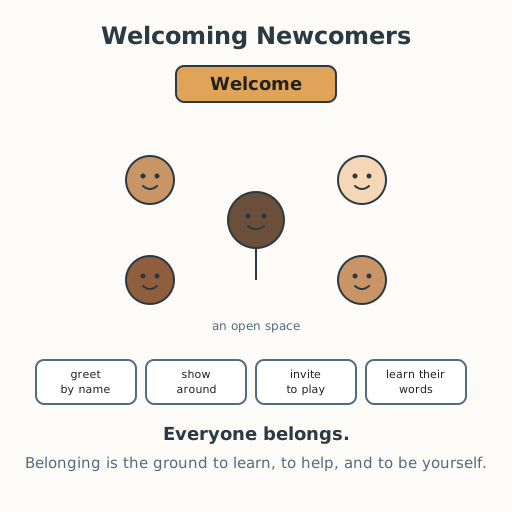
Lesson 6 — Welcoming Newcomers
Summary
Learners describe how communities welcome newcomers — greeting by name, showing them around, inviting them to play, learning their words — and explain why belonging matters: people who feel they belong can learn, help, and be themselves.
Objectives
- Describe how communities welcome newcomers and why belonging matters. (D02.S3.04.02)
Connection
Think of the first day in a new place — a new school, a new street, a new town. You do not yet know the rules, the faces, or where anything is. Then someone says your name, shows you where to sit, and invites you to join. In that moment you stop being a stranger and start to belong. Every culture on Earth has welcome customs: a shared meal, a bow, a handshake, a cup of tea, a word in your own language. Belonging is not a small thing — it is the ground a person stands on to learn, to help, and to be fully themselves.
Materials
- A welcome-ways chart
- Newcomer scenario cards
- Paper and pencils
Preparation
- Post the welcome-ways chart.
- Prepare newcomer scenario cards (a new student, a new neighbor, a new family).
- Arrange a welcome circle for the closing.
Facilitator note
This deepens Grade 3’s “compare my community with one far away” and Grade 2’s “what makes a group feel welcoming.” The two ideas to land: welcome is something you do (specific, learnable acts), and belonging matters because it lets people learn, help, and be themselves — not because it feels merely pleasant. Teach the welcome ways as explicit instruction and model each with a greeting (Kirschner, Sweller & Clark, 2006). Hold the global lens: welcome customs differ across cultures, and none is the “right” one — honor them side by side. Hold the egalitarian lens: a community that welcomes everyone is stronger for everyone; the newcomer is not a “guest to be tolerated” but a full member with something to give. Notice the technology lens lightly: a newcomer might connect online before arriving, and a kind message can be a first welcome — but a screen cannot replace the seat offered or the name spoken. Keep this lesson warm and concrete, never a lecture; the welcome circle is the heart of it.
Procedure
- Gather (5 min). Remember Lesson 5: a community is built of many small roles. Today you learn the first role every community shares — welcoming the newcomer. Have you ever been the new one? What did it feel like?
- Meet the welcome ways (10 min). Learn the acts of welcome: greet by name, show them around, invite them to play, learn their words, share a seat or a meal. Watch a worked example: a new student arrives. You say, “Hi, I’m Amara — what should I call you?” Then you show them the water fountain and invite them to sit with you.
- Welcome the newcomer (10 min). In pairs, take a scenario card — a new student, a new neighbor, a new family. Choose two or three welcome ways and act them out, each taking a turn as the newcomer and as the welcomer.
- Why belonging matters (15 min). Now answer the big question: why does belonging matter? Because a person who belongs can learn (they know the rules), help (they join the roles), and be themselves (they are not hiding). Write or draw one reason, and share it in the circle.
- Close (5 min). Everyone was once the newcomer, somewhere. When you welcome a newcomer — with a name, a seat, an invitation — you give them the ground to stand on. That is how communities are built, one welcome at a time.
Differentiation
- Support: Offer a two-picture choice (“greet by name” or “show around”) and a sentence starter “They belong because…”; a non-speaking learner points to welcome-way cards.
- Extension: Write a full “welcome plan” for a newcomer that includes a greeting in their language and one thing the community could learn from them.
Assessment
- Formative (observation): Can the learner name at least two ways to welcome a newcomer and give one reason belonging matters (to learn, help, or be oneself)?
- Peer (check): In the role-play, did the newcomer get welcomed by name, and did both partners get a turn as welcomer and newcomer?
Home connection
If a new person moves onto your street or into your building, greet them by name, show them one useful thing, and invite them into something — then notice how the welcome changes the day.
Resources
- CASEL SEL Framework (social awareness and relationship skills): https://casel.org/fundamentals-of-sel/