Lesson 09 — Listen and Fair Fix, Rehearsal
Learners rehearse the unit's two interpersonal skills together — active listening and fair negotiation — by role-playing a disagreement, paraphrasing before responding, and then negotiating a solution both sides can live with.
Objectives
Objectives
- D02.S1.04.01 Practice active listening by paraphrasing what a partner said before responding.
- D02.S1.04.02 Negotiate a fair solution to a disagreement with a peer, with minimal adult help.
Essential question
How do listening and negotiating work together to solve a disagreement fairly?
Key vocabulary
Materials
Standard materials
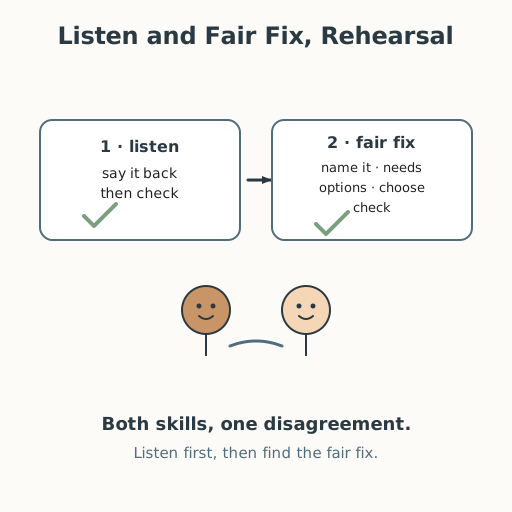
- Combined-skills poster · 1 The two skills together — "listen (say it back, check)" then "fair fix (name it, needs, options, choose, check)"
- Role-play scenario cards · 1 set Real, friendly disagreements with two clear sides — the last swing, the shared crayons, whose turn to feed the class pet
Low-tech / no-cost
- Voices and bodies Act the whole loop — listen, say back, negotiate — aloud with no poster or cards
- A found "stage" A mat, a blanket, or a clear patch of ground marks the role-play space
Enriched / lab & device
- A laminated combined-skills poster · 1 per pair A durable reference for both skills while rehearsing
- A voice recorder · 1 per pair Record the rehearsal and listen back to check both skills were used
Works in different contexts
- large-group Run two rehearsals in front of everyone, then let pairs work their own; debrief one pair's fair fix aloud
- self-directed A learner writes a two-part script — first a paraphrase, then a fair fix — for a scenario, and reads it back
- outdoor-only Use a clear patch of ground as the "stage" and act the whole loop in the open air with found props
- multi-age Older learners play the "checker" who asks "Did you say it back? Is the fix fair to both?" while younger learners act the roles
- level-grouped Group by comfort with role-play; every pair runs the same two-skill loop, and confident pairs model first
Lesson 9 — Listen and Fair Fix, Rehearsal
Summary
Learners rehearse the unit’s two interpersonal skills together: active listening (say it back, check) and fair negotiation (name it, needs, options, choose, check). They role-play a disagreement, paraphrase before responding, and then negotiate a solution both sides can live with.
Objectives
- Practice active listening by paraphrasing what a partner said before responding. (D02.S1.04.01)
- Negotiate a fair solution to a disagreement with a peer, with minimal adult help. (D02.S1.04.02)
Connection
Real disagreements do not wait to be solved one skill at a time. You listen and you negotiate, in one flow: first you say back what the other person needs so they know they are heard; then you find a fix that gives both of you something. It is like two steps of one dance — listen, then fix. A fisher listens to the water and then casts; a friend hears you out and then helps you find a way. Today you rehearse the whole dance, slowly, until it feels natural.
Materials
- A combined-skills poster
- Role-play scenario cards
- A voice recorder (optional)
Preparation
- Post the combined-skills poster: “listen (say it back, check)” then “fair fix (name it, needs, options, choose, check)”.
- Prepare friendly role-play scenario cards with two clear sides.
- Arrange a “stage” space for role-plays.
Facilitator note
This rehearsal combines and retrieves Lessons 1 and 2 — the heart of the unit’s
interpersonal work. The evidence-based move here is spaced practice with feedback:
rather than teaching anything new, learners retrieve and use both skills together, and
get a peer-check on whether they used them (see docs/contexts.md on retrieval and
feedback). Run it as guided practice before any independent role-play (Kirschner, Sweller
& Clark, 2006). Protect the flow: listen first, then fix — a fair fix that skips the
paraphrase often misses what the other side actually needs. Watch for the learner who
jumps straight to “winning”; invite them back to “what did you hear them need?” Honor
every way of performing — sign, gesture, a written script, a puppet, a scribed line — all
are full rehearsals. This is egalitarian and ethical practice: both voices get heard, and
the fix must serve both. A learner who uses only one skill today is not yet at both —
name the one they did well, then invite the second. Read the procedure aloud.
Procedure
- Gather (5 min). You have practiced two skills: listen and say it back (Lesson
- and negotiate a fair fix (Lesson 2). Today you put them together, like two steps of one dance.
- Recall the two skills (10 min). Say them back without looking: listen — say it back in your own words, then check. Fair fix — name the problem, say what each side needs, think of options, choose one both can live with, check it feels fair. Watch a worked example: two volunteers run one whole flow for the class.
- Rehearse in pairs (20 min). Draw a role-play card. One of you starts with the problem. The other listens and says it back before responding. Then together you negotiate a fair fix using the five steps. Switch roles and try a second scenario. Your partner checks you: “Did you say it back? Is the fix fair to both?”
- Swap feedback (5 min). Tell your partner one thing they did well and one thing to try next time — kindly, like a coach, never like a judge.
- Close (5 min). Listen, then fix — the whole dance. You have both steps now, and you can do them together, with almost no adult help. That is a skill for life.
Differentiation
- Support: Offer the poster as a two-step script and a scenario with only two options; a non-speaking learner points to each step as their partner performs it.
- Extension: Add a third role — a “checker” who watches and then tells the pair whether both skills were used and whether the fix served both sides.
Assessment
- Formative (performance/observation): In the role-play, does the learner paraphrase before responding and then use the five fair-fix steps to reach a solution both sides accept?
- Peer (check): The partner (or checker) confirms: “They said it back” and “the fix was fair to both.”
Home connection
The next time a disagreement comes up at home, try the whole dance — listen and say it back, then find a fair fix — and tell someone which step was hardest for you.
Resources
- CASEL SEL Framework (relationship skills and responsible decision-making): https://casel.org/fundamentals-of-sel/