Lesson 08 — Sharing for the Common Good
Learners explain the difference between sharing for the common good — so everyone has enough — and taking more than one's share, which leaves someone out. They sort real scenarios and practice dividing resources fairly.
Objectives
Objectives
- D02.S4.04.02 Explain the difference between sharing for the common good and taking more than one's share.
Essential question
What is the difference between sharing for the common good and taking more than my share?
Key vocabulary
Materials
Standard materials
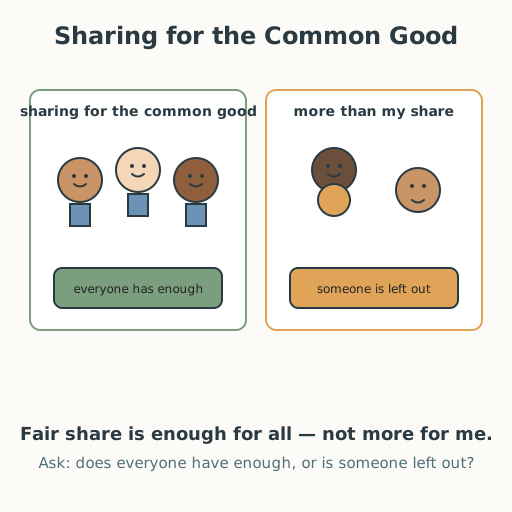
- Fair-share balance poster · 1 Two scenes side by side — cups shared so everyone has enough, and one person grabbing a big pile while someone is left with none
- Sharing scenario cards · 1 set Situations to sort — a bowl of fruit for the table, a tray of cups, a single swing, a box of crayons
Low-tech / no-cost
- Real found objects Divide stones, seeds, or sticks so everyone has enough — the "common good" made visible with real things
- Voices and bodies Act out "share for all" and "grab more than my share" and feel the difference in the room
Enriched / lab & device
- A class "fair share" tray and tokens · 1 set A tray of tokens learners divide fairly, trying different rules and noticing who is left out
- A short story or film · 1 A story where characters choose between the common good and taking more, for discussion
Works in different contexts
- large-group Divide one real tray of shared objects in front of everyone, then ask — did everyone get enough, or did someone take more?
- self-directed A learner sorts scenario cards into "common good" and "more than my share", writing a reason for each
- outdoor-only Divide found objects (stones, seeds) so each person has enough, then try it where one grabs more and notice who is left out
- multi-age Older learners explain the *why* — enough for all leaves no one out — while younger learners count and hand out the shares
- level-grouped Group by comfort with explaining; every group sorts the same scenarios, and confident speakers model the "common good" sentence
Lesson 8 — Sharing for the Common Good
Summary
Learners explain the difference between sharing for the common good — so everyone has enough — and taking more than one’s share, which leaves someone out. They sort real scenarios and practice dividing resources fairly.
Objectives
- Explain the difference between sharing for the common good and taking more than one’s share. (D02.S4.04.02)
Connection
A bowl of fruit sits on the table for the whole family. If one person takes the biggest pile, someone at the far end may get nothing. But if each person takes a fair share, the bowl serves everyone — and the table becomes a place where nobody is hungry and nobody is left out. In a village, sharing a catch of fish so every family eats is the common good; one boat taking it all is more than its share. Everywhere, the same choice appears: take for me, or share for us. Today you learn to see the difference — and to choose the common good.
Materials
- A fair-share balance poster
- Sharing scenario cards
- A tray of real objects to divide (optional)
Preparation
- Post the fair-share balance poster.
- Prepare sharing scenario cards.
- Set out a tray of small objects for a real fair-share trial.
Facilitator note
This is the unit’s fairness lesson, and it carries the deepest egalitarian weight: the difference between enough for all and some left with none. Teach the two ideas as explicit, contrasted instruction with the side-by-side poster (Kirschner, Sweller & Clark, 2006). Guard the moral clarity while keeping it non-shaming: “taking more than one’s share” names a choice, not a bad child — a learner who has grabbed more is invited to notice the person left out and re-divide, never to be humiliated. The common good is not “everyone gets exactly equal piles” — it is everyone has enough, which may mean a bigger person needs more food and a smaller one less, fairly. Let learners discover that fairness is not always identical shares but enough for each. Hold the global lens: sharing for the common good is how communities everywhere survive — a shared catch, a shared harvest, a shared well. A learner who struggles with the concept revisits it with concrete objects; “not yet” is information, never a verdict.
Procedure
- Gather (5 min). You have listened, negotiated, taken a role, and done an act of care. Today you learn the big idea underneath all of it: sharing for the common good.
- Meet the two choices (10 min). Look at the poster. Left: cups handed out so every child has one — the common good: everyone has enough. Right: one child grabs a big pile while another has none — more than my share: someone is left out. Say the two labels together.
- A real fair-share trial (10 min). With the tray of objects, try it twice. First, divide so everyone has enough — notice that shares may differ in size but nobody is empty. Second, let one person grab more — and feel what happens to the person left with nothing.
- Sort the scenarios (15 min). With a partner, take the scenario cards — a bowl of fruit, a tray of cups, one swing, a box of crayons. Sort each: is this common good or more than my share? Say why, using “everyone has enough” or “someone is left out.”
- Close (5 min). Sharing for the common good is a choice you can see: does everyone have enough, or did someone take more and leave another with none? You can choose the common good — at a table, on a playground, anywhere people share.
Differentiation
- Support: Use only real objects and the two labels (“everyone has enough” / “someone is left out”); a non-speaking learner points to the scene that matches.
- Extension: Divide a set of resources where “fair” means enough for each rather than equal piles, and explain why the two differ.
Assessment
- Formative (observation): Can the learner sort a scenario as common good or more than one’s share, and give the reason (“everyone has enough” or “someone is left out”)?
- Peer (check): In the fair-share trial, did the pair notice when someone was left out and re-divide so everyone had enough?
Home connection
At your next shared meal or game, notice: does everyone have enough, or did someone take more than their share? Try a fair re-divide and see how it changes the table.
Resources
- CASEL SEL Framework (social awareness and responsible decision-making): https://casel.org/fundamentals-of-sel/