Lesson 03 — A Controlled Experiment
Learners put the pieces together. They plan and run one controlled experiment — does a covered cup keep water warmer than an open one? — changing only one thing (the cover) and keeping the rest the same. They measure with a thermometer and units, repeat the test across three trials, compare the results, and write what the evidence shows. This is the full shape of an honest test: change one thing, keep the rest the same, measure, and repeat.
Objectives
Objectives
- D06.S1.04.01 Use simple tools (such as a ruler, scale, thermometer, or magnifier) to measure and record observations with units.
- D06.S1.04.02 Compare results across repeated trials and explain why repeating a test matters.
Essential question
How do measurement, fair-testing, and repeated trials come together in one trustworthy experiment?
Key vocabulary
Materials
Standard materials
- Two identical cups and a thermometer · 1 set For the class experiment — which keeps water warmer, a covered cup or an open one?
- Warm water and a kettle (facilitator only) · as needed Warm (not boiling) water for the two-cup test
- A timer or clock · 1 To measure time as the controlled variable
- A class experiment chart · 1 Columns for What changes, What stays the same, and a trial-by-trial record
Low-tech / no-cost
- Two found cups and a hand Feel which cup stays warm longer with the back of the hand, counting aloud each minute
- A drawn record on paper Three trials marked with tallies and a "warm / cool / cold" note for each
Enriched / lab & device
- A "my controlled experiment" planning sheet · per learner Spaces for the question, the one change, the things kept the same, and three trials
- A digital thermometer and timer · 1 per group For precise temperature readings each minute
Works in different contexts
- large-group Run the shared experiment together, assigning pairs to read the thermometer, call the time, and record each trial
- self-directed A learner plans and runs the two-cup test alone, records three trials, and writes what the evidence shows
- outdoor-only Run a sun-and-shade experiment — the same cup of water in sun versus shade — changing only the place and keeping everything else the same
- multi-age Older learners run the timers and read the thermometer; younger learners call out "warmer" or "colder" and help record
- level-grouped Learners still learning keep the test fair by naming the one change; learners who can reason write a full evidence-based conclusion
Lesson 3 — A Controlled Experiment
Summary
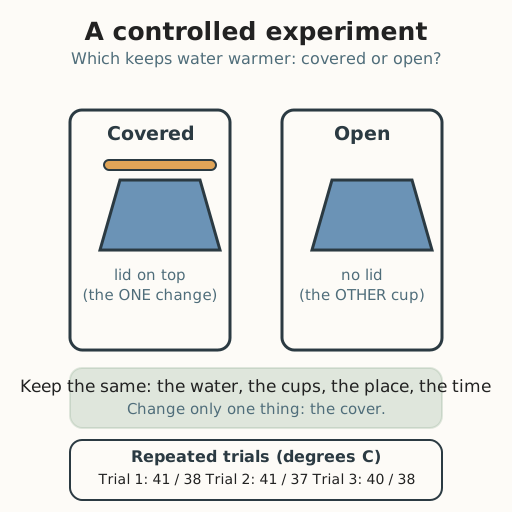
Grade 3 introduced the fair test — change one thing, keep the rest the same. Lessons 1 and 2 added measurement (numbers with units) and repeated trials. Now the three join into a controlled experiment: learners ask “Does a covered cup keep water warmer than an open one?”, change only one thing (the cover), keep the cups, water, place, and time the same, measure with a thermometer across three repeated trials, and write what the evidence shows. This is the honest shape of every trustworthy test.
Objectives
- Use simple tools to measure and record observations with units. (D06.S1.04.01)
- Compare results across repeated trials and explain why repeating a test matters. (D06.S1.04.02)
Connection
When a cook tries a new recipe, they do not change the salt, the heat, and the pan all at once — they would never know what worked. They change one thing, taste, and try again. When a bike rider wants to know if oiling the chain makes the ride easier, they oil only the chain and keep the tires, the road, and the rider the same. That is a controlled experiment: change one thing, keep everything else the same, measure the result with a unit, and repeat it to be sure. It is the same careful habit in a kitchen, a workshop, or a science lab — and it is how we come to trust what we learn.
Materials
- Two identical cups and a thermometer
- Warm water (facilitator only — not boiling)
- A timer or clock
- A class experiment chart
Preparation
- Pour the same amount of warm water into two identical cups; cover one, leave one open.
- Set out the thermometer and timer.
- Prepare the chart with What changes | What stays the same | Trial 1 | Trial 2 | Trial 3.
Facilitator note
This lesson is written to the learner (“you”). It is the capstone of the inquiry strand, so structure it as a worked example then guided practice (Kirschner, Sweller & Clark, 2006): plan the test together on the chart first, naming the one change and the things kept the same, then run the trials as a group, and let learners write their own conclusion. Handle warm water safely yourself — never boiling, and never left where a learner could spill it on skin. Keep the egalitarian lens alive: a controlled experiment belongs to everyone, not only to people in labs; anyone with two cups and a hand can ask this question and get real evidence. Remind learners that a result that surprises us is still evidence — we describe it honestly and wonder why. This experiment feeds forward: learners will reuse “change one thing, keep the rest the same” all year.
Procedure
- Gather and remember (5 min). You have measured with tools and units, and you have repeated a test three times. Today you will do both at once in a controlled experiment.
- Plan the test (10 min). Our question: does a covered cup keep water warmer than an open one? Say the one thing that changes (the cover) and everything we keep the same (the cups, the amount of water, the place, the time). Predict: which cup will stay warmer, and why?
- Run it with repeated trials (20 min). After the same time, measure the temperature of each cup with the thermometer — say the number and its unit (degrees Celsius) — and record it. Pour fresh warm water and run it again (Trial 2), then again (Trial 3). Compare the three trials.
- Read the evidence (15 min). Which cup stayed warmer, and was that true across all three trials? Were the trials close together? Write a sentence: “The evidence shows that ___ because ___.”
- Close (5 min). A controlled experiment changes one thing, keeps the rest the same, measures with units, and repeats. That is how we build trust in what we know.
Differentiation
- Support: Use a picture board for “change” and “keep the same,” and record with a partner’s help.
- Support (non-speaking): Point to the cup that stayed warmer and to the cover as the one change.
- Support (blind/low-vision): Feel both cups with the back of the hand and describe which is warmer; a partner reads the thermometer aloud.
- Extension: Write a new testable question, list the one change and three things kept the same, and run two trials.
Assessment
- Formative (observation): Can the learner name the one thing that changed and at least two things kept the same?
- Performance: The learner runs or helps run three trials and records each with a unit.
- Artifact (portfolio): The completed experiment chart with a written conclusion, kept for the unit portfolio.
Home connection
At home, run a tiny controlled experiment with a grown-up: “Which dries faster — a sock in the sun or a sock in the shade?” Change only the place, keep the socks, the water, and the time the same, and check twice.
Resources
- BBC Bitesize (KS2 Science), “What is a fair test?” — change one thing, keep the rest the same, and measure. https://www.bbc.co.uk/bitesize/topics/zqkk7ty/articles/z69qwnb