Lesson 02 — Why Repeat? Repeated Trials
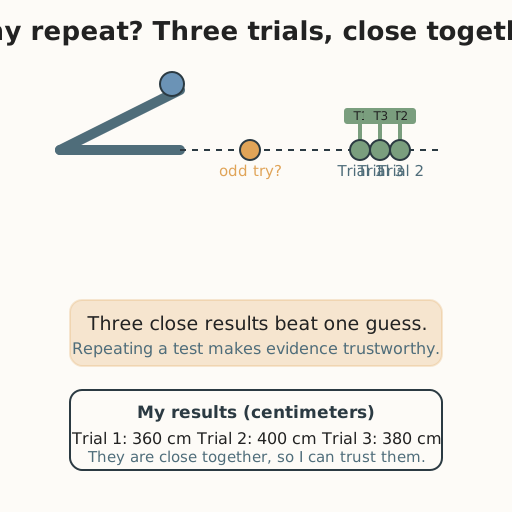
Learners discover why one try is not enough. They roll the same object down the same ramp three times, measure and record each result, and compare: repeated trials usually land close together, and any odd result stands out. They learn that repeating a test makes evidence more trustworthy, not because it is always the same, but because the spread of results tells us how sure we can be.
Objectives
Objectives
- D06.S1.04.02 Compare results across repeated trials and explain why repeating a test matters.
Essential question
Why does a scientist repeat a test more than once, and what do repeated trials tell us?
Key vocabulary
Materials
Standard materials
- A ball (or toy car) and a ramp · 1 set For the worked example — how far does it roll on the same surface?
- A meter stick or ruler · 1 To measure the distance each trial rolls
- A class results chart · 1 Columns for Trial 1, Trial 2, Trial 3, and a space to compare
- Paper and pencils · per learner
Low-tech / no-cost
- A found object and a marked line Roll or slide a stone or seed on the same ground, marking each stopping place with a stick or chalk
- A tally drawn in the dust or on paper Record each trial with a mark; count and compare aloud with a partner
Enriched / lab & device
- A "my repeated trials" recording sheet · per learner A table for three or more trials, a column for the range, and a line for a conclusion
- A stopwatch · 1 per group To add a timed trial (how long does the ball take to roll) as a second kind of measurement
Works in different contexts
- large-group Run the shared trial three times at the front while the whole group records each result, then compare as a class
- self-directed A learner runs the same trial three times alone, records each result, and writes whether the three results are close together
- outdoor-only Repeat an outdoor test — a stone rolled on flat ground three times — and mark each stopping place in the dust to compare
- multi-age Older learners run and measure the trials; younger learners mark and count the results and say whether they are close
- level-grouped Learners still learning compare two trials; learners who can reason compare three or more and describe any odd result
Lesson 2 — Why Repeat? Repeated Trials
Summary
A single try can mislead. Learners run the same test three times — rolling the same ball down the same ramp — and measure how far it goes each time. They record three results and compare them. Usually the three land close together; sometimes one result is far off (an outlier). Learners conclude that repeating a test matters because several close results are more trustworthy than one, and a spread of results tells us how careful we must be before we believe a claim.
Objectives
- Compare results across repeated trials and explain why repeating a test matters. (D06.S1.04.02)
Connection
Imagine you flip a coin once and it lands heads. If you said “this coin always lands heads” after one flip, would you trust that? Now imagine you flip it twenty times and it lands heads every time — that is different. Repeating a test is how we find out whether a result was a lucky accident or something real. The same idea shows up in everyday life: a cook tastes the soup more than once before serving it; a doctor takes a temperature and then checks again; a farmer watches the rain season after season before deciding when to plant. One look can fool you; repeated looks build trust.
Materials
- A ball (or toy car) and a ramp
- A meter stick or ruler
- A class results chart
- Paper and pencils
Preparation
- Set up the ramp on a clear, flat stretch of floor.
- Mark a starting line and set the meter stick beside the rolling path.
- Prepare the results chart with columns Trial 1 | Trial 2 | Trial 3 and a row for “How far it rolled.”
Facilitator note
This lesson is written to the learner (“you”). Teach the habit of repetition with a worked example — model three rolls, saying each measurement aloud and recording it — then let learners run their own trials (guided practice) before writing a conclusion. The key idea to protect: repeating is not about getting the same number every time; it is about seeing the spread of results, because that spread is honest evidence about how sure we can be (the critical-thinking and ethics lenses). A result that looks wrong is information, not a mistake to hide — scientists report it and wonder why. Note that repeating tests is a shared human practice across cultures, from early astronomers watching the sky night after night to cooks tasting and retasting. Keep it calm and honest; no result is “the winner.”
Procedure
- Gather and remember (5 min). Yesterday you measured with numbers and units. Today: can you trust a test you ran only once?
- Meet a trial (10 min). A trial is one run of a test. One trial tells us little. Watch the worked example: roll the ball once and record how far it went. Say: “Would I trust this if I only tried once?”
- Repeat the test (15 min). Run the same test again — same ball, same ramp, same release. Record Trial 2, then Trial 3. Write each result as a number with its unit (centimeters).
- Compare the results (15 min). Look at your three numbers. Are they close together or far apart? Did one stand out as very different? Which is more trustworthy — one trial, or three? Say why.
- Close (5 min). Repeating a test matters because a few close results beat one lucky guess. Tomorrow you will put measurement and repetition together in a full experiment.
Differentiation
- Support: Compare two trials only; a partner marks each stopping place and the learner says “close” or “far.”
- Support (non-speaking): Move a marker to each stopping place; point to the trial that is farthest from the others.
- Support (blind/low-vision): Use a ball that makes a sound at the end and count steps or use a raised ruler; describe the results aloud.
- Extension: Run a fourth and fifth trial, then write whether the extra trials changed your mind and why.
Assessment
- Formative (observation): Can the learner record three results and say whether they are close together?
- Artifact (portfolio): The repeated-trials chart with a one-sentence conclusion, kept for the unit portfolio.
Home connection
At home, repeat a tiny test with a grown-up three times — how many seconds it takes a small object to sink in water, or how far a coin spins before it stops — and compare the three results.
Resources
- BBC Bitesize (KS2 Science), “How do scientists use their findings?” — why scientists repeat tests to make their evidence more reliable. https://www.bbc.co.uk/bitesize/topics/zqkk7ty/articles/zbxsp4j