Lesson 05 — Living and Nonliving: An Ecosystem Web
Learners see an ecosystem as a web, not a list. A plant needs nonliving things — sunlight, water, soil, and air — and animals need the plant and the water. Learners sort parts into living and nonliving, then build a string web that shows who depends on whom, discovering that take one part away and the whole web feels it. Every part matters, living and nonliving alike.
Objectives
Objectives
- D06.S2.04.02 Explain how living and nonliving things in an ecosystem depend on each other (such as soil, water, and sunlight).
Essential question
How do living and nonliving things in an ecosystem depend on each other?
Key vocabulary
Materials
Standard materials
- Ecosystem picture cards · 1 set Sun, water, soil, air, a plant, a worm, a fish, and a person or bird
- A ball of string · 1 To build a web of dependence from card to card
- Paper and crayons · per learner
Low-tech / no-cost
- Found things from outside A stone and a handful of soil (nonliving), a leaf and a small creature (living) to sort and connect
- Voice and body Each learner is a part — one is the Sun, one water, one soil, one a plant — and they join hands to show who depends on whom
Enriched / lab & device
- A photo set of different ecosystems · 1 set A pond, a desert, a forest, and a coral reef to compare how each depends on its nonliving parts
- A "my ecosystem web" drawing sheet · per learner A sheet with a center space for a plant and spokes to draw the nonliving things it depends on
Works in different contexts
- large-group Build one giant web with string across the room — each learner holds a card and passes the string to the part they depend on
- self-directed A learner sorts the cards into living and nonliving, then draws lines to show who depends on whom
- outdoor-only Stand in a real place and name its living and nonliving parts — a plant, the soil, the sunlight, the water — and say how each depends on the rest
- multi-age Older learners label living and nonliving and read the connections; younger learners pass the string and say who gives to whom
- level-grouped Learners still learning sort living from nonliving; learners who can reason draw a full web and explain one missing part
Lesson 5 — Living and Nonliving: An Ecosystem Web
Summary
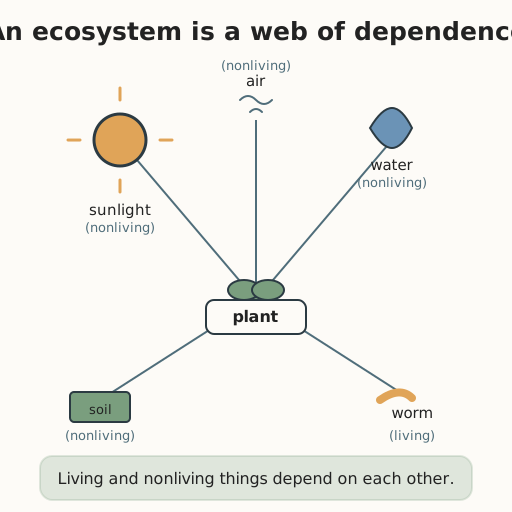
An ecosystem is everything — living and nonliving — in a place, and they all depend on one another. Learners sort the parts into living (a plant, a worm, a fish, a bird) and nonliving (soil, water, sunlight, air), then build a string web that shows the dependence: the plant needs soil, water, sunlight, and air; the animal needs the plant and the water; the worm returns life to the soil. Take one part away and the whole web pulls. Learners see that a worm and a river are as vital as a lion.
Objectives
- Explain how living and nonliving things in an ecosystem depend on each other (such as soil, water, and sunlight). (D06.S2.04.02)
Connection
Think of the place where you live — a field, a garden, a riverbank, a city park. The plants there do not grow alone. They need sunlight to make food, water to drink, soil to stand in, and air to breathe. The animals need the plants and the water. And when living things die, tiny living things and soil break them down so new plants can grow. That is an ecosystem — living and nonliving things depending on each other, the way the people in a village depend on the well, the soil, and each other. Pull out one part and everyone notices.
Materials
- Ecosystem picture cards (Sun, water, soil, air, a plant, a worm, a fish, a person or bird)
- A ball of string
- Paper and crayons
Preparation
- Prepare and shuffle the picture cards.
- Clear a circle of floor or ground for the string web.
- Keep a large sheet ready to draw the finished web together.
Facilitator note
This lesson is written to the learner (“you”). Teach with a worked example — model one connection (“the plant depends on sunlight”) — then let learners build the web together (guided practice) before drawing their own. The central value: an ecosystem is a circle of dependence, not a ladder; the nonliving parts — soil, water, sunlight, air — are not “background” but full partners in keeping life alive (the egalitarian, ethics, and environment lenses). Use ecosystems from many places — a rice paddy, a coral reef, a desert, a forest — so no single landscape is the default (global lens). This is evidence from ecology, gathered by observing many places over many years; hold it with wonder and care. The web activity doubles as a kinesthetic and social lesson: everyone holds the string, and everyone matters.
Procedure
- Gather and remember (5 min). Yesterday you saw how an animal’s body parts help it survive. But an animal never survives alone. Today: who does everything depend on?
- Sort living and nonliving (10 min). An ecosystem is all the living and nonliving things in a place. Sort the cards: which are living (they grow, move, and need food)? Which are nonliving (soil, water, sunlight, air)? Say each name as you sort.
- Build the web (15 min). Hold the cards in a circle. Pass the string from each thing to what it depends on: the plant to the sunlight, the plant to the water, the plant to the soil; the worm to the plant; the fish to the water; the bird to the fish. Say each connection aloud.
- Feel the web (10 min). Everyone pulls gently on the string. Now imagine one part is gone — the water dries up, or the soil washes away. Let that part drop the string. What happens to the web?
- Close (5 min). Living and nonliving things depend on each other. Every part of the web matters — the soil and the sunlight as much as the lion. Tomorrow you will draw your own ecosystem.
Differentiation
- Support: Sort just three cards — one living, two nonliving — and say who depends on whom with a partner.
- Support (non-speaking): Pass the string from a living card to a nonliving card it needs; a partner names the connection.
- Support (blind/low-vision): Feel soil, water, and a leaf, and describe what each gives to a plant; build the web by passing the string and listening for names.
- Extension: Choose a second ecosystem (a desert or an ocean) and tell how its living and nonliving parts depend on each other differently.
Assessment
- Formative (observation): Can the learner name one nonliving thing a plant depends on and one living thing that depends on the plant?
- Artifact (portfolio): The learner’s ecosystem web drawing with living and nonliving parts labeled, kept for the unit portfolio.
Home connection
At home, find one small ecosystem with a grown-up — a windowsill plant, a garden patch, or a puddle — and name two living and two nonliving things in it and how they depend on each other.
Resources
- BBC Bitesize (KS2 Science), “How do ecosystems work?” — living and nonliving things in a habitat and how they depend on each other. https://www.bbc.co.uk/bitesize/topics/z6wwxnb/articles/zbd4g7h