Lesson 10 — Fossils and Rock Layers: Earth's Long Story
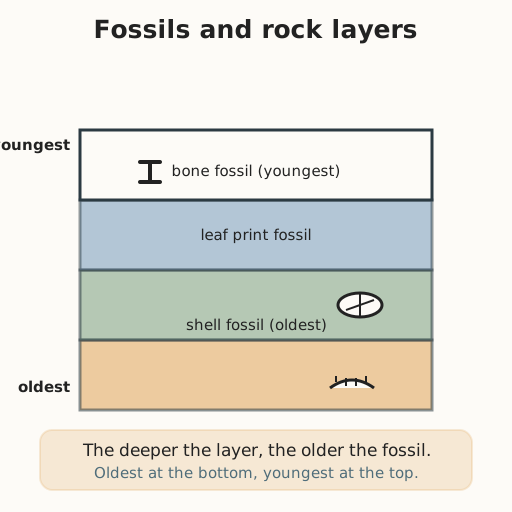
Learners read Earth's long story in its layers. Sediment settles over time into stacked rock layers, with the oldest at the bottom and the youngest at the top. Fossils — the preserved remains or traces of past life — are caught inside those layers, so a fossil in a deep layer is older than one in a shallow layer. Learners build a layered model with a "fossil" in each layer, order them oldest to youngest, and close the unit by recalling how measurement, repetition, and careful reading of clues all build trustworthy knowledge.
Objectives
Objectives
- D06.S4.04.02 Explain how fossils and rock layers give clues about Earth's long history.
Essential question
How do fossils and rock layers give us clues about Earth's long history?
Key vocabulary
Materials
Standard materials
- A "rock layers" model (stacked colored papers or play-dough slabs) · 1 set Layers with a "fossil" — a leaf print, shell, or drawn bone — placed in each
- A real or pictured fossil (a shell, a leaf print, or a photo) · 1 or a photo set To hold and observe a real trace of past life
- Paper and crayons · per learner
Low-tech / no-cost
- Stacked sand, soil, and pebbles in a clear jar Build real layers and press a leaf or shell into one to make a "fossil"
- Voice and story Tell the layer story aloud — oldest at the bottom, youngest at the top — and act out each layer settling
Enriched / lab & device
- A printed rock-layer diagram with fossils · per learner A cross-section to label the layers and the fossils, oldest at the bottom
- A small collection of fossils or high-quality photos · 1 set Real or pictured fossils from different depths to compare
Works in different contexts
- large-group Build the layer model at the front and place each fossil as a group, then pairs draw and label their own cross-section
- self-directed A learner stacks layers, places a "fossil" in each, and writes which is oldest and which is youngest and why
- outdoor-only Find real layers outdoors — a cut bank, a streambed, or stacked soil — and describe which layer is oldest and where a fossil might hide
- multi-age Older learners explain why the bottom layer is oldest; younger learners place the fossils in order from bottom to top
- level-grouped Learners still learning stack three layers and say "bottom is oldest"; learners who can extend infer what a fossil's layer tells about when it lived
Lesson 10 — Fossils and Rock Layers: Earth’s Long Story
Summary
Earth keeps a diary in stone. Sediment settles over time and hardens into stacked rock layers — the oldest at the bottom, the youngest at the top. Fossils — the preserved remains or traces of plants and animals — are caught inside those layers, so a fossil buried deep is older than one near the surface. Learners build a layered model with a “fossil” in each layer, order them oldest to youngest, and close the unit by recalling that measurement, repetition, and the patient reading of clues all build knowledge we can trust.
Objectives
- Explain how fossils and rock layers give clues about Earth’s long history. (D06.S4.04.02)
Connection
Have you ever stacked books one on top of another? The book at the bottom was put there first. Earth works the same way: sediment — tiny bits of sand and mud — settles and hardens into layers, the oldest at the bottom and the youngest at the top. Caught inside those layers are fossils: the shells, bones, and leaf prints of living things from long ago. A fossil deep down is older than one near the surface. It is how we read Earth’s long story — not from a book someone wrote, but from clues the Earth left behind, the way a footprint in mud tells you someone walked there before you.
Materials
- A “rock layers” model (stacked colored papers or play-dough slabs) with a “fossil” in each
- A real or pictured fossil (a shell, a leaf print, or a photo)
- Paper and crayons
Preparation
- Build (or have ready) a stack of three or more layers, each with a different “fossil” (a leaf print, a shell, a drawn bone) placed inside.
- Set out a real or pictured fossil for learners to observe closely.
- Prepare a space to draw a labeled cross-section.
Facilitator note
This lesson is written to the learner (“you”), and it is the unit’s closing lesson, so weave in retrieval practice — ask learners to recall the tools of measurement, the reason for repeated trials, and the water cycle — before and after the new idea. Teach layer order with a worked example (the stacked-books model), then let learners build their own layers (guided practice). Hold origins gently, as philosophy §11 asks: the fossil record is a story scientists read from evidence gathered over centuries, held as a story grounded in evidence — alongside other traditions’ stories of beginnings, which we honor without ranking. Keep the global and environment lenses: fossils are found on every continent and belong to the shared history of all life, and caring for the Earth is caring for a story still being written. This lesson’s labeled cross-section is a summative portfolio artifact for the living-world and Earth strands.
Procedure
- Gather and remember (5 min). This whole unit you have measured, repeated tests, and followed energy and water. Today: how do we read the Earth’s own long story?
- Meet the layers (10 min). Sediment — sand and mud — settles and hardens into rock layers. The oldest layer is at the bottom; the youngest is at the top. Say it together: bottom is oldest, top is youngest.
- Meet a fossil (10 min). A fossil is the preserved remains or trace of a living thing from long ago — a shell, a leaf print, a bone, a footprint. Hold or look at the fossil. What living thing might have left this trace?
- Build your layers (15 min). Stack three or more layers, placing a “fossil” in each. Point to the oldest and the youngest fossil, and say why: the deeper the layer, the older the fossil.
- Read the story and close (10 min). What does each layer’s fossil tell us about what lived then? Draw and label your cross-section, oldest at the bottom. Close by naming one thing from this whole unit you can now do — measure, repeat, build, or read clues — that makes your knowledge trustworthy.
Differentiation
- Support: Stack three layers and say “bottom is oldest” with a partner; match one fossil to its layer.
- Support (non-speaking): Place the fossils in order from bottom to top and point to the oldest and youngest.
- Support (blind/low-vision): Feel the stacked layers (different textures) and each “fossil” (a shell, a leaf, a stick), and describe which is deepest.
- Extension: Infer, from the fossils’ order, which living thing lived earliest and which latest, and write one sentence of evidence for your answer.
Assessment
- Formative (observation): Can the learner order layers oldest-to-youngest and explain why a deeper fossil is older?
- Summative (portfolio): The labeled rock-layer cross-section with fossils, kept as the unit’s closing portfolio artifact.
Home connection
At home, look with a grown-up for layers and traces — a stack of soil in a pot, rings in a tree stump, or old photos stacked in a drawer — and say which is oldest and how you know.
Resources
- BBC Bitesize (KS2 Science), “What can fossils tell us?” — how fossils give clues about Earth’s long history and past life. https://www.bbc.co.uk/bitesize/topics/zvhhvcw/articles/ztbshcw