Lesson 09 — The Water Cycle
Learners discover that water is never used up — it travels in a loop called the water cycle. Water evaporates from oceans, lakes, and puddles into the air as vapor, cools and condenses into clouds, falls back as precipitation, and collects in rivers, lakes, and soil — to begin again. Learners watch a small model of the cycle and draw and label the four stages, seeing that the water they drink today has been recycled for billions of years.
Objectives
Objectives
- D06.S4.04.01 Describe the water cycle and how water moves and is reused around the Earth.
Essential question
How does water move and get reused around the Earth in the water cycle?
Key vocabulary
Materials
Standard materials
- A clear bowl or cup of warm water · 1 per group To watch evaporation
- A clear plastic wrap or lid and an ice cube · 1 set To make condensation form and "rain" drip down
- Paper and crayons · per learner
- A kettle or warm-water source (facilitator only) · 1 For the warm water demonstration
Low-tech / no-cost
- A puddle or a wet cloth and a sunny or breezy spot Watch real evaporation — where did the water go? — and find water returning as dew or rain
- Voice and body Act out the cycle — learners play water rising (evaporation), gathering (condensation), falling (precipitation), and flowing (collection)
Enriched / lab & device
- A small model with a heat lamp and a clear container · 1 per group A closed model to speed up evaporation and condensation and watch the "rain" form
- A water-cycle labeling sheet · per learner A blank diagram to label the four stages with arrows
Works in different contexts
- large-group Run the bowl model at the front while the whole group names each stage as it appears, then pairs draw and label their own cycle
- self-directed A learner runs the warm-water model, watches the stages, and draws and labels the four parts with arrows
- outdoor-only Watch a puddle shrink in the sun, feel dew on grass, and trace the same water moving through the sky and ground
- multi-age Older learners label the four stages and write what happens at each; younger learners act out and name the stages in order
- level-grouped Learners still learning order the four stages with pictures; learners who can extend explain how the same water is reused
Lesson 9 — The Water Cycle
Summary
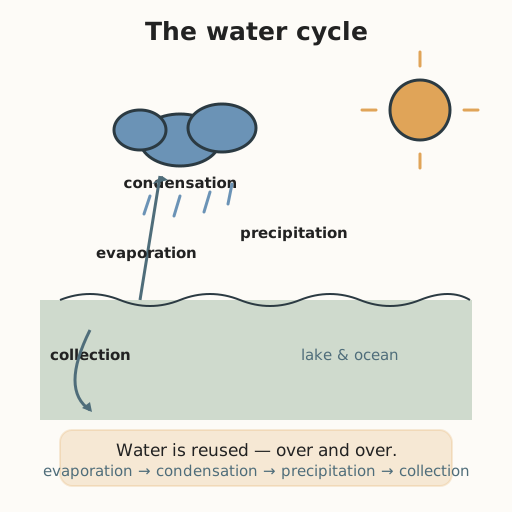
Water is not used up — it is reused, endlessly. Learners follow the water cycle: the Sun warms oceans, lakes, and puddles and evaporation turns water into invisible vapor that rises into the air; the vapor cools and condensation gathers it into clouds; when the drops grow heavy, precipitation returns the water as rain, snow, or hail; and collection gathers it in rivers, lakes, and soil, to begin again. Learners watch a small warm-water model and draw and label the four stages, discovering that the same water has been traveling this loop for billions of years.
Objectives
- Describe the water cycle and how water moves and is reused around the Earth. (D06.S4.04.01)
Connection
Have you ever watched a puddle dry up on a sunny day and wondered where the water went? It did not vanish — it rose into the air as invisible vapor. High in the sky it cooled into a cloud, and later it fell somewhere else as rain. That is the water cycle: water evaporates up, condenses into clouds, precipitates back down, and collects to begin again. It is why a river keeps flowing, why clouds form over the sea and rain over the land, and why the water you drink today may once have been rain on a mountain, snow in a forest, or a wave in the ocean. The Earth reuses its water, over and over, for every living thing.
Materials
- A clear bowl or cup of warm water
- Clear plastic wrap or a lid and an ice cube
- Paper and crayons
- A kettle or warm-water source (facilitator only)
Preparation
- Prepare one clear bowl of warm water per group, and have plastic wrap and an ice cube ready.
- Keep a large sheet ready to draw the four stages together.
- Have a kettle of warm (not boiling) water available, handled by the facilitator only.
Facilitator note
This lesson is written to the learner (“you”). Teach the cycle with a worked example — run the warm-water model and name each stage as it appears — then let learners draw and label their own cycle (guided practice). Handle warm water yourself, never boiling, and never left where a learner could spill it. The core idea to protect: water is reused, not used up — the same water cycles for billions of years (evidence from Earth science), which carries a quiet ethics and environment message: water is shared and precious, and caring for it is caring for the whole loop (the ethics and environment lenses). Use water from many places — a rice paddy, a desert oasis, a mountain spring, a city tap — so every learner can see their own water in the cycle (global lens). Invite wonder alongside fact: the water in the bowl may once have been part of a cloud, a river, or an ancient sea.
Procedure
- Gather and remember (5 min). You have traced energy moving and built a circuit. Now follow a different loop: where does water go when a puddle dries up?
- Meet the stages (10 min). The water cycle has four steps: evaporation (water rises into the air as vapor), condensation (vapor cools into clouds), precipitation (water falls as rain or snow), and collection (water gathers in rivers, lakes, and soil). Say them in order.
- Watch the model (15 min). Watch the warm water. Over the plastic wrap, small drops form — that is condensation. When the drops grow heavy, they drip — that is precipitation. Where is the water going next? Back to collection. Name each stage as you see it.
- Draw and label your cycle (15 min). Draw the loop: water on the ground, an arrow up for evaporation, a cloud for condensation, rain for precipitation, and arrows back to the water for collection. Label all four.
- Close (5 min). Water is never used up — it is reused, over and over, for every living thing. Tomorrow you will meet the long, long story that water and rock can tell.
Differentiation
- Support: Order four picture cards of the stages with a partner and say each name.
- Support (non-speaking): Point to each stage on a diagram as a partner names it, then arrange picture cards in order.
- Support (blind/low-vision): Feel condensation form on the plastic and the drip of “rain,” and describe each stage aloud in order.
- Extension: Explain where the water in your own tap or well may have come from before today, using the four stages.
Assessment
- Formative (observation): Can the learner name the four stages in order and say what happens at each?
- Artifact (portfolio): The labeled water-cycle diagram, kept for the unit portfolio.
Home connection
At home, leave a shallow dish of water in the sun with a grown-up and check it over a day or two. Where did the water go? Talk about which stage of the cycle you watched.
Resources
- BBC Bitesize (KS2), “What is the water cycle?” — evaporation, condensation, precipitation, and collection, and how water is recycled. https://www.bbc.co.uk/bitesize/topics/z849q6f/articles/zj2nydm