Lesson 02 — Two Tools for One Job
Learners compare two tools for the same job and say which works better and why for a given person or situation. They learn that "better" is not one answer — it depends on the person and the situation (a wide-mouth pot is easy to scoop and pour; a lidded bottle carries water without spilling). They sort pairs, fill a "better for whom and why" chart, and defend one choice.
Objectives
Objectives
- D10.S1.04.02 Compare two tools for the same job and say which works better and why for a given person or situation.
Essential question
How do I compare two tools for the same job and say which works better, for whom, and why?
Key vocabulary
Materials
Standard materials
- Tool-pair cards · 1 set Two tools for the same job — a wide-mouth pot and a narrow-neck bottle (carrying water), a broom and a hand brush (sweeping), a spoon and a ladle (serving)
- A "which works better, for whom, and why" chart · 1 Three columns — the job, the two tools, and "better for whom / which situation and why"
Low-tech / no-cost
- Real found tools and spoken examples Compare two real found objects that do the same job (two bowls, two carrying things) aloud; no printed cards needed
- Voice and body Act out the job with each tool and feel which is easier for which person or situation
Enriched / lab & device
- Two real tools per pair to handle · per pair Two real tools for one job (e.g., two kinds of spoon, two carrying containers) to try and compare
- A device to see how the same job is done differently in two places · 1 Optional — a short clip of carrying water with a pot versus a jerrycan, or sweeping with a broom versus a brush
Works in different contexts
- large-group Hold each tool up big and the whole group names the job, the two tools, and who each works better for before a few learners fill the chart
- self-directed A learner picks one job, names two tools for it, and writes or says which works better, for whom, and why
- outdoor-only Compare two real found things that do the same job outside (two sticks for digging, two leaves for carrying) and say which is better for which situation
- multi-age Older learners read the tool names and write the "better for whom and why" sentences; younger learners act out the job with each tool
- level-grouped Learners who finish early compare a third pair and explain a trade-off; others compare one given pair
Lesson 2 — Two Tools for One Job
Summary
Learners compare two tools for the same job and say which works better and why for a given person or situation. They learn that “better” is not one fixed answer — it depends on who is using the tool and what the situation is (a wide-mouth pot is easy to scoop and pour at home; a narrow-neck bottle with a lid carries water without spilling). They sort pairs, fill a “better for whom and why” chart, and defend one choice.
Objectives
- Compare two tools for the same job and say which works better and why for a given person or situation. (D10.S1.04.02)
Connection
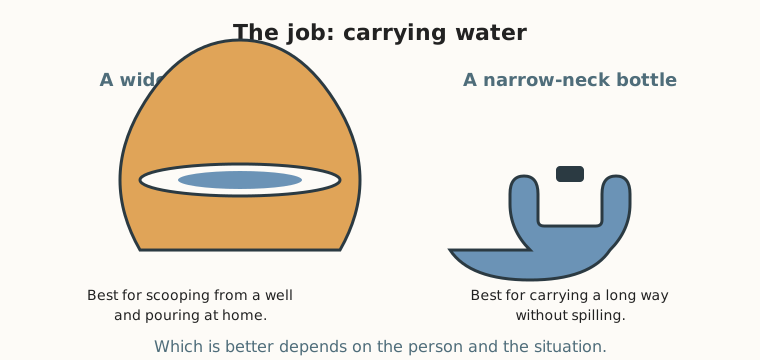
Two people can do the very same job with two different tools — and both be right. A wide-mouth clay pot and a narrow-neck bottle both carry water, but the pot is easier to scoop from a well and pour into a cooking pot, while the lidded bottle is easier to carry on a long walk without spilling. Saying “which is better” always means asking better for whom, and in which situation? That is the habit of a careful thinker.
Materials
- Tool-pair cards (pot vs. bottle; broom vs. hand brush; spoon vs. ladle)
- A “which works better, for whom, and why” chart
- Paper and pencils
Preparation
- Prepare the tool-pair cards, each labeled with the job and the two tools.
- Prepare the chart with three columns: the job, the two tools, and better for whom / which situation, and why.
- Think of a second pair to do together (two spoons of different sizes; a basket vs. a sack).
Facilitator note
This lesson is written to the learner (“you”). Grade 3 compared an old tool and a new tool for the same job; Grade 4 compares any two tools and must say which works better and why for a given person or situation. The key idea is that “better” is situational and personal, not absolute — this is both a thinking skill and a small lesson in fairness (a tool that suits one body or one life may not suit another). Model the compare-and-defend sentence once (“The lidded bottle works better for a person carrying water a long way, because it does not spill; the wide pot works better for someone scooping and pouring at home”), then guide one pair together before independent work (Kirschner, Sweller & Clark, 2006). Keep it global and egalitarian: use pairs from many lives — a pot and a jerrycan, a broom and a brush, a basket and a sack — so no single culture’s tools are the default, and ask “who is this tool easier for?” to honor different bodies and abilities. Honor every body: describe each tool in words for a learner who is blind or has low vision; a non-speaking learner points to the better tool and to the person or situation; acting out the job with each tool works for learners who learn best by moving.
Procedure
- Gather (5 min). Sometimes two different tools do the same job. Is one always “better”? Not always — it depends on who and where. Today you learn to compare fairly.
- Meet comparing (10 min). To compare two tools for one job, ask three questions: What is the job? What are the two tools? Which works better — for whom, and in which situation — and why? Follow the worked example: carrying water, a wide pot vs. a lidded bottle.
- Compare together (8 min). For a second pair — sweeping: a long broom vs. a short hand brush — say the job, the two tools, and who each is better for. (“The long broom is better for sweeping a big floor; the hand brush is better for a small, low space.”)
- Your own comparison (12 min). Pick one job and two tools for it. Fill the chart: the job, the two tools, and which works better for whom or which situation, and why.
- Defend your choice (5 min). Tell a partner your answer and your “because.” Can they think of a person or situation where the other tool is better?
- Close (5 min). “Better” is never one answer. A careful thinker always asks: better for whom, in which situation, and why.
Differentiation
- Support: Compare one given pair aloud using the frame “For the job of ___, the ___ works better for ___, because ___.”
- Blind/low vision: Hear each tool described and say which works better, for whom, and why; a partner scribes the chart.
- Deaf/hard of hearing / non-speaking: Point to the better tool and to the person or situation; the learner’s answer may be drawn and labeled with pictures.
- Motor differences: Direct a partner’s hands to handle or draw the tools while the learner says or points to the better tool and why.
- Extension: Compare a third pair and name a trade-off — something each tool gives up to gain something else.
Assessment
- Formative (observation): Can the learner compare two tools for the same job and say which works better and why for a given person or situation?
- Artifact (portfolio): The completed “better for whom and why” chart.
Home connection
At home, find two tools that do the same job (two knives, two ways to carry water, two ways to sweep). Tell a grown-up which works better for which person or situation, and why.
Resources
- TeachEngineering, “Engineering Design Process” — comparing and evaluating solutions is a design step; this lesson practices it on simple tools. https://www.teachengineering.org/populartopics/designprocess