Lesson 10 — Our Earth Home — Design, Media, Living Systems, and Care
Learners close the unit by retrieving and connecting all four strands — designing tools, reading messages, understanding living systems, and caring for the Earth — into one picture of "our Earth home." They sort their own portfolio artifacts into four corners, recall one idea from each, and write a short "my steward plan" naming one real action they will take.
Objectives
Objectives
- D10.S1.04.01 Explain what it means to design a tool (making something to meet a need) and describe one step in designing.
- D10.S1.04.02 Compare two tools for the same job and say which works better and why for a given person or situation.
- D10.S2.04.01 Identify the author, purpose, and audience of a message and explain how they shape it.
- D10.S2.04.02 Check whether a simple claim is true by finding a second source and comparing them.
- D10.S3.04.01 Describe an ecosystem as living and nonliving parts that depend on each other, and name two of its parts.
- D10.S3.04.02 Explain the jobs of producers, consumers, and decomposers in an ecosystem, with an example of each.
- D10.S4.04.01 Explain what happens to trash after it is thrown away and name "reduce, reuse, recycle" in order of what is best to do first.
- D10.S4.04.02 Investigate how one human action, such as littering or planting, can help or harm a local place.
Essential question
How do designing tools, reading messages, understanding living systems, and caring for the Earth fit together as one way of being?
Key vocabulary
Materials
Standard materials
- Unit portfolio artifacts · per learner The learner's own work from Lessons 1–9 (design drawing, comparison chart, message, two-source check, ecosystem drawing, cycle, trash path, help-or-harm sheet, care message)
- A "four corners" review chart · 1 Four labels — Design, Media, Living systems, Care — to sort and recall the unit's ideas
- Paper and pencils · per learner For a final "my steward plan" note
Low-tech / no-cost
- Voices and remembered work Recall each lesson aloud and sort the ideas into four corners by speaking or pointing; no printed chart needed
- Body and space Stand in four corners of the room (or four spots outside) for Design, Media, Living systems, and Care, and say one idea for each
Enriched / lab & device
- A shared class display or digital slideshow · 1 Optional — assemble the class's portfolio artifacts into one display or slideshow of the unit
- A small celebration or sharing circle · 1 Optional — invite families or another class to see the finished work and hear the steward plans
Works in different contexts
- large-group Run the four-corner review as a whole-group recall, with a few learners placing each portfolio artifact under the right corner
- self-directed A learner sorts their own artifacts into the four corners and writes a "my steward plan" note alone
- outdoor-only Do the four-corner recall in four spots outside, and write the steward plan about a real local place
- multi-age Older learners read the review prompts and coach younger ones in naming one idea per corner; everyone shares one steward plan
- level-grouped Learners who finish early add a second idea per corner or teach a younger learner one concept; others complete one idea per corner
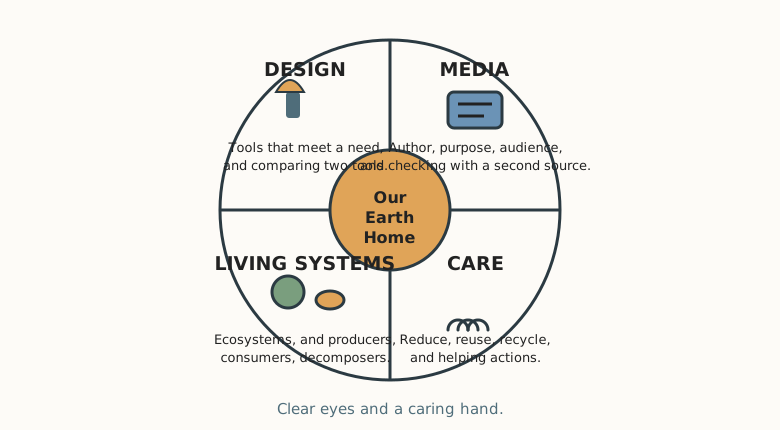
Lesson 10 — Our Earth Home: Design, Media, Living Systems, and Care
Summary
Learners close the unit by retrieving and connecting all four strands — designing tools, reading messages, understanding living systems, and caring for the Earth — into one picture of “our Earth home.” They sort their own portfolio artifacts into four corners, recall one idea from each, and write a short “my steward plan” naming one real action they will take.
Objectives
- Explain what it means to design a tool and describe one step in designing. (D10.S1.04.01)
- Compare two tools for the same job and say which works better and why for a given person or situation. (D10.S1.04.02)
- Identify the author, purpose, and audience of a message and explain how they shape it. (D10.S2.04.01)
- Check whether a simple claim is true by finding a second source and comparing them. (D10.S2.04.02)
- Describe an ecosystem as living and nonliving parts that depend on each other, and name two of its parts. (D10.S3.04.01)
- Explain the jobs of producers, consumers, and decomposers in an ecosystem, with an example of each. (D10.S3.04.02)
- Explain what happens to trash after it is thrown away and name “reduce, reuse, recycle” in order of what is best to do first. (D10.S4.04.01)
- Investigate how one human action, such as littering or planting, can help or harm a local place. (D10.S4.04.02)
Connection
This unit asked two big questions: how are tools designed, and how do I read a message’s purpose and audience? and how do living systems work, and how can I care for my place on Earth? Today you look back and see that they are really one question: how do I meet the made world and the living Earth with clear eyes and a caring hand? A designer meets a need; a careful reader names author, purpose, and audience; a thinker checks a claim with a second source; a steward knows the living system and acts to help it. These are not four separate skills — they are one way of being a person on this one, shared Earth home.
Materials
- Your own unit work from Lessons 1–9
- A “four corners” review chart (Design, Media, Living systems, Care)
- Paper and pencils
Preparation
- Gather each learner’s portfolio artifacts from Lessons 1–9.
- Set up four corners (or four spots outside) labeled Design, Media, Living systems, Care.
- Prepare a short list of recall prompts, one per corner.
Facilitator note
This lesson is written to the learner (“you”). It is the unit’s culminating review — retrieval practice and connection, not new content. The science of learning says recalling and organizing is what makes learning last (retrieval practice; spacing); this lesson does that deliberately. Guide the four-corner sort, then let learners recall one idea per corner and write a “my steward plan” — one real, doable action — so the unit ends in agency, not a test. Keep it hope-full and global: the steward plan should cost nothing and work anywhere (pick up litter safely, plant or water a seed, carry a reusable bag, mend something, check a claim before sharing it, tell others kindly). Emphasize that these habits are practiced by people everywhere, with or without wealth — stewardship is not a product to buy. Honor every body: a learner who is blind or has low vision recalls ideas by voice; a non-speaking learner points to artifacts and corners; standing in four spots works for learners who learn best by moving; a learner who struggles with recall is invited to pick up their own artifact as a memory cue rather than answer from memory alone.
Procedure
- Gather (5 min). You have traveled through four big ideas: designing tools, reading messages, understanding living systems, and caring for the Earth. Today you gather them all into one picture of our Earth home.
- Sort your work (10 min). Look at your own work from this unit. Place each piece under one of four corners: Design, Media, Living systems, or Care. (Your tool drawing goes under Design; your message and two-source check under Media; your ecosystem and cycle under Living systems; your trash path, help-or-harm sheet, and care message under Care.)
- Recall one idea each (12 min). Visit each corner and recall, from memory if you can: one design step; one way to check a claim; two parts of an ecosystem; the order of reduce, reuse, recycle. Say it to a partner or write it down.
- Connect (8 min). How do the four corners fit together? Talk with a partner: how does reading a message carefully help you care for the Earth? (Answer: so you can check claims before you believe or share them, and so you can spread true, helpful messages.)
- Write your steward plan (8 min). Write one real action you will take this week for a local place — small, free, and doable. Name who or what it will help.
- Close (2 min). Clear eyes and a caring hand: that is what this unit is. You carry it wherever you go.
Differentiation
- Support: Sort artifacts with a partner and recall each corner using the frame “In the ___ corner, I learned ___.”
- Blind/low vision: Recall ideas by voice and have a partner describe each artifact as you sort it.
- Deaf/hard of hearing / non-speaking: Point to artifacts and corners, and write or draw one idea per corner and the steward plan.
- Motor differences: Direct a partner’s hands to sort and write while the learner says or points to the ideas and the steward plan.
- Extension: Add a second idea per corner, or teach one concept from the unit to a younger learner or family member.
Assessment
- Summative (portfolio): The assembled unit portfolio, sorted into the four corners, shows the learner’s growth across all four strands.
- Self: The learner’s own recall and “my steward plan” note — a check of what they can retrieve and apply.
- Performance: The learner shares one idea per corner and one real action they will take.
Home connection
Show your unit work to someone at home. Tell them one thing from each corner — Design, Media, Living systems, and Care — and the one action in your steward plan. Invite them to do it with you.
Resources
- Common Sense Education, “News & Media Literacy” — the unit’s media habits (creator, purpose, audience, checking sources) summarized. https://www.commonsense.org/education/digital-citizenship/topic/news-and-media-literacy
- U.S. Environmental Protection Agency (EPA), “Reduce, Reuse, Recycle” — the stewardship order revisited in the final picture. https://www.epa.gov/recycle