Lesson 09 — Our Care Message — Author, Purpose, Audience, and Checked Facts
Learners bring the unit together by making an honest care message with a clear author, purpose, and audience, and one fact checked against a second source. They model a stream-care poster, check its fact, then create and share a message of their own that urges one real helping action for a local place.
Objectives
Objectives
- D10.S2.04.01 Identify the author, purpose, and audience of a message and explain how they shape it.
- D10.S2.04.02 Check whether a simple claim is true by finding a second source and comparing them.
- D10.S4.04.02 Investigate how one human action, such as littering or planting, can help or harm a local place.
Essential question
How do I make an honest care message with a clear author, purpose, and audience, and a checked fact?
Key vocabulary
Materials
Standard materials
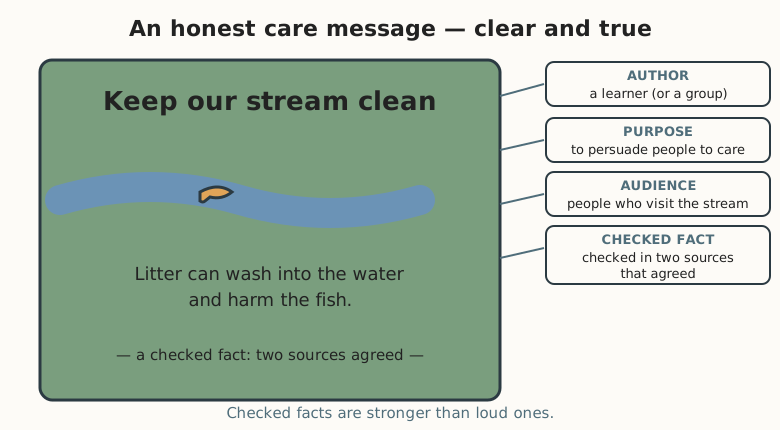
- A "care message" model · 1 A model poster reading "Keep our stream clean — litter can wash into the water and harm fish," labeled with author, purpose, audience, and one checked fact
- A "message builder" checklist · per learner Author, purpose, audience, one claim, and its two sources
- Paper and crayons · per learner For making the care message
Low-tech / no-cost
- Voice, body, and found materials Make the care message as a spoken announcement, a song, or a chalk message on the ground; no printed checklist needed
- Two real sources to ask Check the fact by asking two people or one person and one book
Enriched / lab & device
- A device to check one fact in two real places · 1 per pair Check the care fact against a book and a website, or two websites
- A way to share the finished message · 1 Display the message where others can see it, or record it to share
Works in different contexts
- large-group Make one shared care message as a class, with the whole group naming the author, purpose, audience, and the checked fact
- self-directed A learner makes one care message alone, labels author, purpose, and audience, and checks its fact with two sources
- outdoor-only Make the care message about a real local place, written in chalk or spoken, and check its fact with two people or by looking twice
- multi-age Older learners help younger ones check the fact in two sources and write the message; everyone helps choose the care action
- level-grouped Learners who finish early check a second fact and add it; others complete the message with one checked fact
Lesson 9 — Our Care Message: Author, Purpose, Audience, and Checked Facts
Summary
Learners bring the unit together by making an honest care message with a clear author, purpose, and audience, and one fact checked against a second source. They model a stream-care poster, check its fact, then create and share a message of their own that urges one real helping action for a local place.
Objectives
- Identify the author, purpose, and audience of a message and explain how they shape it. (D10.S2.04.01)
- Check whether a simple claim is true by finding a second source and comparing them. (D10.S2.04.02)
- Investigate how one human action, such as littering or planting, can help or harm a local place. (D10.S4.04.02)
Connection
When people want to care for a place, they do not just act — they tell others, so the care spreads. A good care message is honest: it names who made it (author), what it is for (purpose), who it is for (audience), and it rests on a fact that has been checked in more than one place. You now know how to do all of that — so today you make a message that could really help the place you live.
Materials
- A “care message” model poster
- A “message builder” checklist
- Paper and crayons
Preparation
- Prepare the model poster: “Keep our stream clean — litter can wash into the water and harm fish,” labeled with author (a learner), purpose (to persuade people to care), audience (people who visit the stream), and checked fact (litter can wash into water and harm fish, checked in two sources that agreed).
- Prepare the checklist: author, purpose, audience, one claim, source 1, source 2, do they agree?
- Prepare a way to share finished messages (a wall, a window, or a spoken sharing circle).
Facilitator note
This lesson is written to the learner (“you”). It is the unit’s synthesis for media literacy and stewardship: learners make a real message that joins author/purpose/audience (Lessons 3–4) with a checked fact and a helping action (Lessons 7–8). Model the full build on the stream-care poster first, then let learners work with the checklist (Kirschner, Sweller & Clark, 2006). Keep the stance warm and empowering: the message is not “scold people” but “invite people to care” — persuasion used for good, resting on truth. Honor no-wealth and global contexts: a care message needs no screens or printing — it can be spoken, sung, drawn in chalk, or told around a fire; oral sharing is a real and honored medium everywhere. A message can be in any language; let learners write or speak in the language of their home. Hold the ethics thread lightly but firmly: a message that urges care should itself be honest — no exaggerating, because checked facts are stronger than loud ones. Honor every body: a learner who is blind or has low vision may make a spoken or sung message; a non-speaking learner may make a drawn message and point to its parts; a learner with motor differences may direct a partner’s hands while they author the words.
Procedure
- Gather (5 min). You have learned to read messages with clear eyes and to care for a place. Today you join the two: you make an honest care message.
- Meet the model (10 min). Look at the stream-care poster. Its author is a learner; its purpose is to persuade people to care; its audience is people who visit the stream. Its fact — “litter can wash into the water and harm fish” — was checked in two sources that agreed. That is what makes the message strong: it is clear and true.
- Choose your care message (8 min). Pick one real helping action for a local place (picking up litter, planting, saving water, keeping a stream clean). Name your author (you or your group), your purpose, and your audience.
- Check your fact (10 min). Write the one claim your message rests on. Check it in two sources — two books, a book and a person, two people, a book and a page. Note whether they agree.
- Make and share (10 min). Make the message (poster, song, spoken notice, chalk drawing). Label its author, purpose, and audience, and note the checked fact. Share it with a partner or the group.
- Close (2 min). An honest message can spread care far beyond one pair of hands. You now know how to make one.
Differentiation
- Support: Build the message together aloud using the frame “My message’s author is ___, its purpose is to ___, its audience is ___, and its checked fact is ___ (checked in ___ and ___).”
- Blind/low vision: Make a spoken or sung message and say its author, purpose, audience, and checked fact by voice.
- Deaf/hard of hearing / non-speaking: Make a drawn or signed message and point to its author, purpose, audience, and checked fact.
- Motor differences: Direct a partner’s hands to draw and label while the learner authors the words and the checked fact.
- Extension: Check a second fact and add it, or make a second version of the message for a different audience and explain what you changed.
Assessment
- Formative (observation): Can the learner make a message with a clear author, purpose, and audience, and one fact checked against a second source?
- Artifact (portfolio): The care message with its author, purpose, audience, and checked fact labeled.
Home connection
Share your care message at home — say it, sing it, or show it — and tell a grown-up the fact you checked in two sources. Ask if they will join the one helping action it asks for.
Resources
- Common Sense Education, “News & Media Literacy” — creating media responsibly with a clear creator, purpose, and audience. https://www.commonsense.org/education/digital-citizenship/topic/news-and-media-literacy
- National Association for Media Literacy Education (NAMLE), “Key Questions” — checking a claim against more than one source before sharing it. https://namle.org/resources/key-questions/