Lesson 01 — Do Heavy Things Always Sink?
Learners test the idea that "heavy things sink" by predicting, testing, and observing, then learn to separate what they saw (evidence) from why it happened (inference) from what they merely think (opinion).
Objectives
Objectives
- D06.S1.05.01 Form a testable question, design an investigation, and identify what stays the same and what changes.
- D06.S1.05.02 Explain the difference between evidence, inference, and opinion using a simple example.
Essential question
Does how heavy something is decide whether it floats?
Key vocabulary
Materials
Standard materials
- A tub or basin of water · 1 per group
- Lumps of clay or modeling dough (equal size) · 2 per group
- Small objects of varied mass · 1 set A coin, a cork, a pebble, a piece of wood, a metal spoon
Low-tech / no-cost
- Any container of water A bucket, pot, or even a puddle works; clay can be mud shaped into a ball and a boat
- Found objects A stone, a twig, a seed, a leaf, a bottle cap
Enriched / lab & device
- A digital scale · 1 per group To measure mass directly and test the "heavy sinks" idea with numbers
Works in different contexts
- large-group Run one shared tub up front; the group calls out predictions, and two learners do each test while the rest record
- self-directed A learner fills any bowl with water and tests the objects on their own, writing each prediction before each test
- outdoor-only Use a stream or a puddle and natural objects only
Lesson 1 — Do Heavy Things Always Sink?
Summary
Learners hold up a common belief — “heavy things sink” — and test it the way scientists do: predict first, test, observe carefully, then separate evidence from explanation. They discover that shape (how much water is pushed aside) matters more than weight, and they practice naming the difference between what they saw, what they infer, and what they think.
Objectives
- Form a testable question, design an investigation, and identify what stays the same and what changes. (D06.S1.05.01)
- Explain the difference between evidence, inference, and opinion using a simple example. (D06.S1.05.02)
Connection
You already know a lot about floating — you have seen logs float and stones sink. Today you are going to test an idea that sounds obvious: “heavier things sink.” It turns out that the obvious idea is not always true, and finding out why is what science is for. This same habit — question, test, look at the evidence — is how people decide what medicine works, what is safe to eat, and what is actually true.
Materials
- A tub or basin of water
- Two equal lumps of clay or modeling dough
- Small objects of varied mass (a coin, a cork, a pebble, a piece of wood, a spoon)
Preparation
- Fill the basin with enough water to float a small boat.
- Prepare two equal lumps of clay per group.
Facilitator note
Written to the learner (“you”). The heart of this lesson is the sequence, not the answer: predict → test → observe. Insist that every prediction is written or said before the test — a correct guess is not the point; the habit of predicting is. Keep the clay boat subtle: show how the same clay that sank as a ball floats as a boat shape. When learners give an explanation, ask “did you see that, or are you reasoning it out?” — this is how evidence and inference get separated. Do not rush the naming; let them wrestle with it.
Procedure
- Name the idea (5 min). Write your prediction: will heavier things sink? Say “I predict …” for each object before you touch the water.
- Test the objects (15 min). One by one, predict, then place each object in the water, and record only what you see (floats / sinks). Which predictions were wrong?
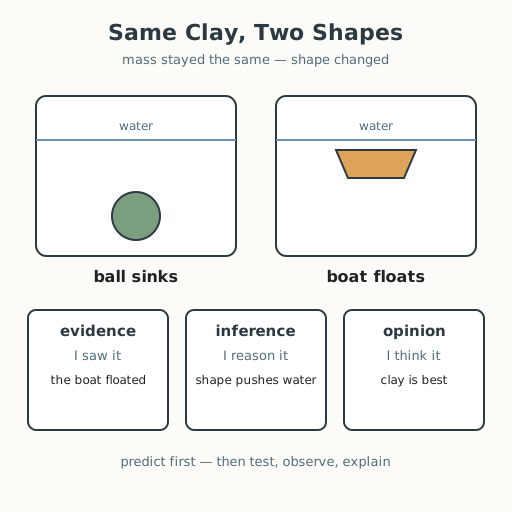
- The clay surprise (10 min). Roll one clay lump into a ball and lower it in — it sinks. Now flatten the other lump and shape it into a boat. Predict again, then place it. What happened? The clay did not change its mass — but its shape changed how much water it pushes aside.
- Evidence, inference, opinion (15 min). Sort each statement into one of three piles: evidence (I saw it — “the boat floated”), inference (I reason it — “it floats because the boat pushes more water aside”), opinion (I think it — “clay is a better boat material”). Which pile is which, and how do you know?
- Close (5 min). Science is this loop: question, predict, test, observe, explain — and then question again. Your best explanation is always open to new evidence.
Differentiation
- Support: Provide a two-column record sheet (prediction | what I saw) and do the clay test together.
- Extension: Change one thing at a time (the control) — same shape, different material — and explain what the controlled test shows.
Assessment
- Formative (observation): Does the learner predict before testing, and can they name at least one piece of evidence and one inference?
- Artifact (portfolio): The claim–evidence–reasoning note from step 4.
Resources
- Archimedes’ principle, explained for children (an age-appropriate source): https://www.britannica.com/science/Archimedes-principle
Home connection
Try it in the sink at home: which of the kitchen things float, and which sink? Record your predictions first, then test, and tell someone what you saw versus what you reasoned.