Lesson 01 — Boundaries: The Yes, the No, and the Maybe
Learners meet the idea of a personal boundary as the line where comfortable ends and uncomfortable begins, expressed with three signals — yes, maybe, and no. They name their own limits in small, safe terms, practice saying a boundary clearly, and learn that a no is complete: it does not need a reason to be respected.
Objectives
Objectives
- D02.S1.07.01 Set and respect personal boundaries and recognize when a peer has set one.
Essential question
How do I set a personal boundary and say it clearly, so that it is respected?
Key vocabulary
Materials
Standard materials
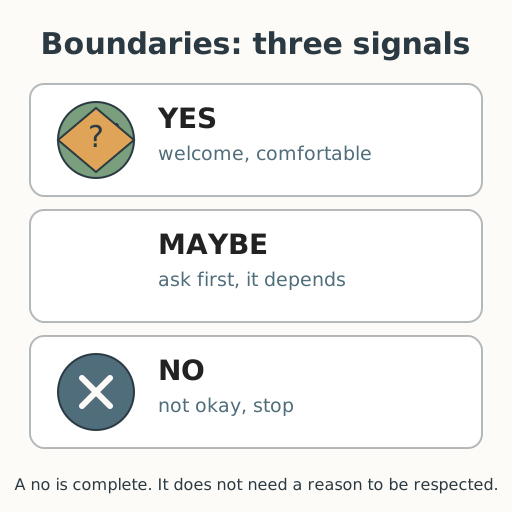
- Yes/No/Maybe poster · 1 Three signals — YES (welcome), MAYBE (ask first), NO (not okay) — each with a distinct shape and symbol, not only color
- Boundary circle page · 1 per learner A page with three rings (public, personal, close) to note one comfortable thing, one ask-first thing, and one not-okay thing
- Pencils · per learner
Low-tech / no-cost
- Voice and body Say and act out the three signals aloud; no poster or page needed — hold a hand up for no, a flat palm for maybe, open arms for yes
- Stones, sticks, or chalk Draw the three rings on the ground or mark them with found objects
Enriched / lab & device
- Class 'signals' wall · 1 A shared display where learners post their yes/maybe/no examples, building a word bank across the unit
- A short, respectful clip of different greeting customs · 1 Bow, handshake, nod, kiss on the cheek — to show that limits are universal while customs differ (verify the clip is appropriate and current)
Works in different contexts
- large-group Work one yes/maybe/no example together on the poster, then have pairs fill their own circle page and share one line each in a whip-around
- multi-age Younger learners name one comfortable and one not-okay thing; older learners also name a "maybe — ask first" thing and say the sentence starter aloud
- self-directed A learner fills the circle page for three small, safe examples of their own and writes one clear boundary sentence for each
- level-grouped Learners ready to extend distinguish a limit for the body, a limit for belongings, and a limit for time or attention — and name one of each
- outdoor-only Mark three rings on the ground and stand in each in turn, saying one thing that is welcome, one that needs asking, and one that is not okay; no paper needed
Lesson 1 — Boundaries: The Yes, the No, and the Maybe
Summary
Learners meet a boundary as the line where comfortable ends and uncomfortable begins, expressed with three signals — yes, maybe, and no. They name their own limits in small, safe terms, practice saying a boundary clearly, and learn that a no is complete: it does not need a reason to be respected.
Objectives
- Set a personal boundary and say it clearly, and respect a boundary someone else has set. (D02.S1.07.01)
Connection
Everyone has a line where comfortable ends and uncomfortable begins. You feel it when a stranger stands too close on a crowded bus, when someone borrows your things without asking, when a person assumes a hug that you did not offer, when someone keeps messaging after you have gone quiet. That line is a boundary, and it is yours to set. The exact customs differ everywhere — in some places people greet with a bow, in others a handshake or a nod, in others a kiss on the cheek — so there is no single “default” way to be near someone. What is the same in every place is this: each person gets to say what is okay for them, and everyone else is asked to respect it.
Materials
- Yes/No/Maybe poster
- Boundary circle page
- Pencils
Preparation
- Print or draw the Yes/No/Maybe poster (three signals, each with a distinct shape).
- Copy a boundary circle page for each learner.
- Arrange a circle for discussion.
Facilitator note
This lesson is written to the learner (“you”). The idea to land is that a boundary is a
person’s own line between comfortable and uncomfortable, and it is always the person’s
right to set it — while a “no” from anyone is complete and needs no explanation to be
respected. Keep the topic safe: invite only small, everyday examples (borrowing,
standing close, touching, messaging), never require a learner to disclose anything
private, and never push into pain. Name the cultural range of greetings (bow, handshake,
nod) side by side, never ranked, and do not hold any custom up as the “normal” one. Model
one clear boundary sentence as a worked example before learners write their own
(Kirschner, Sweller & Clark, 2006). Note honestly that in some homes and cultures
asserting a boundary to an older person is hard or unsafe — the right to set a limit is
real even when it is hard to exercise, and a trusted adult can help. If a learner
discloses harm, follow your safeguarding duty (believe them, do not promise secrecy, tell
a trusted adult). See docs/facilitation.md and docs/art-style.md.
Procedure
- Gather and recall (5 min). Last year you learned to choose assertion over being passive or aggressive. Today you meet the thing assertion protects: your boundary — the line where comfortable ends and uncomfortable begins. Without saying anything private: name one thing you are simply not okay with (a touch, a borrowed item, a late-night message). You don’t have to explain why.
- Meet the three signals (10 min). Look at the poster. YES — welcome, comfortable. MAYBE — ask first, it depends. NO — not okay, stop. The difference between the three is the difference between “come in,” “knock first,” and “please don’t.” Worked example, said aloud: “I’m happy to share my pens — YES. For my phone, ask me first — MAYBE. Please don’t read my notebook — NO.”
- Name your own limits (15 min). On your circle page, write or draw one small, safe thing for each ring: one thing that is welcome (public), one that needs asking first (personal), and one that is not okay (close). Keep it to everyday things. Share one with a partner only if you are comfortable.
- Say it clearly (10 min). A boundary only works when it is said. Practice these clear, kind sentences: “I’m not comfortable with that.” / “Please stop.” / “I need some space.” / “No, thank you.” Say one aloud to a partner; a clear “no” is not rude, it is honest.
- Respect the other side (5 min). Now flip it: when someone says no to you, you stop — the first time, without arguing. A no is complete. It does not need a reason to be respected.
- Close (5 min). Your boundaries are yours; other people’s are theirs. Tomorrow you will learn to read when a peer has set a boundary without even saying the word.
Differentiation
- Support: Provide the sentence starters on a card and a word bank (borrow, touch, space, time, phone, message) for the circle page.
- Extension: Write a boundary for each of three areas — your body, your belongings, and your time — and note how the words you would use differ in each.
Assessment
- Formative (observation): Can the learner name one welcome, one ask-first, and one not-okay thing, and say a boundary sentence clearly without aggression or apology?
- Self-check: The learner rereads their three ring entries and checks that each names a real, small limit, and that their “no” sentence is clear and kind.
Home connection
Ask someone at home how people in your family or culture show a limit — a word, a gesture, a custom — and share one boundary sentence you practiced today, if you like.
Resources
- On boundaries, consent, and a child’s right to be heard and protected: the UN Convention on the Rights of the Child (Articles 12 and 19), https://www.unicef.org/child-rights-convention
- On modeling a new skill before independent practice: Kirschner, Sweller & Clark (2006), https://doi.org/10.1207/s15326985ep4102_1