Lesson 02 — Reading the Boundary: Recognizing a Peer's No
Learners learn to recognize when a peer has set a boundary by reading three kinds of cue — words, body, and voice — even when the word "no" is never said. They practice spotting the signal in short scenes, then practice the respectful response: stop, the first time, without argument.
Objectives
Objectives
- D02.S1.07.01 Set and respect personal boundaries and recognize when a peer has set one.
Essential question
How do I recognize when a peer has set a boundary — even when they don't say the word "no"?
Key vocabulary
Materials
Standard materials
- Reading-the-signal poster · 1 A scene of one person signaling a limit through words, body, and voice, with the three cue types labeled
- Cue cards · 1 set per pair Cards showing a short scene, each with one clear boundary signal to read (words, body, or voice)
- Pencils and paper · per learner
Low-tech / no-cost
- Voice and body Act out each cue card with a partner; no printed cards needed — one partner signals, the other names the cue
- Found objects Two sticks or stones mark "too close" and "comfortable" distance on the ground
Enriched / lab & device
- A short, respectful film clip · 1 A scene where a character sets a limit without raising their voice, to name the verbal and nonverbal cues together (verify the clip is appropriate)
- Class 'signal' wall · 1 Learners post one cue they noticed this week, building a shared bank of boundary signals
Works in different contexts
- large-group Show one cue card at a time to the whole group; everyone holds up one finger for words, two for body, three for voice to name the cue type
- multi-age Younger learners name the cue; older learners name the cue *and* say what a respectful response would be
- self-directed A learner reads each cue card alone and writes, for each, the cue they noticed and one respectful response
- level-grouped Learners ready to extend separate a clear "no" from a "maybe — ask first," and explain how the cue differs
- outdoor-only In pairs, one partner signals a limit with body alone while the other steps back at the right moment; then swap; no paper needed
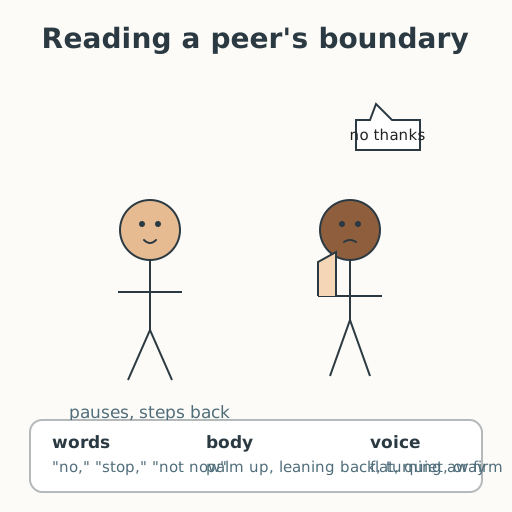
Lesson 2 — Reading the Boundary: Recognizing a Peer’s No
Summary
Learners learn to recognize when a peer has set a boundary by reading three kinds of cue — words, body, and voice — even when the word “no” is never spoken. They practice spotting the signal in short scenes, then practice the one respectful response: stop, the first time, without argument.
Objectives
- Recognize when a peer has set a boundary, from their words, body, and voice, and respond respectfully. (D02.S1.07.01)
Connection
Not every “no” uses the word “no.” A friend steps back when you lean in. A classmate goes quiet and looks away when you ask to borrow their phone. Someone holds up a palm, or laughs a little and says “…maybe later,” or answers in a flat voice. These are all boundaries, said without the word. The skill is to read them — and to treat the softest signal as seriously as the loudest one. This is true everywhere, even though the gestures differ from place to place: in some cultures people signal “stop” or “I’m not comfortable” with an open palm, in others with a step back or a downcast look. Reading the whole person — not only the words — is a universal human skill.
Materials
- Reading-the-signal poster
- Cue cards
- Pencils and paper
Preparation
- Print or draw the reading-the-signal poster.
- Copy and cut the cue cards (one scene per card).
- Arrange pairs for practice.
Facilitator note
This lesson is written to the learner (“you”). The idea to land is that boundaries are
often signaled without the word “no,” through words, body, and voice — and the respectful
response is always to stop the first time, without arguing. Keep scenes small and safe
(borrowing, standing close, a touch on the shoulder, messaging); use hypothetical
characters, never real classmates, so no one is put on the spot. Emphasize that a soft or
hesitant “no” is still a no — hesitation is not an invitation to push. Note the cultural
range of body language honestly (a downcast look, a step back, an open palm) and never rank
one custom above another. Model reading one cue card aloud as a worked example before pairs
work alone (Kirschner, Sweller & Clark, 2006). See docs/facilitation.md and
docs/art-style.md.
Procedure
- Gather and recall (5 min). Yesterday you learned to set a boundary with yes, maybe, and no. Today you learn to read one — because most people signal a limit without ever saying the word “no.” Why might someone not say it out loud? (They might feel awkward, unsure, or not want to hurt feelings.)
- Meet the three cues (10 min). Look at the poster. A person signals a boundary three ways at once: words (“no,” “stop,” “not now,” “I’d rather not”), body (a raised palm, leaning back, stepping away, turning aside, crossing arms), and voice (flat, quiet, uncertain, or firm). Worked example: “Sure… maybe later” said with a step back and a turned shoulder — the words sound like yes, but the body and voice say no. Read the whole person.
- Practice reading (15 min). In pairs, take a cue card. One partner reads or acts the scene; the other names the cue — “I noticed the body — she stepped back” — and says what the respectful response is: stop, the first time. Swap cards and roles.
- The soft no is still a no (10 min). Discuss: which is harder to read, a loud “NO” or a quiet “…maybe later”? A soft or hesitant no is still a no — hesitation is not an invitation to push. Write one sentence: When I’m not sure, I will ___ (ask, pause, stop and check).
- Close (5 min). Respect means reading the signal you were given, not the one you hoped for. Tomorrow you will learn what to do after a boundary gets crossed — how to repair a relationship after a disagreement.
Differentiation
- Support: Give pairs just the body and voice cards first, then add word cards; provide a response sentence starter (“I’ll stop — thanks for telling me”).
- Extension: Write a short scene of your own where a character sets a boundary without the word “no,” and swap with a partner to read each other’s cue.
Assessment
- Formative (observation): Does the learner name at least one verbal and one nonverbal cue in a scene, and state a stop-the-first-time response?
- Peer check: Pairs confirm each other caught the cue — “You noticed the body cue; the respectful response is to stop.”
Home connection
Ask someone at home how people in your family show “no” or “not comfortable” without saying the word — a look, a gesture, a tone — and share one cue you learned to read today.
Resources
- On boundaries, consent, and a child’s right to be heard: the UN Convention on the Rights of the Child (Articles 12 and 19), https://www.unicef.org/child-rights-convention
- On modeling a new skill before independent practice: Kirschner, Sweller & Clark (2006), https://doi.org/10.1207/s15326985ep4102_1