Lesson 06 — The Same Thing, Many Views
Learners move from knowing that views differ to holding several true views of one situation at once. Using the same river seen by a fisher, a farmer, a child, and an elder, they name what shapes each view, practice speaking from a view unlike their own, and begin the core move of empathy across difference: seeking to understand, not to win.
Objectives
Objectives
- D02.S2.07.01 Explain how a person's background, culture, and experiences shape their point of view.
- D02.S2.07.02 Practice empathy across difference by seeking to understand views unlike their own.
Essential question
How do I hold several true points of view at once, and begin to understand a view unlike my own?
Key vocabulary
Materials
Standard materials
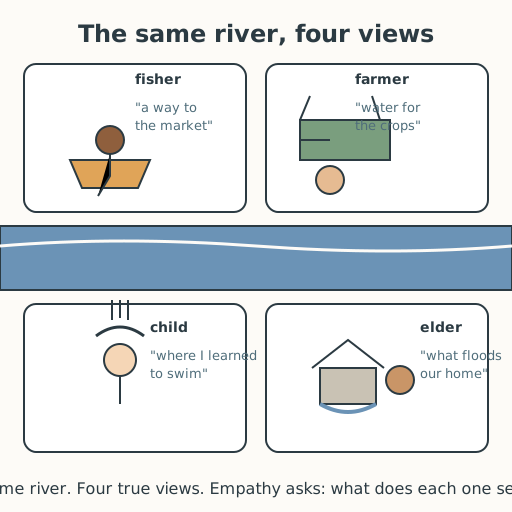
- Same river, four views poster · 1 One river seen four ways — fisher, farmer, child, elder — each a true part, none the whole
- Multiple-views page · 1 per learner A page with one shared situation and spaces for three views, each with a "what shapes this view" line
- Pencils · per learner
Low-tech / no-cost
- Voice and body Stand in four corners of the room, each "role" describing the shared thing from their place; no poster or page needed
- Found objects One real shared object described from four positions around it
Enriched / lab & device
- A short, respectful film clip of one event from two lives · 1 To see the same event through two different lenses before learners try it themselves (verify the clip is appropriate)
- Class 'many views' wall · 1 Learners post their multiple-views pages, building a shared gallery of held-together perspectives
Works in different contexts
- large-group Work the river poster together, then have groups of four each take one role and present it back in turn
- multi-age Younger learners name what each view sees; older learners name what *shapes* each view and where the views might agree
- self-directed A learner fills the multiple-views page for one shared situation and writes one sentence of empathy for each view
- level-grouped Learners ready to extend find a *point of agreement* between two views that first seemed opposite, and write it
- outdoor-only Four learners stand around one real thing and each describe it from their place, then swap positions; no paper needed
Lesson 6 — The Same Thing, Many Views
Summary
Learners move from knowing that views differ to holding several true views of one situation at once. Using the same river seen by a fisher, a farmer, a child, and an elder, they name what shapes each view, practice speaking from a view unlike their own, and begin the core move of empathy across difference: seeking to understand, not to win.
Objectives
- Explain how a person’s background, culture, and experiences shape their point of view. (D02.S2.07.01)
- Practice empathy across difference by seeking to understand views unlike one’s own. (D02.S2.07.02)
Connection
One river, four people: the fisher sees a way to market, the farmer sees water for the crops, the child sees the place they learned to swim, the elder sees what floods their home each rainy season. All four are true, and none is the whole. The world is full of these moments — a new road is progress to one neighbor and the loss of a quiet field to another; a rule feels fair to some and heavy to others. Empathy across difference is not agreeing with every view; it is the skill of seeking to understand a view unlike your own before you judge it.
Materials
- Same river, four views poster
- Multiple-views page
- Pencils
Preparation
- Print or draw the same-river poster.
- Copy a multiple-views page for each learner.
- Arrange small groups of four.
Facilitator note
This lesson is written to the learner (“you”). The idea to land is that several views of
one situation can all be true, and empathy across difference means holding them together
long enough to understand a view unlike your own — not to win an argument. Keep the
global/anthropological lens alive: the fisher–farmer–child–elder example is deliberately
everyday and cross-cultural (a river, a field, a market, a home) so it works in a city, a
village, a coast, or a mountain town. Model speaking from one unfamiliar view aloud as a
worked example before groups try it (Kirschner, Sweller & Clark, 2006). Guard the
egalitarian lens: the goal is not to rank views or to “convert” anyone, and empathy is not
agreement — a learner can understand a view and still hold a different one. Keep all
disclosure optional. See docs/facilitation.md and docs/art-style.md.
Procedure
- Gather and recall (5 min). Yesterday you learned a point of view is a lens built from background, culture, and experience. Today’s harder move: holding several true views of one thing at once.
- Meet the four views (10 min). Look at the poster. One river, four people. Name what each sees, then name what shapes it: the fisher’s work, the farmer’s field, the child’s memory, the elder’s flooded home. None is wrong; each is a true part. The whole truth is all of them together.
- Speak from an unfamiliar view (15 min). In your group, each person takes one role. In the first person, speak that role’s view of the river — “The river is…” — and add one thing that shapes it. Then try a view that is not like your own life: what does it ask you to notice that you had not?
- Map the views (10 min). On your page, write one shared situation (a change in your town, a school rule, a game, a festival). Fill three windows: three different views, each with a “what shapes this view” line. For one window, write one sentence of empathy: “I can see how ___ would make them feel ___ .”
- Close (5 min). Empathy across difference is not agreeing with everyone. It is the discipline of understanding a view before you judge it — and the humility of knowing your own view is also just one part. Tomorrow you will practice the full skill: seeking to understand, not to win.
Differentiation
- Support: Provide the shared situation and two pre-filled windows; ask the learner to add a third view and one empathy sentence.
- Extension: Find a point where two of your windows agree even though they seemed opposite, and write what they share.
Assessment
- Formative (observation): Can the learner state a view unlike their own and name something that shapes it, without mocking or dismissing it?
- Peer check: In groups, partners confirm each view was spoken “in character” and fairly — “You named what shapes that view.”
- Self-check: The learner checks their empathy sentence names the other person’s feeling or need, not just their own.
Home connection
Listen to someone at home describe a shared situation, and before you answer, say back what you heard them value or fear — then notice whether they feel understood.
Resources
- On empathy, perspective-taking, and their link to morality: Decety & Cowell, “The complex relation between morality and empathy” (2014); and Batson’s empathy–altruism research.
- On social awareness and perspective-taking as core competencies: CASEL, https://casel.org/fundamentals-of-sel/
- On modeling a new skill before independent practice: Kirschner, Sweller & Clark (2006), https://doi.org/10.1207/s15326985ep4102_1