Lesson 05 — Where My Point of View Comes From
Learners discover that a point of view is shaped by background, culture, and experience, through the traditional Indian story of the elephant and the people who each touched one part and named it differently. They name the "lenses" — place, family, language, history, experience — that shape their own view, and learn that every view shows a true part, never the whole.
Objectives
Objectives
- D02.S2.07.01 Explain how a person's background, culture, and experiences shape their point of view.
Essential question
How does a person's background, culture, and experience shape the way they see the same thing?
Key vocabulary
Materials
Standard materials
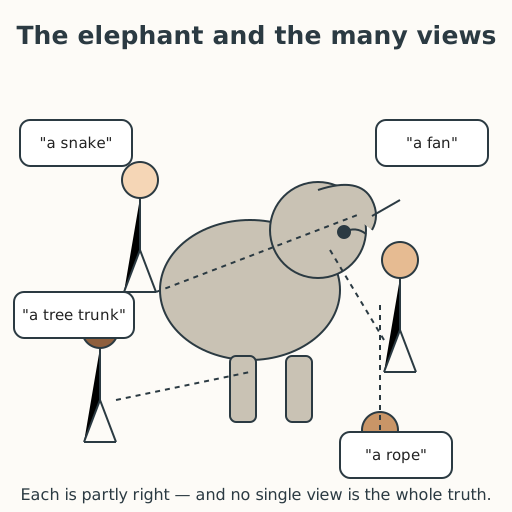
- The elephant and the views poster · 1 The traditional story in pictures — several figures each touching one part of the same elephant, each naming something different
- Same thing, many lenses page · 1 per learner A page with one shared thing in the middle (a river, a market, a game) and blank windows around it for different points of view
- Pencils and crayons · per learner
Low-tech / no-cost
- Voice and body Tell the elephant story aloud and act out each person's claim; no poster or page needed
- Found objects A real object (a gourd, a stone, a cloth) that different learners describe from different sides
Enriched / lab & device
- A short, respectful film clip · 1 A scene where two people experience the same event very differently, to name the lenses at work (verify the clip is appropriate)
- Class 'lenses' wall · 1 Learners post one thing that shapes their own view (a place, a language, a family practice), building a shared map of perspectives
Works in different contexts
- large-group Tell the elephant story to the whole group, then have pairs fill one window each and post them around a shared middle
- multi-age Younger learners name one thing they see; older learners name the *experience* that shaped why they see it that way
- self-directed A learner reads the story, then fills the lenses page for one shared thing, naming three different views and what shapes each
- level-grouped Learners ready to extend add the word "lens" — background is a lens, and each lens shows a true part, never the whole
- outdoor-only Stand around one real object (a tree, a building, a field) and each learner says what they see from where they stand; no paper needed
Lesson 5 — Where My Point of View Comes From
Summary
Learners discover that a point of view is shaped by background, culture, and experience, through the traditional story of the elephant and the people who each touched one part and named it differently. They name the “lenses” — place, family, language, history, experience — that shape their own view, and learn that every view shows a true part, never the whole.
Objectives
- Explain how a person’s background, culture, and experiences shape their point of view. (D02.S2.07.01)
Connection
Two people can look at the same thing and honestly see two different things. A river is “the way to the market” to the fisher, “water for the fields” to the farmer, “the place my grandfather taught me to swim” to one child, and “the thing that floods our house each rainy season” to another. None of them is wrong — each is looking through a lens made of their own life. This is an old, cross-cultural truth, told for centuries in a story from India (and in other forms elsewhere): people who could not see met an elephant, and each touched one part — the trunk felt like a snake, the leg like a tree, the ear like a fan, the tail like a rope. Each was partly right; no single one saw the whole.
Materials
- The elephant and the views poster
- Same thing, many lenses page
- Pencils and crayons
Preparation
- Print or draw the elephant-and-the-views poster.
- Copy a lenses page for each learner.
- Arrange a circle for storytelling and discussion.
Facilitator note
This lesson is written to the learner (“you”). The idea to land is that a point of view
is a lens built from background, culture, and experience — and every lens shows a true
part, never the whole, so differing views are usually not a contest of right versus
wrong. Tell the elephant story as a story, not as a test, and name it honestly as a
traditional tale told in many versions across India (and echoed in other traditions) — a
living story, not a single sacred text to get “right.” Keep the egalitarian lens front and
center: no lens is above another, and the goal is more views, held together, not a
“correct” one. Invite learners to name their own lenses only if they wish; a learner may
pass. Model filling one window of the lenses page as a worked example before independent
work (Kirschner, Sweller & Clark, 2006). See docs/facilitation.md and
docs/art-style.md.
Procedure
- Gather and recall (5 min). You can set a boundary, read one, and repair after a break. Now turn outward: why do two people see the same thing so differently? (Think quietly of a time you and someone else disagreed about what happened — not who was right.)
- Hear the story (10 min). Listen to the tale of the elephant and the people who could not see. Each touched one part and was sure: the trunk was a snake, the leg a tree, the ear a fan, the tail a rope. Each was partly right. What made them see differently? They were each standing in a different place, touching a different part.
- Name the lenses (10 min). A point of view is shaped by three things: your background (where and how you grew up), your culture (the customs, language, and values you learned), and your experience (what has happened to you). Worked example: “I see rain as good news because my family farms and we need it; a friend who lost a home to flooding may see the same rain as fear.” Same rain, two true views.
- Map the lenses (15 min). On your page, put one shared thing in the middle — a river, a market, a game, a festival, a change in your town. In the windows around it, write or draw two or three different points of view on it, and beside each, one thing that shapes that view. Share one window with a partner if you like.
- Close (5 min). A point of view is not a mistake to fix; it is a true part of a bigger whole. The question is never “who is right?” but “what does each person see that I can’t?” Tomorrow you will practice stepping into someone else’s lens.
Differentiation
- Support: Provide a word bank of lenses (place, family, language, work, history, experience) and one pre-filled example window.
- Extension: Take one of your windows and write a short paragraph “through that person’s eyes” — in the first person — naming two things that shaped their view.
Assessment
- Formative (observation): Can the learner name at least one thing (background, culture, or experience) that shapes a given point of view, and describe a second, equally true view of the same thing?
- Self-check: The learner rereads their windows and checks that each view is about the same shared thing and that each names something that shapes it.
Home connection
Ask someone at home to describe a place or event you both know, and listen for what their life makes them notice that you don’t — then share one lens of your own.
Resources
- On perspective-taking and social awareness as core competencies: CASEL, https://casel.org/fundamentals-of-sel/
- On how empathy and perspective-taking develop and connect to morality: Decety & Cowell, “The complex relation between morality and empathy” (2014).
- On modeling a new skill before independent practice: Kirschner, Sweller & Clark (2006), https://doi.org/10.1207/s15326985ep4102_1