Lesson 01 — What Did the Speaker Actually Claim?
Learners recover a skill from earlier grades — separating a speaker's main point from its support — and sharpen it for Grade 7: naming a claim precisely, telling a reason from evidence, and spotting where support is thin or missing.
Objectives
Objectives
- D04.S1.07.01 Evaluate a speaker's reasoning, identifying unsupported claims and asking probing questions.
Essential question
How do I separate what a speaker is claiming from the support they give for it?
Key vocabulary
Materials
Standard materials
- Claim/support poster · 1 A large poster with a claim bubble at the top and empty support boxes below it, to fill in together
- Claim/support page · 1 per learner A page with one claim bubble and three support boxes for the learner to fill in
- Three short spoken examples · 1 set Brief, familiar claims (a market vendor's pitch, a radio weather report, a friend's opinion) read aloud or recorded
Low-tech / no-cost
- Voice and ears Read each example aloud twice; learners listen and separate claim from support by raising a hand for the claim
- Sand or paper scrap Learners jot the claim in the dirt or on a scrap; no printed page needed
Enriched / lab & device
- Audio clips or recordings · 1 set Short recorded claims from radio, podcast, or community announcements to replay and analyze
- Class claim/support board · 1 A reusable board where learners pin claim bubbles and support strips as the unit builds
Works in different contexts
- large-group Work one example together on the poster, then have pairs do the next two and hold up their filled pages to compare
- self-directed A learner listens to or reads each example, fills the claim/support page, and checks against an answer note
- multi-age Younger learners name only the claim; older learners also name the kind of support (reason vs evidence) and flag any gap
- outdoor-only Use a real spoken claim from daily life (a market call, a village announcement) and sort it aloud; no paper needed
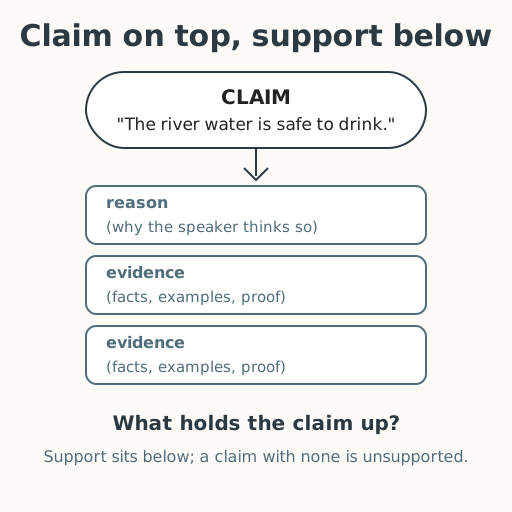
Lesson 1 — What Did the Speaker Actually Claim?
Summary
Learners separate a speaker’s claim (the main point they want you to accept) from their support (the reasons and evidence they offer). They practice on short, everyday examples from several world regions, and begin to notice when support is thin or missing — the first step toward evaluating reasoning.
Objectives
- Separate a speaker’s main claim from its support, telling reasons from evidence, and notice where support is thin or missing. (D04.S1.07.01)
Connection
All day you hear people asking you to accept things: “This fruit is the freshest at the market,” “The bus comes at seven,” “That medicine works,” “My team is better.” Behind every one of these is a claim — a point someone wants you to believe — and support — the reasons and evidence they give for it. Whether you are in a market in Accra, a bus stop in Jakarta, or a clinic in La Paz, the first move of a careful listener is the same: name the claim, then look for its support.
Materials
- Claim/support poster
- Claim/support page
- Three short spoken examples
Preparation
- Print or draw the claim/support poster: one claim bubble on top, three empty support boxes below.
- Copy a claim/support page for each learner.
- Prepare three short spoken claims (about 2–3 sentences each). Suggested, adaptable set: a market vendor’s pitch, a radio weather report, a friend’s opinion about a game or a place.
Facilitator note
This lesson is written to the learner (“you”). The idea to land is that every argument
has a claim and support, and the listener’s first job is to separate them — not yet to
judge whether the support is good (that comes next lesson). Use worked examples: model
naming a claim and its support aloud on the poster before learners try their own
(Kirschner, Sweller & Clark, 2006). Choose examples from many places and languages so no
region or accent is the “default”; translate each into the learners’ home language. Keep
the examples small and safe — market, weather, games — not loaded disputes. See
docs/facilitation.md and docs/art-style.md.
Procedure
- Gather (5 min). Recall: in earlier grades you learned to find a speaker’s main argument. Today you sharpen it. Think of the last time someone tried to convince you of something. What were they claiming?
- Meet claim and support (10 min). Look at the poster. A claim is the point a speaker wants you to accept. Support is what they give for it — reasons (why they think so) and evidence (facts, examples, or proof). Worked example, said aloud: “You should buy these tomatoes — claim. They were picked this morning — evidence. They will taste better than the old ones — reason.” Say each part with me.
- Sort three examples (15 min). Listen to each example twice. For each, write the claim in the bubble and any support in the boxes below. Label each support as a reason or evidence if you can. Compare with a partner.
- Notice the gap (10 min). Look at your pages. Which claim had the thinnest support? Which had none? A claim with little or no support is unsupported — it may still be true, but the speaker has not shown it yet.
- Close (5 min). You can now see the skeleton of any argument: claim on top, support below. Tomorrow you will check whether the support actually holds the claim up.
Differentiation
- Support: Provide the claim bubble pre-filled; learners only find and sort the support, and label “reason” vs “evidence” with a word bank.
- Extension: Ask learners to find a claim with two different kinds of support and a claim with a reason but no evidence, and write each down.
Assessment
- Formative (observation): Can the learner state the claim in their own words and point to at least one piece of support, separating reason from evidence?
- Self-check: The learner rereads their page and checks that the claim is a point to accept (not the support) and that each support box holds a reason or evidence.
Home connection
Listen to one claim at home this week — a family member’s opinion, a radio or phone message — and tell someone at home what the claim was and what support came with it.
Resources
- On separating a main argument from its support as a listening skill: International Listening Association, “Listening Skills,” https://listen.org/; and CASEL’s relationship-skills competency, https://casel.org/fundamentals-of-sel/
- On modeling a new skill before independent practice: Kirschner, Sweller & Clark (2006), https://doi.org/10.1207/s15326985ep4102_1