Lesson 02 — The Reasoning Chain: Claim, Reason, Evidence
Learners see reasoning as a chain of three links — claim, reason, evidence — and learn to find the exact place where a chain is weak or broken. They test strong and weak spoken arguments and name the gap when a reason lacks evidence or evidence is off-topic.
Objectives
Objectives
- D04.S1.07.01 Evaluate a speaker's reasoning, identifying unsupported claims and asking probing questions.
Essential question
How do a claim, its reasons, and its evidence link together — and where can the chain break?
Key vocabulary
Materials
Standard materials
- Chain poster · 1 Three paper links labeled claim, reason, evidence, joined in a chain, with one spare broken link to show a gap
- Chain page · 1 per learner Three blank links in a row for the learner to fill in a claim, a reason, and evidence
- Four short spoken arguments · 1 set Two strong and two with a broken link, read aloud (market, school, health, weather)
Low-tech / no-cost
- Three objects and string Use three stones or leaves linked by a string to stand for claim, reason, evidence; break one link to show a gap
- Voice Say the chain aloud — "claim because reason, shown by evidence" — and pause at the gap
Enriched / lab & device
- Paper chain strips · 1 set Pre-cut strips learners physically link and unlink to build and break reasoning chains
- Recording app · 1 per group Learners record their own short argument and replay it to test the chain for gaps
Works in different contexts
- large-group Build one chain together as a class, then have pairs build and break chains on their own pages and hold them up
- self-directed A learner fills the chain page for each example and checks each link against an answer note that marks the gap
- multi-age Younger learners build a two-link chain (claim + one support); older learners add the evidence link and name where a link is missing
- outdoor-only Build the chain with found objects on the ground — three stones joined by string — and break one link to reveal the gap
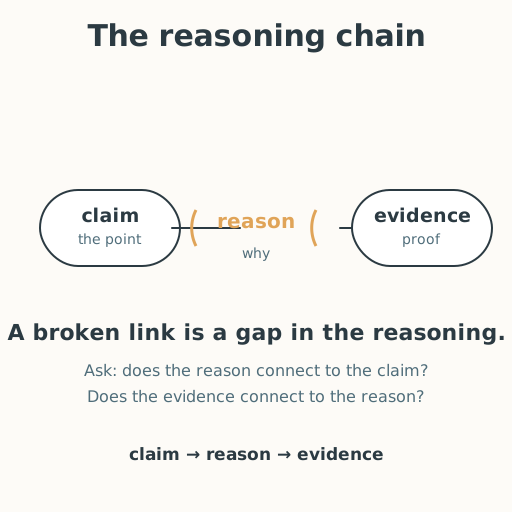
Lesson 2 — The Reasoning Chain: Claim, Reason, Evidence
Summary
Learners model reasoning as a chain of three links — claim, reason, evidence — and learn to find the exact place a chain is weak. They test spoken arguments from several world regions, naming a gap when a claim has no reason, a reason has no evidence, or the evidence does not fit the claim.
Objectives
- Trace the link from claim to reason to evidence in a spoken argument, and name where the chain is weak or broken. (D04.S1.07.01)
Connection
A strong argument holds together like a chain. The claim is the first link, the reason the second, the evidence the third. Pull on a chain and it breaks at its weakest link — so the careful listener asks not just “what is the claim?” but “does each link actually connect to the next?” A neighbor’s advice about which seed to plant, a radio story about a storm, a friend’s case for which road to take: each one is a chain you can check.
Materials
- Chain poster
- Chain page
- Four short spoken arguments
Preparation
- Make the chain poster: three paper links labeled claim, reason, evidence, plus one spare broken link.
- Copy a chain page for each learner.
- Prepare four short arguments (two strong, two with a broken link). Adaptable set: a market pitch (strong), a school proposal (strong), a health claim with no evidence (broken), a weather claim with off-topic evidence (broken).
Facilitator note
This lesson is written to the learner (“you”). The idea to land is that reasoning is a
chain, and evaluating it means finding the weak link — not rejecting the person.
Model one full chain and one broken chain as worked examples before independent practice
(Kirschner, Sweller & Clark, 2006). Keep arguments small and safe; translate everything
into the home language; vary accents and regions so no voice is “the correct one.” The
four lenses: ethics (is the reasoning honest?); egalitarianism (does a weak chain
hurt some people more — e.g., a false health claim spread to those with less access to
doctors?); global (reasoning patterns appear everywhere); technology (radio, phone,
and internet carry claims faster, so checking chains matters more). See
docs/facilitation.md.
Procedure
- Gather (5 min). Recall last lesson: a claim sits on top and support sits below. Today you check whether the support holds. What is the difference between a reason and evidence?
- Meet the chain (10 min). Look at the chain poster. A full chain: claim → reason → evidence. Worked example, said aloud: “We should leave early for the market — claim. The bridge floods in heavy rain — reason. It flooded twice last month — evidence.” Now a broken one: “This drink cures colds — claim. My uncle says so — reason. … and then nothing.” Where is the break? (No evidence.)
- Test four arguments (15 min). Listen to each argument twice. On your chain page, fill the three links. If a link is missing or the evidence does not fit the claim, draw the link broken and write one word for the gap (no reason / no evidence / off-topic).
- Name the gap (10 min). With a partner, say each gap aloud: “The claim has a reason, but no evidence,” or “The evidence is about something else.” Which gap was hardest to spot?
- Close (5 min). You now check the connections, not just the pieces. Tomorrow you will turn the gaps you find into probing questions.
Differentiation
- Support: Provide the chain page with the claim pre-filled; learners add one reason or mark “missing” and “off-topic” from a checklist.
- Extension: Write one new argument with a deliberately off-topic evidence link and ask a partner to find it.
Assessment
- Formative (observation): Can the learner fill all three links for a strong argument and correctly name the broken link for a weak one?
- Peer-check: Partners exchange chain pages and check that each gap is named with the right word (no reason / no evidence / off-topic).
Home connection
Ask someone at home to give you one reason for something they believe, then gently ask, “What is the evidence?” — and notice whether the chain holds or breaks.
Resources
- On separating claim, reason, and evidence as comprehension and listening skills: Duke & Pearson (2002), “Effective Practices for Developing Reading Comprehension”; and the International Listening Association, https://listen.org/
- On modeling before practice: Kirschner, Sweller & Clark (2006), https://doi.org/10.1207/s15326985ep4102_1