Lesson 06 — Setting and Plot: The World and What Happens
Learners analyze how an author develops a story's setting and plot together — how the world of the story causes the conflict and shapes the events. They map a short original story onto a story-mountain and explain the link between setting and plot.
Objectives
Objectives
- D04.S2.07.01 Analyze how an author develops characters, setting, and plot or central ideas across a text.
Essential question
How do a story's setting and its plot work together, and how does the author develop them across the text?
Key vocabulary
Materials
Standard materials
- Story-mountain page · 1 per learner A blank story-mountain (rising action, climax, falling action, resolution) with a setting box at the base
- The River Crossing (original short story) · 1 per learner A short original story set beside a flooding river, with a clear plot arc (about 200 words)
- Highlighter or pencil · per learner
Low-tech / no-cost
- Voice and body Retell the plot aloud, climbing a hand up the "mountain" at the climax; no paper needed
- Stones to mark plot beats Place five stones in a rising line to show the plot climbing to a peak
Enriched / lab & device
- A second story from another region · 1 Optional text to compare how setting shapes a different plot
- Digital story-mountain template · 1 per pair A shared slide or document to build the mountain together
Works in different contexts
- large-group Build the mountain on the board together, then have pairs find the setting details that make the plot possible
- self-directed A learner reads the story, fills the mountain, and checks the five beats against an answer note
- multi-age Younger learners name the setting and the climax; older learners map all five beats and explain how the setting causes the conflict
- outdoor-only Tell the story in a circle, then walk the plot arc across the ground, climbing to the climax
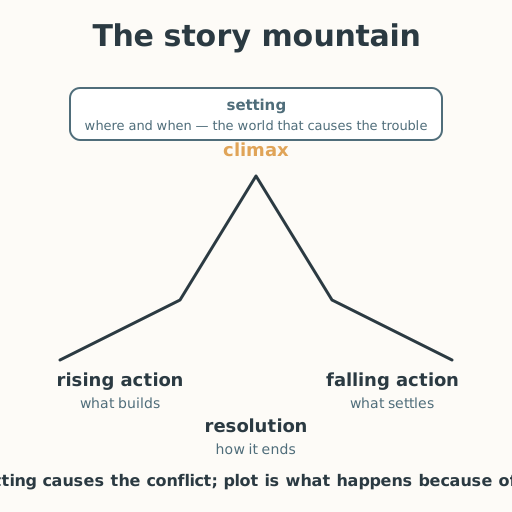
Lesson 6 — Setting and Plot: The World and What Happens
Summary
Learners trace how a story’s setting (where and when it happens) and its plot (what happens, in order) develop together. They map a short original story onto a story-mountain — rising action, climax, falling action, resolution — and explain how the setting causes the conflict.
Objectives
- Analyze how an author develops setting and plot across a text, and how the two work together. (D04.S2.07.01)
Connection
Every story happens somewhere, and that somewhere usually causes the trouble. A story set beside a flooding river is about the flood; a story set on a dry steppe is about water; a story set in a crowded city is about people. The setting is not wallpaper — it is the engine of the plot. Whether the story comes from a fishing village in Senegal, a mountain pass in Nepal, or a port city in Chile, the reader’s job is the same: find the world, then watch what it makes happen.
Materials
- Story-mountain page
- “The River Crossing (original short story)”
- Highlighter or pencil
Preparation
- Copy the story-mountain page and the story for each learner.
- Read the story once; mark where the climax occurs.
Facilitator note
This lesson is written to the learner (“you”). The idea to land is that setting and
plot develop together — the setting causes the conflict, and the plot is the chain of
what happens because of it. Model one worked example: read the story aloud, then place
the first two beats on the mountain and say why the setting caused them (Kirschner,
Sweller & Clark, 2006). The story is an original teaching text, not a sacred or cultural
narrative; treat it as one invented example. The four lenses: environment (the natural
world is a character — flood, steppe, city); global (compare this river story with
water stories learners know); egalitarianism (in the story, everyone must work together
to cross — no hero alone); critical-thinking (plot beats need text evidence). See
docs/facilitation.md.
Procedure
- Gather (5 min). Think of a story you know. Where does it happen? Would the story still work if you moved it somewhere else? Why or why not?
- Read the story (10 min). Read “The River Crossing” once, then once more. As you read, underline words that tell you the setting (place, weather, time).
- Map the mountain (15 min). On your story-mountain, write the setting in the base box. Then fill the beats: the rising action (what builds), the climax (the turning point), the falling action, and the resolution (how it ends).
- Link setting to plot (10 min). With a partner, say it aloud: “Because the river was flooding, …” — trace how the setting caused the conflict. What would change if the setting were a dry plain?
- Close (5 min). Setting and plot are one machine. Tomorrow you will trace the third strand: the central idea an author develops across a whole text.
Differentiation
- Support: Provide the mountain with the setting and climax pre-filled; learners add the resolution only.
- Extension: Rewrite the story’s ending in a different setting and explain how the plot changes.
Assessment
- Formative (observation): Can the learner place the climax correctly and name one way the setting causes the conflict?
- Self-check: The learner rereads the mountain and confirms each beat is backed by a sentence from the story.
Home connection
Retell the plot of a film or story you watched to someone at home in four beats — including the climax — and ask them to guess the setting from your retelling.
Resources
- On how story structure and setting shape meaning: Duke & Pearson (2002), “Effective Practices for Developing Reading Comprehension”; and IES/What Works Clearinghouse, “Improving Adolescent Literacy” (2008), https://ies.ed.gov/ncee/wwc/practiceguide/8
- On modeling before practice: Kirschner, Sweller & Clark (2006), https://doi.org/10.1207/s15326985ep4102_1
The River Crossing (original short story)
It was the season of rains, and the river behind the village had risen in the night. By morning it was no longer a river but a wide, brown road of rushing water, carrying branches and a drowned cooking pot. The only bridge — three planks and a rope — was half under the flood.
An old woman stood on the near bank with a sack of seed rice. A boy stood beside her with a goat on a rope. “We must cross before the water rises more,” the woman said. “The seed must reach the far fields, or the planting will be late.”
The planks were slick. The boy went first, leading the goat. The goat bleated and slipped, and the boy grabbed the rope with both hands. The current pulled. “Help me,” he called.
The old woman set down the rice, took the rope, and pulled with all her strength. The boy dug his heels into the mud. The goat scrambled onto the bank. Then the boy held the rope for the old woman as she crossed, the sack of seed balanced on her head.
On the far bank, the two of them stood and watched the river swallow the bridge. “We crossed just in time,” the boy said. The old woman smiled. “No,” she said. “We crossed because we pulled together.”