Lesson 05 — How an Author Builds a Character
Learners analyze how an author develops a character across a text — through what the character does, says, and learns — and support their reading with text evidence. They use a short retelling of the Japanese folktale "The Stonecutter," then apply the same map to a character from their own reading.
Objectives
Objectives
- D04.S2.07.01 Analyze how an author develops characters, setting, and plot or central ideas across a text.
Essential question
How does an author develop a character across a story — and how do I find the evidence for the change?
Key vocabulary
Materials
Standard materials
- Character-change map · 1 per learner A two-column page — character at the beginning, character at the end — with an arrow between and a line for text evidence
- The Stonecutter (retold) · 1 per learner A short, faithful retelling of the Japanese folktale for close reading (about 200 words)
- Highlighter or pencil · per learner
Low-tech / no-cost
- Voice Read the tale aloud twice; learners retell the change aloud and point to the words that show it
- Two stones and a line in the dirt One stone is the character at the start, one at the end; the line between shows the change
Enriched / lab & device
- Two short character passages · 1 set Optional second and third texts (a story from another region) to compare how different authors build character
- Digital annotation tool · 1 per pair Highlight text evidence in a shared document
Works in different contexts
- large-group Read the tale together, build the change map on the board, then have pairs find one piece of evidence each
- self-directed A learner reads the tale, fills the change map, and checks their evidence against an answer note
- multi-age Younger learners name one trait at the start and one at the end; older learners add the *cause* of the change and cite the sentence
- outdoor-only Tell the tale aloud in a circle, then act out the character's change with the body; no paper needed
Lesson 5 — How an Author Builds a Character
Summary
Learners trace how an author develops a character across a text — through actions, words, and what the character learns — and back each step with text evidence. They close-read a retelling of the Japanese folktale “The Stonecutter,” map the change, and apply the same map to a character of their own choosing.
Objectives
- Analyze how an author develops a character across a text, using evidence from the text to support the reading. (D04.S2.07.01)
Connection
People in stories are not the same at the end as they were at the beginning — and neither are the people around you. The stonecutter who wishes for more, the friend who learns to listen, the character who stops being afraid: an author shows these changes through small clues — what a person does, says, and learns. Finding those clues is the reader’s detective work, and it works the same in a Japanese folktale, a novel from Lagos, or a telenovela from Mexico City.
Materials
- Character-change map
- “The Stonecutter (retold)”
- Highlighter or pencil
Preparation
- Copy the character-change map and the tale for each learner.
- Read the tale once yourself; mark the sentences that show the change.
Facilitator note
This lesson is written to the learner (“you”). The idea to land is that character is
shown, not stated — through actions, words, and learning — and the reader supports the
reading with evidence from the text. Model one worked example: read the tale aloud,
then mark the sentence where the character changes and say why it shows change
(Kirschner, Sweller & Clark, 2006; Duke & Pearson, 2002). The tale is a folktale in the
public tradition; teach it as one culture’s story among many, never as “the” way. The
four lenses: ethics (what the character values, and whether it changes); egalitarianism
(every culture’s stories carry wisdom — none is the default); global (this is a Japanese
tale; compare with tales learners know); critical-thinking (claims about a character
need text evidence). See docs/facilitation.md.
Procedure
- Gather (5 min). Think of a character you know from a story, film, or series. How were they at the start? How were they at the end? What changed?
- Read the tale (10 min). Read “The Stonecutter” once, then once more. As you read, underline any sentence that shows what the character is like or how he changes.
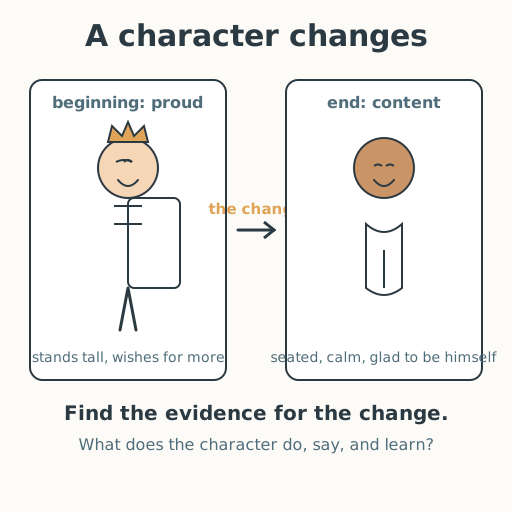
- Map the change (15 min). On your map, write the character at the beginning (proud, wishing to be greater) and at the end (content, glad to be himself). On the line, write the evidence — the exact words that show the change. Example: at the end he wishes to be a stonecutter again and is happy.
- Name the craft (10 min). How does the author show the change — through actions (what he does), words (what he asks for), or learning (what he understands)? Put a check beside each one you find.
- Close (5 min). You can now trace a character’s arc. Next lesson you will trace how the world of a story — its setting — and its plot develop too.
Differentiation
- Support: Provide the map with the beginning and end traits pre-filled; learners find and copy one sentence of evidence for each.
- Extension: Choose a character from your own reading and fill a second change map, naming the cause of the change.
Assessment
- Formative (observation): Can the learner state how the character changed and point to a specific sentence as evidence?
- Self-check: The learner rereads their map and confirms each trait is backed by at least one piece of text evidence.
Home connection
Ask someone at home about a character in a story or show you both know: how did they change, and what made them change?
Resources
- On citing text evidence to support an interpretation: Duke & Pearson (2002), “Effective Practices for Developing Reading Comprehension”; and IES/What Works Clearinghouse, “Improving Adolescent Literacy” (2008), https://ies.ed.gov/ncee/wwc/practiceguide/8
- On modeling before practice: Kirschner, Sweller & Clark (2006), https://doi.org/10.1207/s15326985ep4102_1
The Stonecutter (retold)
Once there was a stonecutter who cut stone at the foot of a mountain. One hot day, as he worked, a rich man passed in a fine carriage with servants. “How great it must be to be rich,” the stonecutter sighed. A spirit of the mountain heard him and made him rich.
But then the sun beat down on his fine house, and he wished to be the sun. The spirit made him the sun. Then a cloud covered the sun, and he wished to be the cloud. The spirit made him the cloud. Then the wind blew the cloud away, and he wished to be the wind. The spirit made him the wind. Then the wind blew against the mountain and could not move it, and he wished to be the mountain. The spirit made him the mountain.
Then, from far below, he felt a small tapping — a stonecutter, cutting stone at his foot. “Ah,” said the mountain, “it is good to be a stonecutter.” And the spirit made him a stonecutter again, and he was content.