Lesson 08 — Can I Trust This Source?
Learners evaluate the credibility of a source by running a three-part check — author, purpose, evidence — and reach a verdict of trust, question, or reject. They practice on four short sources that make the same claim but differ in who wrote them, why, and what proof they give.
Objectives
Objectives
- D04.S2.07.02 Evaluate the credibility of a source by checking its author, purpose, and evidence.
Essential question
How do I judge whether a source is credible by checking its author, purpose, and evidence?
Key vocabulary
Materials
Standard materials
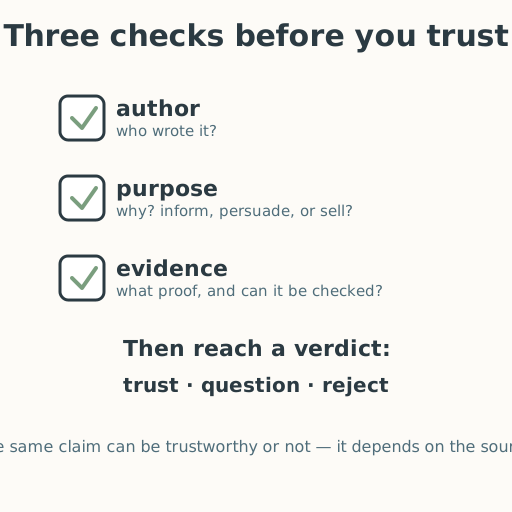
- Three-part trust checker · 1 per learner A page with three check boxes — author, purpose, evidence — each with one or two probing questions
- Source cards · 1 set Four short sources making the same claim (a health remedy, a product, a news event), varying in author, purpose, and evidence
- Highlighter or pencil · per learner
Low-tech / no-cost
- Voice Read each source aloud; learners call out the author, purpose, and evidence; no cards needed
- Three stones as the three checks Place a stone for author, one for purpose, one for evidence; lift a stone when a check fails
Enriched / lab & device
- Real online sources · 1 set Optional: open two real pages about the same claim and run the three-part check on each
- Device with a browser · 1 per pair For looking up an author or organization when the card does not say
Works in different contexts
- large-group Run the three-part check on one source together, then have pairs check the rest and hold up their verdicts
- self-directed A learner runs the three-part check on each source and writes a verdict — trust, question, or reject — with a reason
- multi-age Younger learners check just the author; older learners check all three and name the source's purpose (inform vs persuade vs sell)
- outdoor-only Discuss a claim from daily life (a sign, a rumor, a seller's promise) and run the three checks aloud
Lesson 8 — Can I Trust This Source?
Summary
Learners judge whether a source is credible by running a three-part check — author, purpose, evidence — and reaching a verdict: trust, question, or reject. They practice on four short sources that make the same claim but differ in who wrote them, why they wrote, and what proof they offer.
Objectives
- Evaluate the credibility of a source by checking its author, purpose, and evidence. (D04.S2.07.02)
Connection
Not everything you read or hear is equally trustworthy. A claim that a certain tea cures colds, that a certain phone is the best, that a certain event happened — the same claim can come from a doctor or a stranger, from a newsroom or a seller, with proof or with none. Before you believe, you check three things: who wrote it, why they wrote it, and what evidence they give. This habit protects you and the people you care about, whether the claim arrives by paper in Bamako, by radio in Manila, or by phone anywhere.
Materials
- Three-part trust checker
- Source cards
- Highlighter or pencil
Preparation
- Copy the trust checker and the source cards for each learner.
- Prepare four short sources making one shared claim. Adaptable example claim: “This herb tea cures colds.” Sources: (1) a doctor’s note with a study, (2) a seller’s ad with no evidence, (3) an anonymous post with a strong feeling, (4) a health-organization page with named evidence.
Facilitator note
This lesson is written to the learner (“you”). The idea to land is that credibility is
checked, not felt — through author, purpose, and evidence — and the result is a verdict,
not a ranking of people. Model one worked example: run all three checks on one source
aloud, reaching “trust” and saying why (Kirschner, Sweller & Clark, 2006). Distinguish
a source’s purpose (to inform, to persuade, to sell) from its bias. The four lenses:
ethics (honest sources show their evidence); egalitarianism (a false health claim
hurts those with least access to doctors most); global (credibility checks work in every
language and media system); technology (the internet spreads both good and bad sources
at the same speed — the check matters more, not less). See docs/facilitation.md.
Procedure
- Gather (5 min). Think of a time you believed something and later found it was not true. What would you check now, before believing again?
- Meet the three-part check (10 min). Read the trust checker. Author: who wrote this, and do they know the subject? Purpose: why — to inform, to persuade, or to sell? Evidence: what proof is given, and can it be checked? Worked example: run the three checks on source 1 aloud and reach a verdict.
- Check four sources (15 min). With a partner, read the source cards. For each, fill the three boxes and write a verdict: trust, question, or reject — with one reason.
- Compare verdicts (10 min). Two pairs share. Did you agree? Where you differed, what check changed the verdict? Notice: the same claim can be trustworthy or not depending on the source.
- Close (5 min). You now own a shield and a tool: before you believe, check who, why, and what proof. Tomorrow you begin to write — with the same standards you now expect of others.
Differentiation
- Support: Provide the verdicts pre-suggested and a sentence starter (“I question this because the author…”); learners check one source at a time.
- Extension: Look up the author of one source online and add what you found to the author box, revising your verdict if needed.
Assessment
- Formative (observation): Can the learner name the author, purpose, and evidence of a source and give a verdict with a reason?
- Peer-check: Partners exchange trust checkers and confirm each verdict is backed by at least one named check.
Home connection
Pick one claim you hear this week — an ad, a message, a rumor — and run the three checks aloud with someone at home: who, why, and what proof?
Resources
- On source credibility and media literacy: UNESCO Media and Information Literacy (MIL), https://www.unesco.org/en/media-information-literacy; and Common Sense Education, “News & Media Literacy,” https://www.commonsense.org/education/digital-citizenship/topic/news-and-media-literacy
- On modeling before practice: Kirschner, Sweller & Clark (2006), https://doi.org/10.1207/s15326985ep4102_1