Lesson 09 — Precise Language and Well-Chosen Details
Learners turn vague writing into precise writing by choosing relevant, well-chosen details and concrete, sensory words. They compare vague-to-precise sentence pairs, revise three sentences of their own, and explain why each new detail belongs to the idea.
Objectives
Objectives
- D04.S3.07.01 Develop ideas with relevant, well-chosen details and precise language across a range of genres.
Essential question
How do I develop an idea with relevant, well-chosen details and precise language?
Key vocabulary
Materials
Standard materials
- Vague-to-precise pairs · 1 set A set of sentence pairs — a vague sentence beside a precise revision — to compare
- Revision page · 1 per learner A page with three vague sentences to rewrite with precise, relevant details
- Highlighters or two colors of pencil · per learner
Low-tech / no-cost
- Voice Say a vague sentence aloud, then a precise one; learners name which is which and why
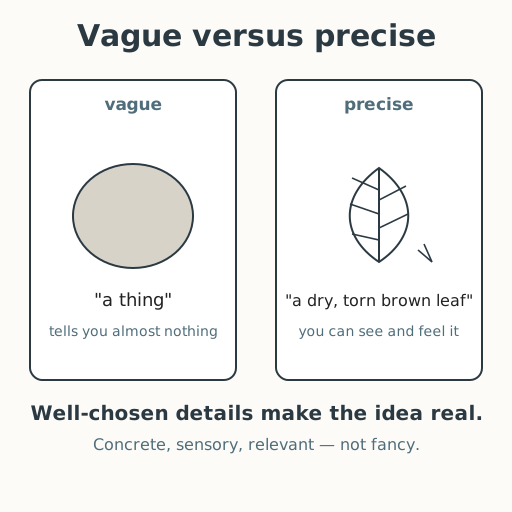
- Two objects from nearby Describe a leaf or stone first vaguely ("a thing") then precisely ("a dry brown leaf, torn at the edge"); compare
Enriched / lab & device
- A word-bank of precise verbs and sensory words · 1 per pair A list (trudged, glinted, sour, rustled) to choose from when revising
- Digital document for shared editing · 1 per pair Revise sentences together in a shared file, tracking the changes
Works in different contexts
- large-group Revise one vague sentence together on the board, then have pairs revise the rest and share one favorite change
- self-directed A learner rewrites each vague sentence and checks each change against the question "does this detail belong to the idea?"
- multi-age Younger learners replace one vague word with a precise one; older learners add two relevant sensory details and cut one irrelevant one
- outdoor-only Describe a nearby object first vaguely then precisely aloud; no paper needed
Lesson 9 — Precise Language and Well-Chosen Details
Summary
Learners develop ideas with relevant, well-chosen details and precise language. They compare vague and precise sentence pairs, revise three vague sentences of their own, and explain why each new detail belongs to the idea — the writer’s version of the evidence standard they applied as readers and listeners.
Objectives
- Develop ideas with relevant, well-chosen details and precise language. (D04.S3.07.01)
Connection
“Somewhere there was a thing that did something.” That sentence is true of almost everything and tells you almost nothing. Writing comes alive when the words get specific: not “a bird” but “a wet-eyed heron,” not “it was hot” but “the tin roof burned your hand.” The same idea — a hard journey, a good meal, a storm — can be told vaguely or precisely, in any language. Precise writing is not fancy writing; it is honest writing, and it is how you make a reader see what you see.
Materials
- Vague-to-precise pairs
- Revision page
- Highlighters or two colors of pencil
Preparation
- Copy the vague-to-precise pairs and the revision page for each learner.
- Prepare one vague sentence to revise together on the board.
Facilitator note
This lesson is written to the learner (“you”). The idea to land is that precise writing
chooses details that belong to the idea — relevant, concrete, sensory — and cuts details
that wander off. Model one worked example: take a vague sentence, revise it step by
step, and say why each added detail belongs (Kirschner, Sweller & Clark, 2006; Graham
& Perin, 2007). Emphasize “relevant” as much as “precise”: a precise detail that does not
fit the idea is clutter, not craft. The four lenses: ethics (precision is honesty — the
writer refuses to blur); egalitarianism (every learner’s language has precise words;
none is “more precise” by nature); global (sensory details differ by place — a roof of
tin, of thatch, of snow — and all can be precise); critical-thinking (choosing is
judging: which detail earns its place?). See docs/facilitation.md.
Procedure
- Gather (5 min). Say this sentence: “The weather was bad.” Now say it so someone can see it. What did you add?
- Compare pairs (10 min). Read the vague-to-precise pairs. For each, find the words that changed: vague nouns become concrete, weak verbs become exact, general weather becomes sensory detail. Underline the precise words.
- Revise three sentences (15 min). On your revision page, rewrite each vague sentence with at least two relevant, precise details. Use words a reader can see, hear, smell, or feel.
- Check relevance (10 min). With a partner, read your revisions. For each added detail, ask: “Does this detail belong to the idea?” Cross out any detail that wanders off, and keep the ones that earn their place.
- Close (5 min). Precise writing is a choice you make word by word. Tomorrow you will shape one idea into many different genres.
Differentiation
- Support: Provide a word bank and revise one sentence at a time; allow one added detail instead of two.
- Extension: Revise a paragraph of your own from another subject, adding precise details and cutting one irrelevant one.
Assessment
- Formative (observation): Can the learner replace vague words with precise ones and name why a detail is relevant?
- Self-check: The learner rereads each revision and confirms every added detail can be seen, heard, or felt — and belongs to the idea.
Home connection
Describe one ordinary thing at home to someone — first vaguely, then precisely — and ask them which version they could see.
Resources
- On teaching word choice, detail, and revision explicitly: Graham & Perin (2007), “Writing Next,” https://all4ed.org/reports-factsheets/writing-next/; and IES/What Works Clearinghouse, “Teaching Secondary Students to Write Effectively” (2016), https://ies.ed.gov/ncee/wwc/practiceguide/22
- On modeling before practice: Kirschner, Sweller & Clark (2006), https://doi.org/10.1207/s15326985ep4102_1