Lesson 14 — Every Voice Is a Correct Voice: Dialect and Accent
Learners recognize dialect and accent as natural variation in every language, and challenge the idea that one "standard" way of speaking is the only correct one. They name varieties of several world languages with respect and connect the idea to the unit's bigger theme: multilingualism as wealth.
Objectives
Objectives
- D04.S4.07.02 Recognize dialect and accent as natural variation, and challenge the idea that one way of speaking is correct.
- D04.S4.07.01 Explain what translation and interpretation are and describe when each is needed in everyday life.
Essential question
Why are dialect and accent natural variation — and how do I challenge the idea that one way of speaking is "correct"?
Key vocabulary
Materials
Standard materials
- Many voices map · 1 A world map or chart naming dialects and accents of several languages (Arabic, Spanish, Chinese, English, Hindi, Swahili) as equal variations
- One language, many ways cards · 1 set Cards naming several regional varieties of one language (e.g., Moroccan, Egyptian, Levantine Arabic) with a respectful note on each
- Voice-rights poster · 1 A poster stating "Every way of speaking is a correct way of speaking — for the people who speak it"
Low-tech / no-cost
- Voice Share greetings and words learners know in their own dialect or accent; name them as variations, not errors
- A map drawn in the dirt Draw the region of one language and place stones for its different ways of speaking
Enriched / lab & device
- Short audio clips of different accents · 1 set Optional: recordings of the same sentence in several accents of one language, to hear variation with respect
- Device with speakers · 1 per group For playing the clips
Works in different contexts
- large-group Build the many-voices map together, then have small groups each share one variety they know and one respectful phrase
- self-directed A learner reads the cards, writes one sentence naming a variety and why it is not "wrong," and checks it against the poster
- multi-age Younger learners share one word in their home variety; older learners also name a "standard" idea and challenge it
- outdoor-only Stand in a circle and share one word each in your own way of speaking; name them as equal variations aloud
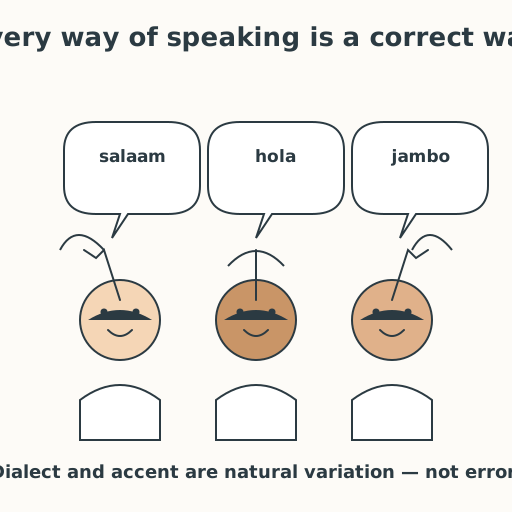
Lesson 14 — Every Voice Is a Correct Voice: Dialect and Accent
Summary
Learners recognize dialect and accent as natural variation in every language, and challenge the idea that one “standard” way of speaking is the only correct one. They name varieties of several world languages with respect, and connect the idea to the unit’s closing theme: multilingualism is wealth, and every voice carries dignity.
Objectives
- Recognize dialect and accent as natural variation, and challenge the idea that one way of speaking is correct. (D04.S4.07.02)
- Connect respect for every way of speaking to the work of translation and interpretation across languages. (D04.S4.07.01)
Connection
There is no language on Earth spoken exactly the same way everywhere. Arabic sounds one way in Casablanca, another in Cairo, another in Beirut — and each is fully, correctly Arabic. Spanish in Mexico City and in Buenos Aires differ, and both are right. The idea that one version is the “proper” one is a story people tell — usually about power, not about language. Every way of speaking is a correct way of speaking, for the people who speak it.
Materials
- Many voices map
- One language, many ways cards
- Voice-rights poster
Preparation
- Make or print the many-voices map and the voice-rights poster.
- Copy the “one language, many ways” cards for each group.
- Reflect on the class’s own languages and varieties so the discussion can begin at home.
Facilitator note
This lesson is written to the learner (“you”). The idea to land is that dialect and
accent are natural, rule-governed variation — every variety is “correct” for its speakers
— and the “one correct way” story is about prestige and power, not language itself
(Everett, 2012). Model respect first: share your own way of speaking before asking
learners to share theirs. Guard against ranking — no “better” or “worse,” ever (see
docs/facilitation.md). The four lenses: egalitarianism (whose way gets called
“standard” is a question of power, not merit); ethics (mocking an accent is harm, not
humor); global (every language has varieties — name several respectfully);
social-emotional (a learner’s accent may be a tender part of identity — handle with
care). This closes the unit: evaluation, writing, and now honoring every voice.
Procedure
- Gather (5 min). Recall the unit: you learned to evaluate reasoning, build presentations, judge sources, write precisely, and bridge languages. Today’s question: is there one “correct” way to speak a language?
- Meet variation (10 min). Look at the many-voices map. A dialect is a regional or social variety of a language — its own words and grammar. An accent is a way of pronouncing. Both are natural, everywhere, in every language. No variety is “broken.”
- Name many ways (15 min). With a group, read the “one language, many ways” cards — several varieties of Arabic, or Spanish, or Chinese, or English. For each, say one respectful thing: where it is spoken, what makes it distinct. Then share one word or phrase you know in your own way of speaking.
- Challenge the story (10 min). Together, ask: who decided one way was “standard”? Who benefits when other ways are called “wrong”? Write one sentence: “___ is not wrong — it is the correct way for the people who speak it.”
- Close (5 min). You have built the habits of a careful, fair, many-voiced world: evaluate reasoning, write with precision, bridge languages, and honor every voice. Carry these into every day.
Differentiation
- Support: Provide the sentence starter and one variety to describe; accept a spoken answer instead of a written one.
- Extension: Research one variety of a language you know and share two things that make it distinct — then name a time it was unfairly called “wrong.”
Assessment
- Formative (observation): Can the learner name a dialect or accent as natural variation and say why it is not “wrong”?
- Self-check: The learner rereads their sentence and confirms it names a real variety and challenges the “one correct way” idea.
Home connection
Ask someone at home which ways of speaking your family or region uses, and share one thing you love about the way your family speaks.
Resources
- On language as shaped by culture and use, and varieties as complete systems: Everett (2012), Language: The Cultural Tool; and UNESCO, International Mother Language Day (multilingualism and mother-tongue dignity), https://www.unesco.org/en/days/mother-language
- On learning a peer’s name and pronunciation as a matter of respect: Kohli & Solórzano (2012), “Teachers, please learn our names!”, https://doi.org/10.1080/13613324.2012.674026