Lesson 13 — Interpretation: Meaning in the Moment
Learners distinguish interpretation from translation — interpretation is spoken and live, translation is written and can take time — and sort everyday situations into which one is needed. They practice a short live interpretation and explain the choice.
Objectives
Objectives
- D04.S4.07.01 Explain what translation and interpretation are and describe when each is needed in everyday life.
Essential question
What is interpretation, how is it different from translation, and when is each needed in everyday life?
Key vocabulary
Materials
Standard materials
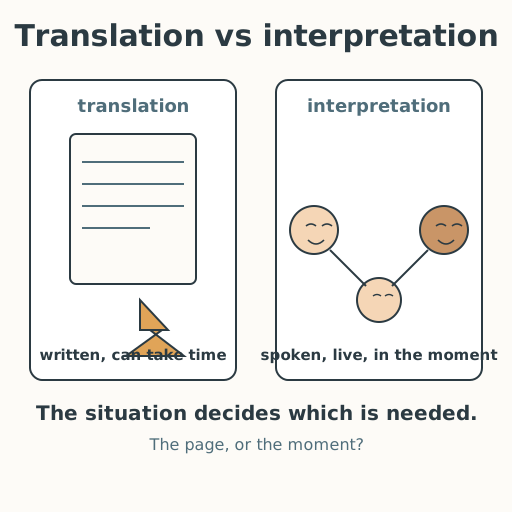
- Translation vs interpretation poster · 1 Two columns — "translation (written, can take time)" and "interpretation (spoken, live)" — with example situations under each
- Situation cards · 1 set Eight everyday situations (a medicine label, a doctor's visit, a news broadcast, a family letter) to sort into translation or interpretation
- Situation sort page · 1 per learner A two-column page to sort the situations and write one sentence of reason for each
Low-tech / no-cost
- Voice Act out one situation live (interpretation) and one written (translation); learners name which is which
- Two baskets or piles Sort situation slips into two piles — written or spoken — as a physical sort
Enriched / lab & device
- A recorded short speech or announcement · 1 Optional: watch or hear a live-interpretation example and compare it with a written translation
- Video of a conference interpreter · 1 Optional: a short clip showing live interpretation in action
Works in different contexts
- large-group Sort the situations together on the poster, then have pairs sort their own set and defend two choices
- self-directed A learner sorts the situations and writes a reason for each, then checks against an answer note
- multi-age Younger learners sort the situations; older learners also explain *why* a situation needs one and not the other
- outdoor-only Name real situations from daily life (a market bargain vs a written notice) and sort them aloud; no paper needed
Lesson 13 — Interpretation: Meaning in the Moment
Summary
Learners distinguish interpretation from translation — interpretation is spoken and live, translation is written and can take time — and sort everyday situations into which one is needed. They practice a short live interpretation and explain the choice, completing their picture of how people bridge languages.
Objectives
- Explain what interpretation is and describe when it — rather than translation — is needed in everyday life. (D04.S4.07.01)
Connection
A medicine label can be translated once, carefully, and printed on a thousand bottles. But when a grandmother describes her pain to a doctor in a language the doctor does not speak, no printed page will do — someone must carry the meaning right then, in the room, as it is spoken. That live, spoken bridge is interpretation. One is for the page, the other for the moment; both are skills real people use every day, in a hospital in Nairobi, a courtroom in São Paulo, or a parent–teacher meeting anywhere.
Materials
- Translation vs interpretation poster
- Situation cards
- Situation sort page
Preparation
- Make or print the two-column poster.
- Copy the situation cards and sort page for each learner.
- Prepare the eight situations (four written, four spoken). Adaptable set: a medicine label, a doctor’s visit, a news broadcast, a family letter, a school meeting, a train announcement, a poem in a book, a market bargain.
Facilitator note
This lesson is written to the learner (“you”). The idea to land is that translation is
written and can take time; interpretation is spoken and live — and the situation decides
which is needed. Model the sort with one written and one spoken situation as worked
examples before practice (Kirschner, Sweller & Clark, 2006). Keep the distinction clean
but honest: a real interpreter may also translate, and some jobs need both. The four
lenses: ethics (an interpreter must be faithful and honest about uncertainty in the
moment); egalitarianism (interpretation lets people who do not share a language meet as
equals); global (live interpretation happens wherever languages meet — markets,
hospitals, ports); social-emotional (interpreting for a family member is a real
responsibility — honor the person, not just the words). See docs/facilitation.md.
Procedure
- Gather (5 min). Recall translation — carrying written meaning across languages. What if the meaning must travel right now, as someone speaks? What do we call that?
- Meet the two columns (10 min). Read the poster. Translation: written, can take time, polished. Interpretation: spoken, live, in the moment. Worked example: a medicine label → translation; a doctor’s visit → interpretation. Say why for each.
- Sort the situations (15 min). With a partner, take the situation cards and place each in the right column on your page. Under each, write one short reason.
- Practice a live bridge (10 min). Choose one spoken situation and role-play it in pairs of three: a speaker, a listener who does not share the language, and an interpreter who carries the meaning live. Keep it short and kind.
- Close (5 min). You now hold both tools: the pen for the page and the voice for the moment. Tomorrow the unit closes by honoring the many ways one language is spoken.
Differentiation
- Support: Provide the situations pre-sorted; learners write the reason for each.
- Extension: Describe one real situation in your life that needed translation, one that needed interpretation, and one that needed both.
Assessment
- Formative (observation): Can the learner sort a situation correctly and give a reason that names written-vs-live?
- Peer-check: Partners compare sorts and defend any two different choices with reasons.
Home connection
Think of a moment in your family or neighborhood where someone bridged two languages — was it written or spoken? Tell someone at home what you decided.
Resources
- On plurilingual communication across languages: Common European Framework of Reference for Languages, Companion Volume (Council of Europe, 2020), https://www.coe.int/en/web/common-european-framework-reference-languages/
- On language as a cultural tool: Everett (2012), Language: The Cultural Tool
- On modeling before practice: Kirschner, Sweller & Clark (2006), https://doi.org/10.1207/s15326985ep4102_1