Lesson 01 — Unit Rates in Real Life
Learners turn a rate (3 kg for $12) into a unit rate (the amount for one — $4 per kg) by dividing, and use unit rates to compare two real offers fairly. They compute and compare unit prices, speeds, and "per one" rates, and write equivalent rates.
Objectives
Objectives
- D05.S1.07.01 Use proportional relationships, including unit rates, scale, and percentages, to solve multi-step problems in real contexts.
Essential question
How does a unit rate let me compare two real situations fairly?
Key vocabulary
Materials
Standard materials
- Market price cards · 1 set per pair Cards showing two competing offers (e.g., 3 kg for $12 vs 5 kg for $18) to compare with unit rates
- Unit-rate recording page · 1 per learner A page with blank unit-rate tables and comparison questions
- Counters and coins (or play money) · per pair To act out buying and rate-comparing before writing numbers
Low-tech / no-cost
- Found objects as goods Use stones, seeds, or leaves as "goods" and pebbles as "coins"; set two offers and find the cheaper per-one price
- Voice and body Chant the rate ("$4 per kg, $4 per kg") and pace out a walking rate in steps per minute
Enriched / lab & device
- A unit-price comparison game · 1 per group Cards pairing offers with their unit rates; learners sort cheapest-to-most-expensive for repeated play
- A calculator or spreadsheet · 1 per group To divide and compare unit prices where devices allow, and to see the same rate in different units
Works in different contexts
- large-group Compare two offers together on a chart, then have pairs work card sets and check each other's unit rates
- multi-age Younger learners count out goods and coins while older learners compute and write the unit rate
- self-directed A learner works the recording page alone, dividing each total by its amount and checking against the worked example
- level-grouped Learners ready to extend work with complex fractions (e.g., 2/3 kg for $4 → rate per 1 kg) and mixed units
- outdoor-only Use found goods and pebbles outdoors; measure a walking or carrying rate in steps per minute
Lesson 1 — Unit Rates in Real Life
Summary
Learners turn a rate (3 kg for $12) into a unit rate — the amount for one ($4 per kg) — by dividing, and use unit rates to compare two real offers fairly. They compute and compare unit prices, speeds, and other “per one” rates, and write equivalent rates.
Objectives
- Use a unit rate to compare two real situations and solve a real problem. (D05.S1.07.01)
Connection
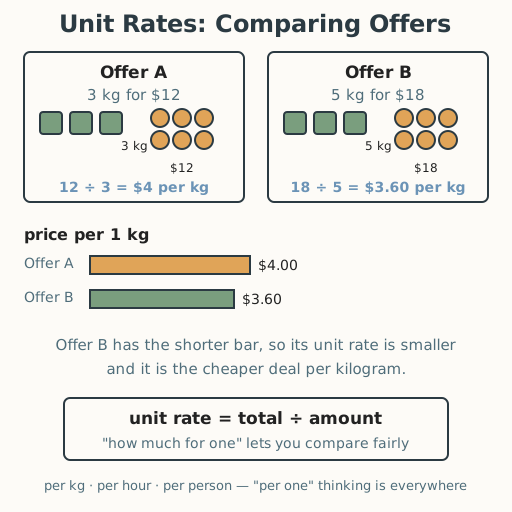
Two stalls in a market sell the same rice: one offers 3 kg for $12, the other 5 kg for $18. Which is the better deal? You cannot compare “3 for 12” with “5 for 18” directly — the amounts differ. So you find the price for one kilogram. The first is $12 ÷ 3 = $4 per kg; the second is $18 ÷ 5 = $3.60 per kg. The second is cheaper. Finding “how much for one” is how shoppers, farmers, drivers (kilometres per hour), and cooks (per person) compare fairly, in every market on Earth.
Materials
- Market price cards
- Unit-rate recording page
- Counters and coins (or play money)
Preparation
- Copy market price cards for pairs and the unit-rate recording page for each learner.
- Have worked examples ready: 3 kg for $12 → $4 per kg; 5 kg for $18 → $3.60 per kg.
- Recall from Grade 6: ratios and equivalent ratios (multiplying both parts together).
Facilitator note
This lesson is written to the learner (“you”). The ideas to land: (1) a rate compares
two different units (money per kilogram, kilometres per hour); (2) a unit rate is the
amount for one, found by dividing; and (3) unit rates let you compare fairly when totals
differ. Because division for unit rates is a foundational skill, use explicit instruction
and worked examples first (Kirschner, Sweller & Clark, 2006): model 3 kg for $12 aloud,
then guide 5 kg for $18 before independent work. Watch for the slip of dividing the wrong
way (writing “kg per dollar” when the question asks dollars per kg). Retrieval: ask learners
to recall ratios and “for every” thinking from Grade 6 — a unit rate is a ratio where the
second number is 1. The egalitarian lens (docs/philosophy.md §4): comparing unit prices is
a tool of fair dealing — it lets a person with little money find the honest cheapest offer
and resist being overcharged. The global lens: unit-rate reckoning appears in the ancient
Egyptian Rhind Mathematical Papyrus (c. 1650 BCE), whose problems divide grain, loaves,
and labour into “per one” amounts — “how much for one” is a human universal, not one
culture’s invention.
Procedure
- Gather (5 min). Think of a time you compared two prices or two speeds. How did you decide which was better? Today you learn the math that makes “better” exact.
- Meet the unit rate (10 min). A rate compares two different units: $12 for 3 kg, 60 km in 2 hours. A unit rate is the amount for one: $12 ÷ 3 = $4 per kg, 60 ÷ 2 = 30 km per hour. To find it, divide the total by the number of units.
- Worked example (10 min). Stall A sells 3 kg for $12. Unit rate: 12 ÷ 3 = $4 per kg. Stall B sells 5 kg for $18. Unit rate: 18 ÷ 5 = $3.60 per kg. Compare: $3.60 is less than $4, so Stall B is the better deal. Write each offer’s own equivalent rate: $12/3 kg = $4/1 kg, and $18/5 kg = $3.60/1 kg (they are different offers, so keep each offer’s own rate).
- Practice with a partner (15 min). Take your market price cards. For each pair of offers, find each unit rate by dividing, then decide which is the better deal and say why. Check each other: did you divide total by amount, and label the units?
- Extend (5 min). A complex rate: if a runner covers 2/3 km in 1/4 hour, the unit rate is (2/3) ÷ (1/4) = (2/3) × 4 = 8/3 km per hour (about 2.67 km/h). Dividing by a fraction is multiplying by its reciprocal.
- Close (5 min). A unit rate is “how much for one.” Find it by dividing, and use it to compare fairly when totals differ.
Differentiation
- Support: Use only whole-number unit rates (12 ÷ 3 = 4) and act them out with counters; describe each step aloud so learners with low vision can follow by listening.
- Extension: Work complex-fraction unit rates (2/3 km in 1/4 hour) and convert between units (metres per second to kilometres per hour).
Assessment
- Formative (observation/self): Can the learner find a unit rate by dividing and use it to compare two offers correctly with labels?
- Self-check: The learner asks, “Did I divide the total by the amount? Does my answer have the right units (per kg, per hour), and does comparing per-one amounts give a fair answer?”
Home connection
At home or in a market, find two different sizes of the same item (two bags of rice, two packets of something) and work out which is cheaper per unit — then check whether the bigger pack is really the better deal.
Resources
- Unit rates and unit pricing are standard in middle-grades mathematics; see John A. Van de
Walle, Elementary and Middle School Mathematics (10th ed., 2019). The note that the
Egyptian Rhind Mathematical Papyrus (c. 1650 BCE) contains division and “per one”
reckoning problems is documented history (MacTutor History of Mathematics, “Mathematics in
Egyptian Papyri,” S-288); treating all mathematical traditions as worthy is a value
(
docs/philosophy.md§4). The claim that finding a fair price is a good is a value commitment, not a mathematical fact.