Lesson 02 — Percentages: Discounts, Tax, and Tips
Learners connect a percentage to "out of 100," its fraction and decimal forms, and a shaded percent bar. They find real amounts — a discount, a tax, a tip — by multiplying the percent by the whole, and solve a multi-step price problem end to end.
Objectives
Objectives
- D05.S1.07.01 Use proportional relationships, including unit rates, scale, and percentages, to solve multi-step problems in real contexts.
Essential question
How do I use a percentage to find a real amount — a discount, a tax, or a tip?
Key vocabulary
Materials
Standard materials
- Percent bar template · 1 per learner A 10-by-10 grid where learners shade a percentage and connect it to a fraction and decimal
- Percentage problem cards · 1 set per pair Real situations (a 20% discount, an 8% tax, a 15% tip) to model and solve
- Hundreds grid or counters · per pair To build "out of 100" physically before writing
Low-tech / no-cost
- A 10 × 10 grid drawn on the ground Chalk or sticks make a 100-square grid; shade a percent of it with stones or leaves
- Voice and body A group of 10 learners can show 30% by having 3 of the 10 stand; scale to 100 by tens
Enriched / lab & device
- A percentage match game · 1 per group Cards pairing a percentage with its fraction, decimal, and a shaded bar, for repeated play
- A calculator · 1 per group To find percentages of amounts quickly and to check mental work, where devices allow
Works in different contexts
- large-group Build one percent bar together, then have pairs work problem cards and check each other
- multi-age Younger learners shade a 10-by-10 grid while older learners compute percentages of amounts
- self-directed A learner works the problem cards alone, using the percent bar and the worked example to self-check
- level-grouped Learners ready to extend find the original price given a discounted price and the percent
- outdoor-only Draw a 10-by-10 grid outdoors and shade a percent with found objects; then find that percent of a real quantity
Lesson 2 — Percentages: Discounts, Tax, and Tips
Summary
Learners connect a percentage to “out of 100,” to its fraction and decimal forms, and to a shaded percent bar. They find real amounts — a discount, a tax, a tip — by multiplying the percent by the whole, and solve a multi-step price problem end to end.
Objectives
- Use a percentage to find a real amount (discount, tax, or tip) and solve a multi-step price problem. (D05.S1.07.01)
Connection
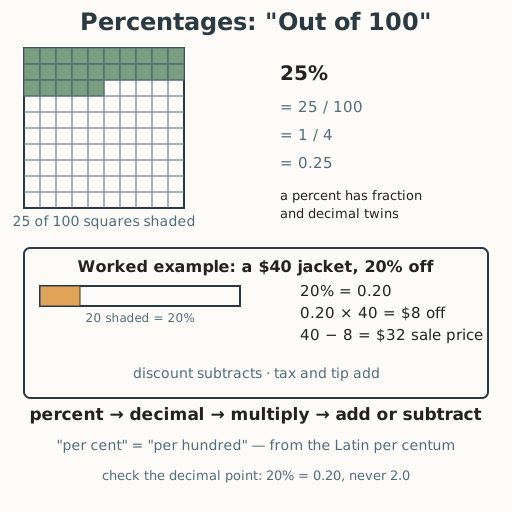
A jacket costs $40 and the shop offers 20% off. “20% off” means “20 out of every 100 taken away.” You find 20% of 40 — that is 0.20 × 40 = $8 — and subtract it: 40 − 8 = $32. Then the cashier may add tax, and a diner may leave a tip. Percentages are “per hundred” reckoning, and they run through buying, saving, borrowing, and sharing in every economy. The word itself is from the Latin per centum, “by the hundred,” and the idea appears in many traditions — for example, the Islamic practice of zakat gives away a fixed share (2.5%) of one’s wealth, a percentage used for care, not profit.
Materials
- Percent bar template
- Percentage problem cards
- Hundreds grid or counters
Preparation
- Copy percent bar templates and percentage problem cards.
- Have worked examples ready: 20% of 40 = 8; 8% tax on $32 = $2.56; 15% tip on $32 = $4.80.
- Recall from Grade 6: fractions and decimals; “percent” is a rate out of 100.
Facilitator note
This lesson is written to the learner (“you”). The ideas to land: (1) a percent is a rate
“out of 100” with fraction and decimal twins (25% = 25/100 = 1/4 = 0.25); (2) to find a
percentage of a whole, multiply the decimal form by the whole; and (3) discount subtracts, tax
and tip add. Because finding a percent of an amount is a foundational skill, use explicit
instruction and worked examples first (Kirschner, Sweller & Clark, 2006): model the discount,
then guide tax and tip before independent work. Watch for the slips of moving the decimal point
wrong (20% = 0.20, not 2.0) and of adding the discount instead of subtracting. Retrieval: ask
learners to recall unit rates from last lesson — “per cent” is “per 100,” a unit rate with a
fixed denominator. The egalitarian lens (docs/philosophy.md §4): knowing percentages protects
a shopper from being misled by “20% off” that is really no bargain, and it lets a person check a
bill or a tip honestly. The global lens: percentages appear across traditions — Latin per
centum, the Islamic zakat (2.5% of wealth), and Indian and Chinese merchants’ proportional
reckoning — “per hundred” is a human universal.
Procedure
- Gather (5 min). Last time you found a unit rate — “how much for one.” Today you work with a special rate: “how much out of 100.”
- Meet the percent (10 min). A percent means “out of 100.” 25% is 25 out of 100, written 25/100 = 1/4 = 0.25. Shade 25 squares of your 100-square grid. The shaded part is the percent; the whole grid is the whole (100%).
- Worked example — discount (10 min). A jacket costs $40 and is 20% off. Write 20% as the decimal 0.20. Find 20% of 40: 0.20 × 40 = $8. That is the amount taken away. Sale price: 40 − 8 = $32.
- Worked example — tax and tip (10 min). On the $32 sale price, add 8% tax: 0.08 × 32 = $2.56, so the total is 32 + 2.56 = $34.56. A diner leaves a 15% tip on a $32 meal: 0.15 × 32 = $4.80. Tax and tip add; a discount subtracts.
- Practice with a partner (10 min). Take your problem cards. For each, shade the percent on your grid, write it as a decimal, multiply to find the amount, then add or subtract as the situation demands. Check each other’s decimal placement and final total.
- Close (5 min). A percent is “per hundred.” Write it as a decimal, multiply by the whole to find the amount, then add (tax, tip, markup) or subtract (discount) as the situation says.
Differentiation
- Support: Use only benchmark percents (50%, 25%, 10%) with the shaded grid as the calculator; describe each step aloud so learners with low vision can follow by listening.
- Extension: Find the original price given a discounted price and the percent (a “work backward” problem), and compare two discounts to find which is truly cheaper.
Assessment
- Formative (observation/self): Can the learner convert a percent to a decimal, find that percent of a whole, and correctly add or subtract in a real price situation?
- Self-check: The learner asks, “Did I write the percent as the right decimal (20% = 0.20)? Did I multiply the decimal by the whole, and did I subtract for a discount but add for tax and tip?”
Home connection
At home, find a real price — a food item, a fare, a phone top-up — and work out a 10% or 20% discount, or a tax or service charge, checking the result against what the seller or bill says.
Resources
- Percents and finding a percent of a whole are standard in middle-grades mathematics; see John
A. Van de Walle, Elementary and Middle School Mathematics (10th ed., 2019). The etymology
“per centum” (Latin, “by the hundred”) and the Islamic zakat fixed share (2.5% of wealth) are
documented facts (Encyclopaedia Britannica, “Zakat,” S-297); treating all traditions as worthy
is a value (
docs/philosophy.md§4). The claim that honest percentage reckoning protects shoppers is a value commitment, not a mathematical fact.