Lesson 06 — Writing and Solving Two-Step Equations
Learners write a two-step equation for a real situation (2 mystery boxes plus 3 equals 11 → 2x + 3 = 11) and solve it by undoing the operations in reverse order — first the add, then the multiply — keeping the equation balanced. They check by substitution.
Objectives
Objectives
- D05.S2.07.01 Write and solve two-step equations and inequalities to represent and solve real problems.
Essential question
How do I write and solve a two-step equation for a real situation?
Key vocabulary
Materials
Standard materials
- Balance-scale cards · 1 set per pair Cards showing a balanced scale with two operations (e.g., 2 boxes + 3 dots = 11 dots) to write and solve
- Equation recording page · 1 per learner A page to write two-step equations from situations and solve them in reverse order
- Small balance or pan scale · 1 per group Where available, to feel "both sides stay equal" across two undoing steps
Low-tech / no-cost
- A stick-and-rope balance Hang a stick with two pans; a bag is the unknown, stones the known amounts; undo in reverse order
- Voice and body Two learners face each other; one side adds/multiplies, the other copies in reverse — the balance holds
Enriched / lab & device
- A two-step equation game · 1 per group Cards matching equations to their two undoing steps and to real situations, for repeated play
- A digital equation balance · 1 per group A tool that keeps a scale balanced across two steps, where devices allow
Works in different contexts
- large-group Solve one two-step equation together on a large balance, then have pairs work cards and check each other
- multi-age Younger learners act out the two balance moves with objects while older learners write the two inverse operations
- self-directed A learner works the recording page alone, solving each equation in reverse order and checking by substitution
- level-grouped Learners ready to extend solve equations with a negative coefficient or fraction and justify each step
- outdoor-only Use a rope balance outdoors with a bag for the unknown and stones for known amounts; undo the two steps in reverse
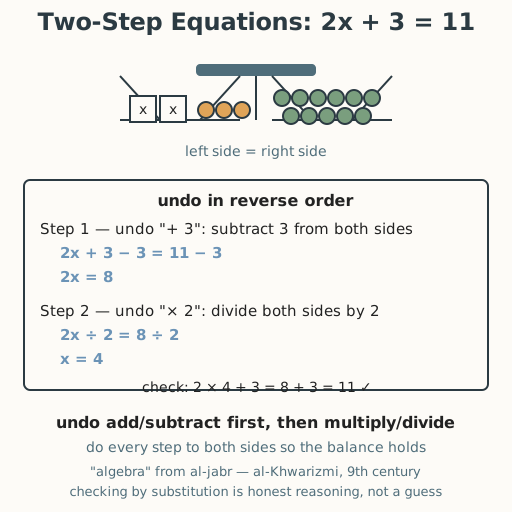
Lesson 6 — Writing and Solving Two-Step Equations
Summary
Learners write a two-step equation for a real situation (2 mystery boxes plus 3 equals 11 → 2x + 3 = 11) and solve it by undoing the operations in reverse order — first the add, then the multiply — keeping the equation balanced. They check by substitution.
Objectives
- Write and solve a two-step equation for a real situation and check the solution. (D05.S2.07.01)
Connection
A vendor sells two identical bundles of fruit plus 3 extra pieces — 11 pieces in all. How many in each bundle? The unknown becomes x: 2x + 3 = 11. To find x you undo in reverse: subtract the 3 first, then halve. 2x = 8, so x = 4. A taxi fare (a flat start fee plus a per-kilometre charge), a phone plan (a base cost plus a per-minute rate), a wage (a base plus a rate per hour) — all are two-step equations. The word “algebra” comes from al-jabr in the 9th-century book of al-Khwarizmi, and the method of balancing both sides is a human achievement shared across cultures, not one person’s or one region’s invention.
Materials
- Balance-scale cards
- Equation recording page
- Small balance or pan scale (where available)
Preparation
- Copy balance-scale cards and equation recording pages.
- Have worked examples ready: 2x + 3 = 11 → 2x = 8 → x = 4; 3x − 4 = 14 → 3x = 18 → x = 6.
- Recall from Grade 6: one-step equations and inverse operations (from U.06.005, Lesson 6).
Facilitator note
This lesson is written to the learner (“you”). The ideas to land: (1) a two-step equation has
two operations on the unknown; (2) to solve, undo them in reverse order — the opposite of
“add/subtract first, then multiply/divide” is “undo multiply/divide last”; concretely, undo the
addition first, then the multiplication; and (3) always check by substitution. Because solving
equations is a foundational skill, use explicit instruction, worked examples, and guided practice
before independent work (Kirschner, Sweller & Clark, 2006). Watch for the slip of undoing in the
wrong order (dividing before subtracting) and of doing a step to only one side. Retrieval: ask
learners to recall one-step equations from Grade 6 — a two-step equation is two one-steps chained.
The global lens: “algebra” derives from al-jabr in al-Khwarizmi’s 9th-century work; balancing
both sides is a shared human method. The critical-thinking lens (docs/philosophy.md §7): checking
by substitution is honest reasoning, never trusting a guess. The egalitarian lens: equations turn a
fair price or wage into solvable form — a tool of clear dealing for everyone.
Procedure
- Gather (5 min). In Grade 6 you solved one-step equations by undoing one operation. Today there are two operations — and you undo them in reverse.
- Meet the two-step equation (10 min). 2x + 3 = 11 means “2 times an unknown, plus 3, equals 11.” The unknown went through multiply by 2 then add 3. To get back to x, undo in reverse: undo the add first, then undo the multiply. Whatever you do, do it to both sides.
- Worked example (10 min). Solve 2x + 3 = 11. Step 1 — undo “+ 3”: subtract 3 from both sides: 2x + 3 − 3 = 11 − 3, so 2x = 8. Step 2 — undo “× 2”: divide both sides by 2: 2x ÷ 2 = 8 ÷ 2, so x = 4. Check: 2 × 4 + 3 = 8 + 3 = 11 ✓.
- Worked example — with subtraction (10 min). Solve 3x − 4 = 14. Step 1 — undo “− 4”: add 4 to both sides: 3x = 18. Step 2 — undo “× 3”: divide both sides by 3: x = 6. Check: 3 × 6 − 4 = 18 − 4 = 14 ✓.
- Practice with a partner (10 min). Take your balance-scale cards: write each balance as a two-step equation, solve by undoing in reverse order, and check by substituting. Trade and check each other’s two steps.
- Close (5 min). A two-step equation is two operations on an unknown. Undo them in reverse order — the add/subtract first, then the multiply/divide — on both sides, and always check.
Differentiation
- Support: Use only equations of the form 2x + 3 = 11 with a real balance to act them out; describe each step aloud so learners with low vision can follow by listening.
- Extension: Solve equations with a negative or fractional coefficient (e.g., −2x + 5 = 1, x/3 + 2 = 7) and write a two-step equation for a situation of the learner’s own.
Assessment
- Formative (observation/self): Can the learner write a two-step equation from a situation and solve it by undoing in reverse order on both sides, then check by substitution?
- Self-check: The learner asks, “Did I undo in the right order (add/subtract first, then multiply/divide)? Did I do each step to both sides, and did my answer check when I substituted it back?”
Home connection
Find a real two-part situation at home (a fare with a flat fee, a bill with a base charge, a wage with a base plus a rate) and write and solve the two-step equation for it.
Resources
- Solving two-step equations is standard in middle-grades mathematics; see John A. Van de Walle,
Elementary and Middle School Mathematics (10th ed., 2019). The note that “algebra” derives
from al-jabr in al-Khwarizmi’s 9th-century work is documented history (MacTutor,
“Al-Khwarizmi,” S-293); the habit of checking answers is a critical-thinking value
(
docs/philosophy.md§7). The claim that equations make fair dealing solvable is a value commitment.