Lesson 05 — Operating with Integers
Learners perform all four operations with integers, using a number line and zero pairs to see each move, then stating the sign rules: add/subtract by moving up or down, and multiply/divide where same signs give positive and different signs give negative. They explain each step in a real context such as temperature or debt.
Objectives
Objectives
- D05.S1.07.02 Perform all four operations with rational numbers such as fractions, decimals, and integers, and explain each step of the reasoning.
Essential question
How do I add, subtract, multiply, and divide with negative numbers — and explain each step?
Key vocabulary
Materials
Standard materials
- Vertical number line (temperature) · 1 per pair A number line from −20 to +20 to model gains and losses
- Integer operation cards · 1 set per pair Real situations (temperature change, elevation, debt and credit) for each operation
- Two-colour counters · per pair One colour for positive, one for negative, to build zero pairs
Low-tech / no-cost
- A drawn number line and pebbles Draw a line on the ground; move a pebble up or down to add and subtract
- Voice and body Step forward for positive, backward for negative; "a negative times a negative turns around and walks forward"
Enriched / lab & device
- An integer operation game · 1 per group Cards pairing an integer operation with its number-line move and its sign result, for repeated play
- A calculator or number-line app · 1 per group To check sign results and explore patterns, where devices allow
Works in different contexts
- large-group Model gains and losses on one big number line, then have pairs work cards and check each other's signs
- multi-age Younger learners step out the moves on a number line while older learners write the operation and the sign rule
- self-directed A learner works the operation cards alone, modeling each on the number line and checking against the worked examples
- level-grouped Learners ready to extend work multi-step integer expressions and justify the sign at each step
- outdoor-only Use a long line outdoors and step or hop the moves; describe each operation aloud
Lesson 5 — Operating with Integers
Summary
Learners perform all four operations with integers, using a number line and zero pairs to see each move, then stating the sign rules: add/subtract by moving up or down, and multiply/divide where same signs give positive and different signs give negative. They explain each step in a real context such as temperature or debt.
Objectives
- Add, subtract, multiply, and divide integers, and explain each step of the reasoning. (D05.S1.07.02)
Connection
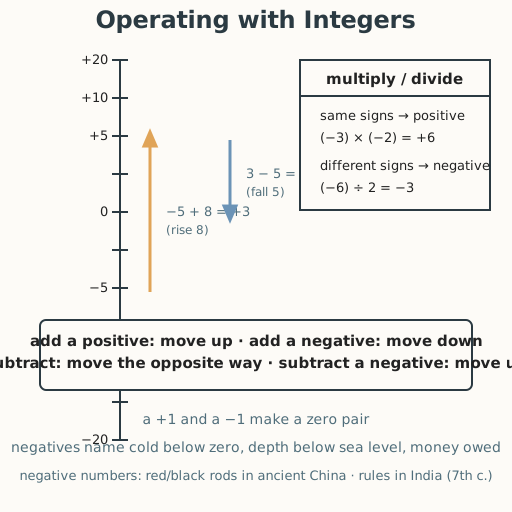
The temperature is −5 °C at dawn and rises 8 degrees by noon: −5 + 8 = +3 °C. A farmer digs 5 metres into debt and then earns 5: the two cancel to zero. Negative numbers name what is below zero — cold below freezing, depth below sea level, money owed. Adding a negative moves down; subtracting a negative turns around and moves up. Negative numbers were used in China more than two thousand years ago — the Nine Chapters on the Mathematical Art (c. 200 BCE) counted with red rods for positive and black rods for negative — and the Indian mathematician Brahmagupta wrote rules for them in the 7th century. They are a shared human tool, not one culture’s idea.
Materials
- Vertical number line (temperature)
- Integer operation cards
- Two-colour counters
Preparation
- Copy number lines and integer operation cards.
- Have worked examples ready: −5 + 8 = 3; 3 − 5 = −2; 3 − (−2) = 5; −3 × −2 = 6.
- Recall from Grade 6: positive and negative numbers on a number line.
Facilitator note
This lesson is written to the learner (“you”). The ideas to land: (1) add a positive moves up
the number line; add a negative moves down; (2) subtract means move the opposite way, so
subtracting a negative moves up (3 − (−2) = 5); and (3) multiply/divide sign rules — same
signs give positive, different signs give negative. Because integer operations are a foundational
skill, use explicit instruction, worked examples, and guided practice before independent work
(Kirschner, Sweller & Clark, 2006). Watch for the slips of subtracting a negative as if it were
adding, and of mixing up the multiply/divide sign rules. Retrieval: ask learners to recall the
number line and ordering of integers from Grade 6 — operations are moves on that same line. The
global lens: negative numbers appear in the Chinese Nine Chapters on the Mathematical Art
(c. 200 BCE, red and black counting rods) and in Brahmagupta’s Indian rules (7th century CE); the
ideas are shared human achievements. The egalitarian lens (docs/philosophy.md §4): negative
numbers let anyone name debt, cold, and depth precisely — they are tools for honest accounting,
not gatekeeping.
Procedure
- Gather (5 min). Last time you operated on fractions and decimals. Today you operate on numbers below zero — the integers — and explain each sign.
- Meet the moves (10 min). On your number line, adding a positive moves up, adding a negative moves down. Subtracting moves the opposite way: subtracting a negative moves up. Build zero pairs with counters: a +1 and a −1 cancel to zero.
- Worked example — add and subtract (12 min). −5 + 8: start at −5, move up 8, land on +3. 3 − 5: start at 3, move down 5, land on −2. 3 − (−2): subtract −2 means move up 2, land on +5 (subtracting a debt raises you, as if the debt were forgiven).
- Worked example — multiply and divide (10 min). −3 × 2: three groups of −2 is −6. −3 × −2: the negative flips the direction twice, landing back on +6. Rule: same signs → positive, different signs → negative. The same rule holds for division: −6 ÷ 2 = −3.
- Practice with a partner (10 min). Take your integer operation cards. For each, move on the number line, write the operation, and say the sign rule. Trade and check each other’s signs.
- Close (5 min). Add moves up or down; subtracting a negative moves up; multiply/divide with same signs → positive, different signs → negative. Explain each step — that is honest math.
Differentiation
- Support: Use only add/subtract with a ready number line and step the moves physically; describe each move aloud so learners with low vision can follow by listening.
- Extension: Solve multi-step integer expressions (e.g., −3 + (−4) − (−5)) and explain the sign at each step; connect to a real debt-and-credit story.
Assessment
- Formative (observation/self): Can the learner perform each of the four integer operations and explain the sign rule and number-line move behind each step?
- Self-check: The learner asks, “Did I move the right way (up for add-positive, down for add-negative, opposite for subtract)? For multiply/divide, did same signs give positive and different signs give negative, and does my move match my written answer?”
Home connection
At home, use a real below-zero situation — temperature, a depth, or money owed and paid back — and write and explain one integer addition and one subtraction, checking the signs.
Resources
- Integer operations are standard in middle-grades mathematics; see John A. Van de Walle,
Elementary and Middle School Mathematics (10th ed., 2019). The notes that negative numbers
appear in the Chinese Nine Chapters on the Mathematical Art (c. 200 BCE, red and black counting
rods) (MacTutor, “Nine Chapters on the Mathematical Art,” S-289) and in Brahmagupta’s rules
(India, 7th century CE) (MacTutor, “Brahmagupta,” S-290) are documented history; treating all
traditions as worthy is a value (
docs/philosophy.md§4). The claim that negative numbers make honest accounting possible is a value commitment.