Lesson 09 — Proportional Relationships as y = kx
Learners express a proportional relationship in the compact form y = kx, where k is the constant of proportionality — the amount of y for each 1 of x. They find k from a table, graph, or story, write the equation, and use it to predict a new value.
Objectives
Objectives
- D05.S2.07.02 Identify proportional relationships in tables, graphs, and equations, and express them in the form y = kx.
Essential question
How do I express a proportional relationship in the form y = kx, and what does k mean?
Key vocabulary
Materials
Standard materials
- y = kx matching cards · 1 set per pair Cards pairing a table, a graph, a sentence, and an equation y = kx for the same relationship
- Equation writing page · 1 per learner A page to find k and write y = kx for real situations
- Counters · per pair To build the relationship and confirm k is the amount per one
Low-tech / no-cost
- Found objects Build the relationship with stones and find k ("per one") before writing the equation
- Voice and body Chant the equation ("y equals three times x") and act out "for every x, three times as much y"
Enriched / lab & device
- A y = kx match game · 1 per group Cards pairing equations, tables, graphs, and stories, for repeated play
- A graphing tool · 1 per group To type different k values and watch the line's steepness change, where devices allow
Works in different contexts
- large-group Write one equation together from a table, then have pairs match cards and check each other's k
- multi-age Younger learners count "per one" with objects while older learners write and use y = kx
- self-directed A learner works the equation page alone, finding k and writing y = kx, checking against the worked examples
- level-grouped Learners ready to extend compare two relationships and explain which k is steeper (faster rate)
- outdoor-only Use found objects to find "per one," then write y = kx in the dust or on a slate
Lesson 9 — Proportional Relationships as y = kx
Summary
Learners express a proportional relationship in the compact form y = kx, where k is the constant of proportionality — the amount of y for each 1 of x. They find k from a table, graph, or story, write the equation, and use it to predict a new value.
Objectives
- Express a proportional relationship in the form y = kx and interpret what k means. (D05.S2.07.02)
Connection
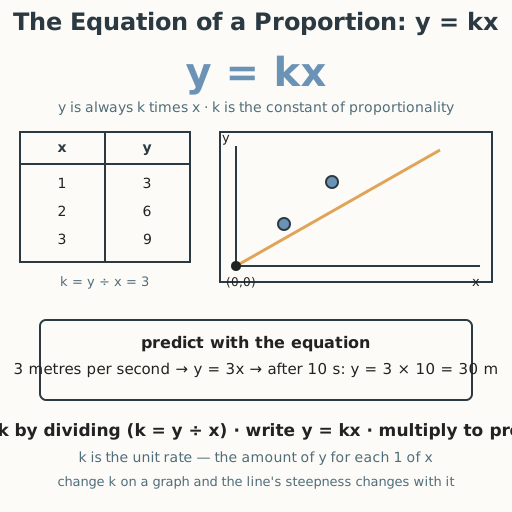
A bicycle moves at a steady 3 metres every second. Then the distance y is always 3 times the time x: y = 3x. The number 3 is the constant of proportionality k — the metres per second, the unit rate. Write it as y = kx and you can predict anything: after 10 seconds, y = 3 × 10 = 30 metres. Every fixed price, speed, or dose compresses to one tidy equation, and that equation is a machine for answering “what if” — a tool used by navigators, engineers, and cooks in every culture where quantity is measured.
Materials
- y = kx matching cards
- Equation writing page
- Counters
Preparation
- Copy matching cards and equation writing pages.
- Have worked examples ready: y = 3x from a table (1,3), (2,6), (3,9); and a story (3 metres per second) → k = 3 → y = 3x.
- Recall from Lesson 8: constant of proportionality and straight lines through the origin.
Facilitator note
This lesson is written to the learner (“you”). The ideas to land: (1) a proportional relationship
can be written y = kx, where k is the constant of proportionality (the unit rate); (2)
k is found by dividing any y by its x (k = y/x); and (3) once you have y = kx you can
predict a new value by multiplying. Because writing y = kx is a foundational skill, use explicit
instruction, worked examples, and guided practice before independent work (Kirschner, Sweller &
Clark, 2006). Watch for the slips of putting k on the wrong side (writing x = ky) and of computing
k as x/y instead of y/x. Retrieval: ask learners to recall Lesson 8’s tests — y = kx is the
equation form of the same relationship; its graph is a straight line through the origin with
steepness k. The technology lens: with a calculator or graphing tool, changing k and watching the
line steepen is a quick way to feel the rate. The egalitarian lens (docs/philosophy.md §4):
writing a rule as y = kx lets anyone predict fairly and check a claim — the equation is a compact,
portable truth, not a secret. The global lens: expressing a relationship as a single equation
generalizes the proportional “per one” thinking recorded across traditions (e.g., the Rhind
Papyrus’s unit divisions) into one modern, universal form.
Procedure
- Gather (5 min). Last time you saw proportionality in tables and graphs. Today you write it as one short equation and use it to predict.
- Meet y = kx (10 min). In a proportional relationship, y is always k times x: y = kx. The k is the constant of proportionality — the amount of y for each 1 of x. Find it by dividing: k = y ÷ x.
- Worked example — from a table (10 min). The table shows (1, 3), (2, 6), (3, 9). Check the ratio: 3÷1 = 3, 6÷2 = 3, 9÷3 = 3. So k = 3, and the equation is y = 3x.
- Worked example — from a story, then predict (10 min). A bicycle covers 3 metres per second. Here k = 3 (metres per second), so y = 3x. Predict: after 10 seconds, y = 3 × 10 = 30 metres. The equation is a prediction machine.
- Practice with a partner (10 min). Take your matching cards: pair each table, graph, and sentence with its equation y = kx, find k, and use it to predict one new value. Trade and check each other’s k.
- Close (5 min). A proportional relationship is y = kx. Find k by dividing (k = y/x), write the equation, and multiply to predict. One tidy equation holds the whole relationship.
Differentiation
- Support: Use only whole-number k with a ready table; find k by counting “per one” with counters; describe each step aloud so learners with low vision can follow by listening.
- Extension: Given two relationships, compare their k values and explain which grows faster; write y = kx for a real situation of the learner’s own and use it to predict.
Assessment
- Formative (observation/self): Can the learner find k from a table, graph, or story, write y = kx, and use it to predict a new value with a correct interpretation of k?
- Self-check: The learner asks, “Did I compute k as y ÷ x (not x ÷ y)? Does my equation y = kx match the table and graph, and did my prediction come from multiplying x by k?”
Home connection
At home, find a steady rate (price per item, distance per trip, food per person), write it as y = kx, and use it to predict the total for a larger amount.
Resources
- The form y = kx and the constant of proportionality are standard in middle-grades mathematics;
see John A. Van de Walle, Elementary and Middle School Mathematics (10th ed., 2019). The note
that “per one” proportional reasoning appears in the Rhind Papyrus (Egypt, c. 1650 BCE) is
documented history (MacTutor, “Mathematics in Egyptian Papyri,” S-288); treating all traditions
as worthy is a value (
docs/philosophy.md§4). The claim that a compact equation makes prediction open to everyone is a value commitment.